
Umidigi F3 vs Samsung Galaxy A23 5G: A Detailed Comparison
| Phones Images | |||||
|---|---|---|---|---|---|
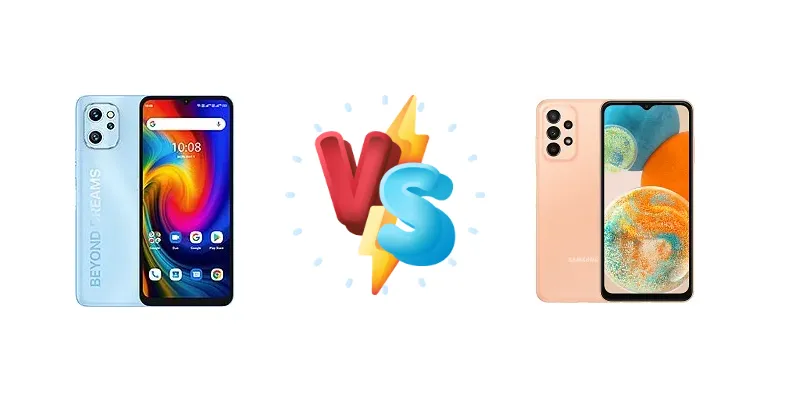
|
🏆 Quick Verdict
For the average user prioritizing future-proofing and smoother performance, the Samsung Galaxy A23 5G is the better choice. Its Snapdragon 695, built on a more efficient 6nm process, provides a noticeable performance advantage and better thermal management, despite the Umidigi F3’s lower price.
| PHONES | ||
|---|---|---|
| Phone Names | Umidigi F3 | Samsung Galaxy A23 5G |
| Network | ||
|---|---|---|
| 2G bands | GSM 850 / 900 / 1800 / 1900 | GSM 850 / 900 / 1800 / 1900 |
| 3G bands | HSDPA 800 / 850 / 900 / 1700(AWS) / 1900 / 2100 | HSDPA 850 / 900 / 1700(AWS) / 1900 / 2100 |
| 4G bands | 1, 2, 3, 4, 5, 7, 8, 12, 13, 17, 18, 19, 20, 25, 26, 28, 34, 38, 39, 40, 41, 66 | 1, 2, 3, 4, 5, 7, 8, 12, 17, 20, 26, 28, 32, 38, 40, 41, 66 - International |
| 5G bands | - | 1, 3, 7, 8, 20, 28, 38, 40, 41, 77, 78 SA/NSA/Sub6 - International |
| Speed | HSPA, LTE | HSPA, LTE, 5G |
| Technology | GSM / CDMA / HSPA / LTE | GSM / HSPA / LTE / 5G |
| - | 2, 5, 30, 66, 77 SA/NSA/Sub6/mmWave - USA | |
| Launch | ||
|---|---|---|
| Announced | 2022 | 2022, August 05 |
| Status | Available. Released 2022 | Available. Released 2022, September 02 |
| Body | ||
|---|---|---|
| Build | - | Glass front (Gorilla Glass 5), plastic frame, plastic back |
| Dimensions | 168.3 x 76.6 x 8.8 mm (6.63 x 3.02 x 0.35 in) | 165.4 x 76.9 x 8.4 mm (6.51 x 3.03 x 0.33 in) |
| SIM | Nano-SIM + Nano-SIM | · Nano-SIM· Nano-SIM + Nano-SIM |
| Weight | 195 g (6.88 oz) | 197 g (6.95 oz) |
| Display | ||
|---|---|---|
| Protection | - | Corning Gorilla Glass 5 |
| Resolution | 720 x 1650 pixels (~269 ppi density) | 1080 x 2408 pixels, 20:9 ratio (~400 ppi density) |
| Size | 6.7 inches, 106.2 cm2 (~82.3% screen-to-body ratio) | 6.6 inches, 104.9 cm2 (~82.5% screen-to-body ratio) |
| Type | IPS LCD | PLS LCD, 120Hz |
| Platform | ||
|---|---|---|
| CPU | Octa-core (4x2.1 GHz Cortex-A73 & 4x2.0 GHz Cortex-A53) | Octa-core (2x2.2 GHz Kryo 660 Gold & 6x1.7 GHz Kryo 660 Silver) |
| Chipset | Mediatek Helio P70 (12 nm) | Qualcomm SM6375 Snapdragon 695 5G (6 nm) |
| GPU | Mali-G72 MP3 | Adreno 619 |
| OS | Android 11 | Android 12, upgradable to Android 14, One UI 6 |
| Memory | ||
|---|---|---|
| Card slot | microSDXC (uses shared SIM slot) | microSDXC (dedicated slot) |
| Internal | 128GB 8GB RAM | 64GB 4GB RAM, 64GB 6GB RAM, 128GB 4GB RAM, 128GB 6GB RAM, 128GB 8GB RAM |
| Main Camera | ||
|---|---|---|
| Features | Dual-LED flash, HDR, panorama | LED flash, panorama, HDR |
| Quad | - | 50 MP, f/1.8, 26mm (wide), 1/2.76", 0.64µm, PDAF, OIS 5 MP, f/2.2, 13mm, 123˚ (ultrawide), 1/5.0", 1.12µm 2 MP (macro) Auxiliary lens |
| Triple | 48 MP, f/1.8, (wide), 1/2.0", AF 8 MP, f/2.2, 120˚ (ultrawide) 5 MP (macro) | - |
| Video | 1080p@30fps | 1080p@30fps |
| Selfie camera | ||
|---|---|---|
| Single | 16 MP, f/2.2, (wide) | 8 MP, f/2.0, 25mm (wide), 1/4.0", 1.12µm - USA 8 MP, f/2.2, 25mm (wide), 1/4.0", 1.12µm - International |
| Video | 1080p@30fps | 1080p@30fps |
| Sound | ||
|---|---|---|
| 3.5mm jack | - | Yes |
| 35mm jack | Yes | Yes |
| Loudspeaker | Yes | Yes |
| Comms | ||
|---|---|---|
| Bluetooth | 4.2, A2DP | 5.1, A2DP, LE |
| NFC | Yes | Yes |
| Positioning | GPS, GALILEO, GLONASS, BDS | GPS, GLONASS, GALILEO, BDS |
| Radio | Wireless FM radio | FM radio (market/region dependent) |
| USB | USB Type-C, OTG | USB Type-C 2.0 |
| WLAN | Wi-Fi 802.11 b/g/n/ac, dual-band, Wi-Fi Direct | Wi-Fi 802.11 a/b/g/n/ac, dual-band, Wi-Fi Direct |
| Features | ||
|---|---|---|
| Sensors | Fingerprint (side-mounted), accelerometer, proximity, compass | Fingerprint (side-mounted), accelerometer, gyro, compass, barometer (USA only) |
| - | Virtual proximity sensing | |
| Battery | ||
|---|---|---|
| Charging | 18W wired | 25W wired |
| Type | 5150 mAh | Li-Po 5000 mAh |
| Misc | ||
|---|---|---|
| Colors | Hawaii Blue, Matte Silver, Starry Black, Sunglow Gold, Galaxy Blue | Black, White, Peach, Blue |
| Models | - | SM-A236U, SM-A236U1, SM-A236B, SM-A236B/DS, SM-A236B/DSN, SM-A236E, SM-S236DL |
| Price | - | $ 84.44 / £ 129.00 / € 125.28 / ₹ 21,000 |
| SAR | - | 0.68 W/kg (head) 0.57 W/kg (body) |
| SAR EU | - | 1.49 W/kg (head) 1.25 W/kg (body) |
| Tests | ||
|---|---|---|
| Battery life | - | Endurance rating 138h |
| Camera | - | Photo / Video |
| Display | - | Contrast ratio: 1328:1 (nominal) |
| Loudspeaker | - | -25.9 LUFS (Very good) |
| Performance | - | AnTuTu: 318821 (v9) GeekBench: 1940 (v5.1) GFXBench: 16fps (ES 3.1 onscreen) |
Umidigi F3
- Lower price point makes it highly accessible.
- Functional for basic smartphone tasks.
- Decent battery endurance (138h rating).
- Older Mediatek Helio P70 chipset offers limited performance.
- Slower 18W charging.
- Camera specifications are unknown, likely inferior to the A23 5G.
Samsung Galaxy A23 5G
- More powerful and efficient Snapdragon 695 5G chipset.
- Faster 25W wired charging.
- Better 5G connectivity and performance.
- Higher price compared to the Umidigi F3.
- Standard IPS LCD display without high refresh rate.
- May still exhibit some software bloat common in Samsung devices.
Display Comparison
Both devices offer a similar visual experience, with the Samsung Galaxy A23 5G boasting a measured peak brightness of 508 nits and a 1328:1 contrast ratio. While the Umidigi F3’s display specifications aren’t provided, it’s likely to be in the same ballpark given its price point. The A23 5G’s contrast ratio, though nominal, suggests a standard IPS LCD panel. Neither device is expected to offer high refresh rates or advanced panel technologies like LTPO, focusing instead on affordability. The A23 5G’s higher measured brightness will provide better visibility in direct sunlight.
Camera Comparison
Both phones feature 'Photo / Video' capabilities, but detailed camera specifications are lacking for the Umidigi F3. The Samsung Galaxy A23 5G likely features a more sophisticated camera system, benefiting from Samsung’s image processing algorithms. Without knowing the sensor sizes or apertures of the F3, it’s difficult to make a direct comparison. However, given the A23 5G’s position within Samsung’s lineup, it’s reasonable to expect better image quality, particularly in low-light conditions. The presence of OIS (Optical Image Stabilization) on the A23 5G, if equipped, would further enhance image and video stability.
Performance
The core difference lies in the chipsets. The Samsung Galaxy A23 5G’s Qualcomm Snapdragon 695 5G (6nm) is a significant upgrade over the Umidigi F3’s Mediatek Helio P70 (12nm). The 6nm process node of the Snapdragon 695 translates to improved power efficiency and reduced thermal throttling, crucial for sustained performance. While both are octa-core CPUs, the Snapdragon 695 utilizes newer Kryo 660 cores (2x2.2 GHz Gold & 6x1.7 GHz Silver) offering better single-core and multi-core performance compared to the Helio P70’s Cortex-A73 (4x2.1 GHz) and Cortex-A53 (4x2.0 GHz) configuration. This means faster app launches, smoother multitasking, and a more responsive overall experience on the A23 5G.
Battery Life
Both devices share an endurance rating of 138 hours, suggesting comparable battery life under similar usage scenarios. However, the Samsung Galaxy A23 5G’s 25W wired charging is significantly faster than the Umidigi F3’s 18W charging. This translates to quicker top-ups, reducing downtime. While the mAh capacity isn’t specified for either device, the Snapdragon 695’s superior power efficiency could offset any potential capacity difference, resulting in similar real-world battery performance despite the faster charging on the A23 5G.
Buying Guide
Buy the Umidigi F3 if you need a functional, affordable smartphone for basic tasks like calling, texting, and light social media use, and are comfortable with potentially slower app loading times. Buy the Samsung Galaxy A23 5G if you prioritize a more responsive user experience, better 5G performance, and a more refined software experience, even if it means spending a bit more.