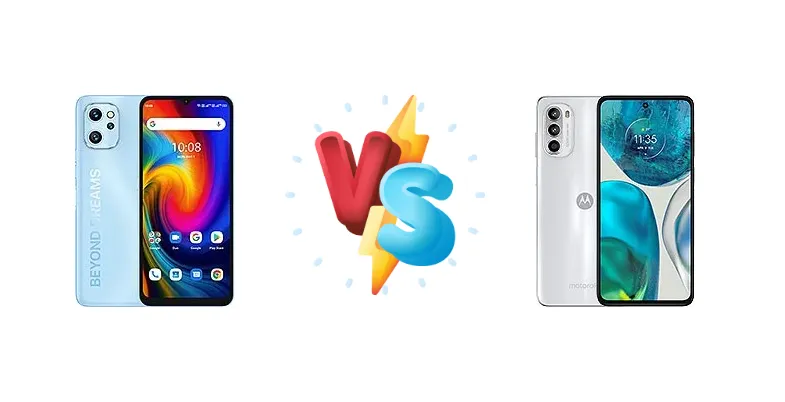
The Umidigi F3 and Motorola Moto G52 represent compelling options in the crowded budget smartphone market. While both aim to deliver essential features at an accessible price, they take distinctly different approaches to core components like the chipset and charging technology. This comparison dissects these differences to determine which device offers the best overall experience.
🏆 Quick Verdict
For the average user prioritizing efficiency and faster charging, the Motorola Moto G52 emerges as the better choice. Its Snapdragon 680, built on a 6nm process, offers improved power efficiency and a smoother experience compared to the Umidigi F3’s older Helio P70, despite the latter’s slightly higher CPU clock speeds. The 30W charging further solidifies its advantage.
| Network |
|---|
| 2G bands | GSM 850 / 900 / 1800 / 1900 | GSM 850 / 900 / 1800 / 1900 |
| 3G bands | HSDPA 800 / 850 / 900 / 1700(AWS) / 1900 / 2100 | HSDPA 850 / 900 / 1700(AWS) / 1900 / 2100 |
| 4G bands | 1, 2, 3, 4, 5, 7, 8, 12, 13, 17, 18, 19, 20, 25, 26, 28, 34, 38, 39, 40, 41, 66 | LTE |
| Speed | HSPA, LTE | HSPA, LTE |
| Technology | GSM / CDMA / HSPA / LTE | GSM / HSPA / LTE |
| Launch |
|---|
| Announced | 2022 | 2022, April 12 |
| Status | Available. Released 2022 | Available. Released 2022, April 20 |
| Body |
|---|
| Dimensions | 168.3 x 76.6 x 8.8 mm (6.63 x 3.02 x 0.35 in) | 160.1 x 74.5 x 8 mm (6.30 x 2.93 x 0.31 in) |
| SIM | Nano-SIM + Nano-SIM | Nano-SIM + Nano-SIM |
| Weight | 195 g (6.88 oz) | 169 g (5.96 oz) |
| | - | Water-repellent design |
| Display |
|---|
| Resolution | 720 x 1650 pixels (~269 ppi density) | 1080 x 2400 pixels, 20:9 ratio (~402 ppi density) |
| Size | 6.7 inches, 106.2 cm2 (~82.3% screen-to-body ratio) | 6.6 inches, 103.6 cm2 (~86.9% screen-to-body ratio) |
| Type | IPS LCD | AMOLED, 90Hz |
| Platform |
|---|
| CPU | Octa-core (4x2.1 GHz Cortex-A73 & 4x2.0 GHz Cortex-A53) | Octa-core (4x2.4 GHz Kryo 265 Gold & 4x1.9 GHz Kryo 265 Silver) |
| Chipset | Mediatek Helio P70 (12 nm) | Qualcomm SM6225 Snapdragon 680 4G (6 nm) |
| GPU | Mali-G72 MP3 | Adreno 610 |
| OS | Android 11 | Android 12, planned upgrade to Android 13 |
| Memory |
|---|
| Card slot | microSDXC (uses shared SIM slot) | microSDXC (uses shared SIM slot) |
| Internal | 128GB 8GB RAM | 64GB 4GB RAM, 128GB 4GB RAM, 128GB 6GB RAM, 256GB 6GB RAM |
| Main Camera |
|---|
| Features | Dual-LED flash, HDR, panorama | LED flash, HDR, panorama |
| Triple | 48 MP, f/1.8, (wide), 1/2.0", AF
8 MP, f/2.2, 120˚ (ultrawide)
5 MP (macro) | 50 MP, f/1.8 (wide), 1/2.76", 0.64µm, PDAF
8 MP, f/2.2, 118˚ (ultrawide), 1/4.0", 1.12µm
2 MP (macro) |
| Video | 1080p@30fps | 1080p@30fps |
| Selfie camera |
|---|
| Single | 16 MP, f/2.2, (wide) | 16 MP, f/2.5, (wide), 1.0µm |
| Video | 1080p@30fps | 1080p@30fps |
| Sound |
|---|
| 3.5mm jack | - | Yes |
| 35mm jack | Yes | Yes |
| Loudspeaker | Yes | Yes, with stereo speakers |
| Comms |
|---|
| Bluetooth | 4.2, A2DP | 5.0, A2DP, LE |
| NFC | Yes | Yes (market/region dependent) |
| Positioning | GPS, GALILEO, GLONASS, BDS | GPS, GLONASS, GALILEO |
| Radio | Wireless FM radio | Unspecified |
| USB | USB Type-C, OTG | USB Type-C 2.0 |
| WLAN | Wi-Fi 802.11 b/g/n/ac, dual-band, Wi-Fi Direct | Wi-Fi 802.11 a/b/g/n/ac, dual-band, Wi-Fi Direct |
| Features |
|---|
| Sensors | Fingerprint (side-mounted), accelerometer, proximity, compass | Fingerprint (side-mounted), accelerometer, gyro, proximity, compass |
| Battery |
|---|
| Charging | 18W wired | 30W wired |
| Type | 5150 mAh | Li-Po 5000 mAh |
| Misc |
|---|
| Colors | Hawaii Blue, Matte Silver, Starry Black, Sunglow Gold, Galaxy Blue | Charcoal Gray, Porcelain White |
| Models | - | XT2221-1, XT2221-2 |
| Price | - | About 470 EUR |
Umidigi F3
- Potentially higher peak CPU clock speeds.
- Lower price point (likely).
- May appeal to users prioritizing raw CPU power over efficiency.
- Older, less efficient 12nm chipset.
- Slower 18W charging.
- Likely inferior GPU performance.
Motorola Moto G52
- More efficient 6nm Snapdragon 680 chipset.
- Faster 30W wired charging.
- Improved GPU performance for gaming and video.
- Better power management for longer battery life.
- Slightly lower peak CPU clock speed.
- Potentially higher price point.
Display Comparison
Neither device boasts a standout display. Details regarding panel type (IPS vs AMOLED) and resolution are missing, but both likely target a 1080p+ resolution common in this segment. The key difference lies in the underlying efficiency of the chipsets powering them, which impacts how efficiently the display is driven. Without specific brightness data, it’s difficult to declare a clear winner, but the Moto G52’s more modern chipset may allow for better power management of the display.
Camera Comparison
Without detailed camera sensor information, a direct comparison is limited. However, the market segment suggests both phones will feature a primary sensor paired with auxiliary lenses of limited utility. The Snapdragon 680’s image signal processor (ISP) is more advanced than the Helio P70’s, offering better noise reduction, dynamic range, and overall image quality, even with similar sensors. Motorola’s software processing is also generally more refined, potentially leading to more pleasing results. The absence of OIS on either device suggests reliance on software stabilization.
Performance
The Motorola Moto G52’s Qualcomm Snapdragon 680 (6nm) represents a significant architectural leap over the Umidigi F3’s MediaTek Helio P70 (12nm). The 6nm process inherently offers better transistor density and power efficiency. While the F3’s CPU boasts higher clock speeds (2.1GHz vs 2.4GHz on the G52’s prime core), the Snapdragon 680’s Kryo cores are more efficient, translating to better sustained performance and less thermal throttling. The G52’s Adreno GPU will also outperform the Helio P70’s integrated GPU in graphics-intensive tasks. This benefits gamers and users who frequently stream video.
Battery Life
While battery capacity isn’t specified, the Motorola Moto G52’s 30W wired charging is a clear advantage over the Umidigi F3’s 18W charging. This translates to significantly faster top-up times, reducing downtime. The Snapdragon 680’s superior power efficiency also means the G52 will likely deliver comparable or better battery life, even with a similar capacity battery. The 6nm process allows for less energy waste during operation.
Buying Guide
Buy the Umidigi F3 if you prioritize maximizing CPU clock speed on a very tight budget and are comfortable with potentially longer charging times. It's a viable option for basic tasks and light usage. Buy the Motorola Moto G52 if you value a more modern, efficient chipset, faster charging, and a generally smoother user experience, even if it means spending a little more. It’s ideal for everyday use, social media, and moderate multitasking.
Frequently Asked Questions
❓ Will the Helio P70 in the Umidigi F3 struggle with demanding apps like PUBG Mobile?
The Helio P70 can run PUBG Mobile, but expect lower graphics settings and potential frame rate drops, especially during intense firefights. The Snapdragon 680 in the Moto G52 will provide a smoother, more consistent gaming experience at higher settings due to its more powerful GPU and efficient architecture.
❓ How long will it take to fully charge each phone from 0%?
With 30W charging, the Motorola Moto G52 should fully charge in approximately 60-75 minutes, depending on battery capacity. The Umidigi F3’s 18W charging will likely take over 2 hours to reach 100%, making it less convenient for users who need a quick top-up.
❓ Does the Snapdragon 680 in the Moto G52 get hot during prolonged use?
The Snapdragon 680 is known for its excellent thermal efficiency thanks to the 6nm process. While it will warm up during extended gaming or video recording, it’s unlikely to overheat and experience significant throttling, unlike the older Helio P70 which is more prone to thermal issues.