
Umidigi F3 SE vs Xiaomi Redmi 10 5G: A Deep Dive into Budget 5G Performance
| Phones Images | |||||
|---|---|---|---|---|---|
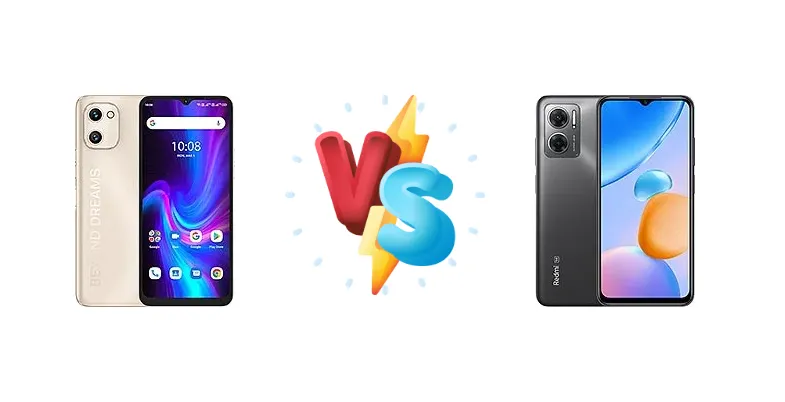
|
🏆 Quick Verdict
For the average user prioritizing responsiveness and future-proofing, the Xiaomi Redmi 10 5G is the better choice. Its Dimensity 700 chipset, built on a more efficient 7nm process, provides a noticeable performance advantage over the Umidigi F3 SE’s Unisoc T610, despite the latter’s slightly higher CPU clock speeds on the prime cores.
| PHONES | ||
|---|---|---|
| Phone Names | Umidigi F3 SE | Xiaomi Redmi 10 5G |
| Network | ||
|---|---|---|
| 2G bands | GSM 850 / 900 / 1800 / 1900 | GSM 850 / 900 / 1800 / 1900 |
| 3G bands | HSDPA 800 / 850 / 900 / 1700(AWS) / 1900 / 2100 | HSDPA 850 / 900 / 1700(AWS) / 1900 / 2100 |
| 4G bands | 1, 2, 3, 4, 5, 7, 8, 12, 13, 17, 18, 19, 20, 25, 26, 28, 34, 38, 39, 40, 41, 66 | 1, 2, 3, 4, 5, 7, 8, 20, 28, 38, 40, 41 |
| 5G bands | - | 1, 3, 5, 7, 8, 20, 28, 38, 40, 41, 77, 78 SA/NSA |
| Speed | HSPA, LTE | HSPA, LTE, 5G |
| Technology | GSM / HSPA / LTE | GSM / HSPA / LTE / 5G |
| Launch | ||
|---|---|---|
| Announced | 2022 | 2022, March 29 |
| Status | Available. Released 2022 | Available. Released 2022, September 23 |
| Body | ||
|---|---|---|
| Dimensions | 168.3 x 76.6 x 8.8 mm (6.63 x 3.02 x 0.35 in) | 164 x 76.1 x 8.9 mm (6.46 x 3.00 x 0.35 in) |
| SIM | Nano-SIM + Nano-SIM | Nano-SIM + Nano-SIM |
| Weight | 185 g (6.53 oz) | 200 g (7.05 oz) |
| Display | ||
|---|---|---|
| Protection | - | Corning Gorilla Glass 3 |
| Resolution | 720 x 1650 pixels (~269 ppi density) | 1080 x 2408 pixels, 20:9 ratio (~401 ppi density) |
| Size | 6.7 inches, 106.2 cm2 (~82.3% screen-to-body ratio) | 6.58 inches, 104.3 cm2 (~83.6% screen-to-body ratio) |
| Type | IPS LCD | IPS LCD, 90Hz |
| Platform | ||
|---|---|---|
| CPU | Octa-core (2x1.8 GHz Cortex-A75 & 6x1.8 GHz Cortex-A55) | Octa-core (2x2.2 GHz Cortex-A76 & 6x2.0 GHz Cortex-A55) |
| Chipset | Unisoc T610 (12 nm) | Mediatek Dimensity 700 (7 nm) |
| GPU | Mali-G52 MP2 | Mali-G57 MC2 |
| OS | Android 11 | Android 12, MIUI 13 |
| Memory | ||
|---|---|---|
| Card slot | microSDXC (uses shared SIM slot) | microSDXC (dedicated slot) |
| Internal | 128GB 4GB RAM | 64GB 4GB RAM, 128GB 4GB RAM, 128GB 6GB RAM |
| - | UFS 2.2 | |
| Main Camera | ||
|---|---|---|
| Dual | 20 MP, f/2.2, (wide), AF 8 MP, f/2.2, 120˚ (ultrawide) | 50 MP, f/1.8, (wide), PDAF Auxiliary lens |
| Features | Dual-LED flash, HDR, panorama | LED flash, HDR, panorama |
| Single | - | 5 MP, f/2.2 |
| Video | 1080p@30fps | 1080p@30fps |
| Selfie camera | ||
|---|---|---|
| Features | - | HDR |
| Single | 8 MP, f/2.2, (wide) | 5 MP, f/2.2 |
| Video | 1080p@30fps | 1080p@30fps |
| Sound | ||
|---|---|---|
| 3.5mm jack | - | Yes |
| 35mm jack | Yes | Yes |
| Loudspeaker | Yes | Yes |
| - | 24-bit/192kHz audio | |
| Comms | ||
|---|---|---|
| Bluetooth | 5.0, A2DP, LE | 5.1, A2DP, LE |
| Infrared port | - | Yes |
| NFC | No | Yes (market/region dependent) |
| Positioning | GPS, GALILEO, GLONASS, BDS | GPS, GLONASS, BDS, GALILEO |
| Radio | Wireless FM radio | FM radio |
| USB | USB Type-C, OTG | USB Type-C 2.0, OTG |
| WLAN | Wi-Fi 802.11 b/g/n/ac, dual-band, Wi-Fi Direct | Wi-Fi 802.11 a/b/g/n/ac, dual-band, Wi-Fi Direct |
| Features | ||
|---|---|---|
| Sensors | Fingerprint (side-mounted), accelerometer, proximity, compass | Fingerprint (side-mounted), accelerometer, proximity, compass |
| Battery | ||
|---|---|---|
| Charging | 10W wired | 18W wired |
| Type | 5150 mAh | Li-Po 5000 mAh |
| Misc | ||
|---|---|---|
| Colors | Hawaii Blue, Matte Silver, Starry Black, Sunglow Gold, Galaxy Blue | Graphite Gray, Chrome Silver, Aurora Green |
| Models | - | 22041219G, 22041219NY |
| Price | - | About 100 EUR |
| SAR | - | 1.09 W/kg (head) 1.09 W/kg (body) |
| SAR EU | - | 0.60 W/kg (head) 0.99 W/kg (body) |
Umidigi F3 SE
- Potentially lower price point
- Functional for basic tasks
- Acceptable for light usage
- Less powerful chipset
- Slower charging speed
- Likely inferior camera performance
Xiaomi Redmi 10 5G
- More powerful and efficient chipset
- Faster charging support
- Better overall performance and responsiveness
- May be slightly more expensive
- Potentially larger physical size
- Still a budget device with limitations
Display Comparison
Neither device boasts a standout display. Given the provided data focuses on internal components, we must infer display characteristics based on market positioning. Both likely feature 6.5-6.6 inch LCD panels with 720p+ resolution. The Redmi 10 5G, being a slightly more premium offering, may have a marginally brighter panel and better color calibration. However, neither is expected to compete with phones featuring AMOLED or high refresh rate technology.
Camera Comparison
Without detailed camera specifications, a direct comparison is difficult. However, given the price points, both phones likely feature a primary sensor around 13-50MP, accompanied by auxiliary lenses of limited utility (depth, macro). The Redmi 10 5G, benefiting from the Dimensity 700’s superior image signal processor (ISP), will likely deliver better image processing, resulting in more detailed photos with improved dynamic range and noise reduction, especially in low-light conditions. The Umidigi F3 SE’s ISP will be less capable, potentially leading to softer images and more visible noise.
Performance
The core difference lies in the chipsets. The Xiaomi Redmi 10 5G’s Mediatek Dimensity 700, fabricated on a 7nm process, offers a significant advantage in efficiency and sustained performance compared to the Umidigi F3 SE’s Unisoc T610 (12nm). While the T610 features a similar octa-core configuration, the Dimensity 700’s Cortex-A76 cores (2x2.2 GHz) are architecturally superior to the T610’s Cortex-A75 cores (2x1.8 GHz), resulting in faster single-core performance. This translates to snappier app launches and smoother multitasking. The 7nm process also means less heat generation under load, reducing the likelihood of thermal throttling during extended gaming sessions. The Redmi 10 5G will handle graphically demanding games with higher frame rates and more consistent performance.
Battery Life
Battery life will depend heavily on usage patterns. While the exact battery capacities are unknown, the Redmi 10 5G’s 18W charging support is a clear advantage over the F3 SE’s 10W charging. This means significantly faster top-ups, reducing downtime. Even with a similar battery capacity, the Dimensity 700’s superior efficiency will likely translate to slightly longer battery life on the Redmi 10 5G, especially during demanding tasks like gaming or video streaming.
Buying Guide
Buy the Umidigi F3 SE if you need a basic, functional smartphone for essential tasks like calling, texting, and light social media browsing, and are extremely budget-constrained. Buy the Xiaomi Redmi 10 5G if you prioritize smoother multitasking, occasional gaming, and a more responsive user experience, and value the benefits of a more powerful and efficient chipset.