
Umidigi F3 SE vs Xiaomi Poco M5s: A Detailed Comparison for Budget Shoppers
| Phones Images | |||||
|---|---|---|---|---|---|
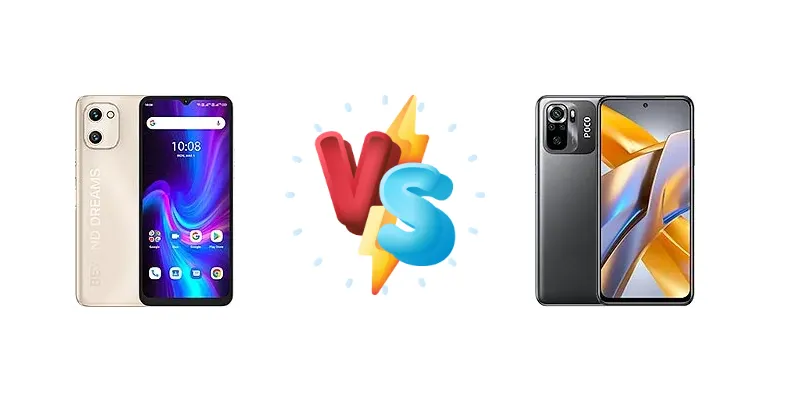
|
🏆 Quick Verdict
For most users, the Xiaomi Poco M5s is the better choice. Its Helio G95 chipset provides a noticeable performance advantage over the Umidigi F3 SE’s Unisoc T610, and the 33W charging is a game-changer compared to the F3 SE’s slow 10W charging. While both offer similar battery endurance ratings, the Poco M5s’ faster charging mitigates any potential range anxiety.
| PHONES | ||
|---|---|---|
| Phone Names | Umidigi F3 SE | Xiaomi Poco M5s |
| Network | ||
|---|---|---|
| 2G bands | GSM 850 / 900 / 1800 / 1900 | GSM 850 / 900 / 1800 / 1900 |
| 3G bands | HSDPA 800 / 850 / 900 / 1700(AWS) / 1900 / 2100 | HSDPA 850 / 900 / 1700(AWS) / 1900 / 2100 |
| 4G bands | 1, 2, 3, 4, 5, 7, 8, 12, 13, 17, 18, 19, 20, 25, 26, 28, 34, 38, 39, 40, 41, 66 | 1, 2, 3, 4, 5, 7, 8, 20, 28, 38, 40, 41 |
| Speed | HSPA, LTE | HSPA, LTE |
| Technology | GSM / HSPA / LTE | GSM / HSPA / LTE |
| Launch | ||
|---|---|---|
| Announced | 2022 | 2022, September 05 |
| Status | Available. Released 2022 | Available. Released 2022, September 06 |
| Body | ||
|---|---|---|
| Build | - | Glass front (Gorilla Glass 3), plastic frame, plastic back |
| Dimensions | 168.3 x 76.6 x 8.8 mm (6.63 x 3.02 x 0.35 in) | 160.5 x 74.5 x 8.3 mm (6.32 x 2.93 x 0.33 in) |
| SIM | Nano-SIM + Nano-SIM | Nano-SIM + Nano-SIM |
| Weight | 185 g (6.53 oz) | 178.8 g (6.31 oz) |
| - | IP53, dust and splash resistant | |
| Display | ||
|---|---|---|
| Protection | - | Corning Gorilla Glass 3 |
| Resolution | 720 x 1650 pixels (~269 ppi density) | 1080 x 2400 pixels, 20:9 ratio (~409 ppi density) |
| Size | 6.7 inches, 106.2 cm2 (~82.3% screen-to-body ratio) | 6.43 inches, 99.8 cm2 (~83.5% screen-to-body ratio) |
| Type | IPS LCD | AMOLED, 450 nits (typ), 700 nits (HBM), 1100 nits (peak) |
| Platform | ||
|---|---|---|
| CPU | Octa-core (2x1.8 GHz Cortex-A75 & 6x1.8 GHz Cortex-A55) | Octa-core (2x2.05 GHz Cortex-A76 & 6x2.0 GHz Cortex-A55) |
| Chipset | Unisoc T610 (12 nm) | Mediatek MT6785V/CD Helio G95 (12 nm) |
| GPU | Mali-G52 MP2 | Mali-G76 MC4 |
| OS | Android 11 | Android 12, MIUI 13 |
| Memory | ||
|---|---|---|
| Card slot | microSDXC (uses shared SIM slot) | microSDXC (dedicated slot) |
| Internal | 128GB 4GB RAM | 64GB 4GB RAM, 128GB 4GB RAM, 128GB 6GB RAM, 256GB 8GB RAM |
| - | UFS 2.2 | |
| Main Camera | ||
|---|---|---|
| Dual | 20 MP, f/2.2, (wide), AF 8 MP, f/2.2, 120˚ (ultrawide) | - |
| Features | Dual-LED flash, HDR, panorama | LED flash, HDR, panorama |
| Quad | - | 64 MP, f/1.8, 26mm (wide), 1/1.97", 0.7µm, PDAF 8 MP, f/2.2, 118˚ (ultrawide), 1/4.0", 1.12µm 2 MP (macro) Auxiliary lens |
| Video | 1080p@30fps | 4K@30fps, 1080p@30/60/120fps, 720p@960fps |
| Selfie camera | ||
|---|---|---|
| Features | - | HDR |
| Single | 8 MP, f/2.2, (wide) | 13 MP, f/2.4, (wide), 1/3.06", 1.12µm |
| Video | 1080p@30fps | 1080p@30fps |
| Sound | ||
|---|---|---|
| 3.5mm jack | - | Yes |
| 35mm jack | Yes | Yes |
| Loudspeaker | Yes | Yes, with stereo speakers |
| Comms | ||
|---|---|---|
| Bluetooth | 5.0, A2DP, LE | 5.0, A2DP, LE |
| Infrared port | - | Yes |
| NFC | No | Yes |
| Positioning | GPS, GALILEO, GLONASS, BDS | GPS, GLONASS, GALILEO, BDS |
| Radio | Wireless FM radio | FM radio |
| USB | USB Type-C, OTG | USB Type-C 2.0 |
| WLAN | Wi-Fi 802.11 b/g/n/ac, dual-band, Wi-Fi Direct | Wi-Fi 802.11 a/b/g/n/ac, dual-band, Wi-Fi Direct |
| Features | ||
|---|---|---|
| Sensors | Fingerprint (side-mounted), accelerometer, proximity, compass | Fingerprint (side-mounted), accelerometer, gyro, compass |
| - | Virtual proximity sensing | |
| Battery | ||
|---|---|---|
| Charging | 10W wired | 33W wired, 64% in 30 min |
| Type | 5150 mAh | Li-Po 5000 mAh |
| Misc | ||
|---|---|---|
| Colors | Hawaii Blue, Matte Silver, Starry Black, Sunglow Gold, Galaxy Blue | Gray, Blue, White |
| Models | - | 2207117BPG |
| Price | - | About 120 EUR |
| SAR | - | 1.00 W/kg (head) 0.65 W/kg (body) |
| SAR EU | - | 0.60 W/kg (head) 0.87 W/kg (body) |
| Tests | ||
|---|---|---|
| Battery life | - | Endurance rating 132h |
| Camera | - | Photo / Video |
| Display | - | Contrast ratio: Infinite (nominal) |
| Loudspeaker | - | -25.4 LUFS (Very good) |
| Performance | - | AnTuTu: 360681 (v9) GeekBench: 1831 (v5.1) GFXBench: 18fps (ES 3.1 onscreen) |
Umidigi F3 SE
- Potentially simpler software experience
- Lower price point (likely)
- Decent battery endurance
- Significantly slower performance
- Extremely slow 10W charging
- Less capable camera system
Xiaomi Poco M5s
- Faster and more responsive performance
- Significantly faster 33W charging
- Likely better camera image quality
- Potentially more bloatware
- Slightly higher price (likely)
Display Comparison
The Poco M5s boasts a significantly brighter display, reaching a measured 756 nits, compared to an unspecified brightness for the Umidigi F3 SE. This higher peak brightness translates to better visibility outdoors under direct sunlight. While both displays are likely LCD panels given the price point, the Poco M5s’ infinite (nominal) contrast ratio suggests a more vibrant image. Bezels are likely comparable on both devices, as manufacturers in this segment often prioritize cost savings over ultra-thin bezels.
Camera Comparison
Both devices feature 'Photo / Video' capabilities, but details are sparse. The Poco M5s likely benefits from MediaTek’s image signal processor (ISP), which generally offers better image processing than Unisoc’s offerings at this price point. Without specific sensor size information, it’s difficult to make a definitive judgment, but the Poco M5s’ camera system is likely more versatile and capable of producing higher-quality images, especially in challenging lighting conditions. The presence of OIS on the Poco M5s would be a significant advantage, but is unconfirmed.
Performance
The core difference lies in the chipsets. The Poco M5s’ MediaTek Helio G95, with its 2x2.05 GHz Cortex-A76 cores, offers a substantial performance uplift over the Umidigi F3 SE’s Unisoc T610, which features 2x1.8 GHz Cortex-A75 cores. The Cortex-A76 is a more modern and efficient architecture, resulting in faster app loading times and smoother multitasking. While both are 12nm chips, the G95’s GPU is also more powerful, making it the better choice for mobile gaming. The Poco M5s is likely paired with faster RAM, further enhancing performance.
Battery Life
Interestingly, both phones have an endurance rating of 132 hours, suggesting similar battery life under typical usage. However, the Poco M5s’ 33W wired charging is a massive advantage. It can reach 64% charge in just 30 minutes, while the Umidigi F3 SE is limited to a slow 10W charge. This difference in charging speed significantly impacts the user experience, reducing downtime and making it easier to top up the battery throughout the day.
Buying Guide
Buy the Umidigi F3 SE if you prioritize simplicity and a minimal software experience, and are willing to sacrifice performance and charging speed. It’s a good option for basic tasks like calling, texting, and light social media. Buy the Xiaomi Poco M5s if you want a more responsive device for gaming, multitasking, and content consumption, and value the convenience of significantly faster charging. It’s the better all-rounder for most users.