
Umidigi F3 SE vs Samsung Galaxy A14: A Detailed Comparison for Budget Shoppers
| Phones Images | |||||
|---|---|---|---|---|---|
|
🏆 Quick Verdict
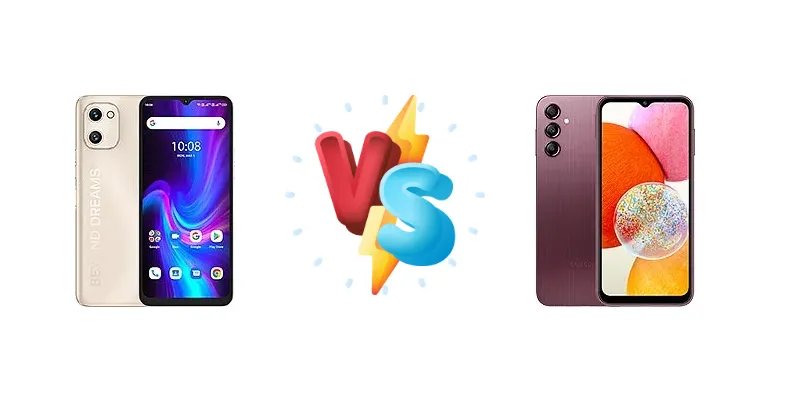
For the average user prioritizing brand reliability and faster charging, the Samsung Galaxy A14 is the better choice. However, the Umidigi F3 SE presents a compelling option for those willing to trade Samsung’s ecosystem for potentially better value, depending on current pricing. The A14’s 15W charging is a significant advantage.
| PHONES | ||
|---|---|---|
| Phone Names | Umidigi F3 SE | Samsung Galaxy A14 |
| Network | ||
|---|---|---|
| 2G bands | GSM 850 / 900 / 1800 / 1900 | GSM 850 / 900 / 1800 / 1900 |
| 3G bands | HSDPA 800 / 850 / 900 / 1700(AWS) / 1900 / 2100 | HSDPA 850 / 900 / 2100 |
| 4G bands | 1, 2, 3, 4, 5, 7, 8, 12, 13, 17, 18, 19, 20, 25, 26, 28, 34, 38, 39, 40, 41, 66 | 1, 3, 5, 7, 8, 20, 28, 38, 40, 41 |
| Speed | HSPA, LTE | HSPA, LTE |
| Technology | GSM / HSPA / LTE | GSM / HSPA / LTE |
| Launch | ||
|---|---|---|
| Announced | 2022 | 2023, February 28 |
| Status | Available. Released 2022 | Available. Released 2023, March 27 |
| Body | ||
|---|---|---|
| Build | - | Glass front, plastic back, plastic frame |
| Dimensions | 168.3 x 76.6 x 8.8 mm (6.63 x 3.02 x 0.35 in) | 167.7 x 78 x 9.1 mm (6.60 x 3.07 x 0.36 in) |
| SIM | Nano-SIM + Nano-SIM | · Nano-SIM· Nano-SIM + Nano-SIM |
| Weight | 185 g (6.53 oz) | 201 g (7.09 oz) |
| Display | ||
|---|---|---|
| Resolution | 720 x 1650 pixels (~269 ppi density) | 1080 x 2408 pixels, 20:9 ratio (~400 ppi density) |
| Size | 6.7 inches, 106.2 cm2 (~82.3% screen-to-body ratio) | 6.6 inches, 104.9 cm2 (~80.2% screen-to-body ratio) |
| Type | IPS LCD | PLS LCD |
| Platform | ||
|---|---|---|
| CPU | Octa-core (2x1.8 GHz Cortex-A75 & 6x1.8 GHz Cortex-A55) | Octa-core (2x2.0 GHz Cortex-A75 & 6x1.8 GHz Cortex-A55) - Version AOcta-core (4x2.0 GHz Cortex-A55 & 4x2.0 GHz Cortex-A55) - Version B |
| Chipset | Unisoc T610 (12 nm) | Mediatek MT6769 Helio G80 (12 nm) - Version AExynos 850 (8 nm) - Version B |
| GPU | Mali-G52 MP2 | Mali-G52 MC2 |
| OS | Android 11 | Android 13, upgradable to Android 15, One UI 7 |
| Memory | ||
|---|---|---|
| Card slot | microSDXC (uses shared SIM slot) | microSDXC (dedicated slot) |
| Internal | 128GB 4GB RAM | 64GB 4GB RAM, 128GB 4GB RAM, 128GB 6GB RAM |
| Main Camera | ||
|---|---|---|
| Dual | 20 MP, f/2.2, (wide), AF 8 MP, f/2.2, 120˚ (ultrawide) | - |
| Features | Dual-LED flash, HDR, panorama | LED flash, panorama, HDR |
| Single | - | 13 MP, f/2.0, (wide) |
| Triple | - | 50 MP, f/1.8, 26mm (wide), 1/2.75", 0.64µm, PDAF 5 MP, f/2.2, 17mm (ultrawide), 1/5.0", 1.12µm 2 MP (macro) |
| Video | 1080p@30fps | 1080p@30fps |
| Selfie camera | ||
|---|---|---|
| Single | 8 MP, f/2.2, (wide) | 13 MP, f/2.0, 26mm (wide), 1/3.1", 1.12µm |
| Video | 1080p@30fps | 1080p@30fps |
| Sound | ||
|---|---|---|
| 3.5mm jack | - | Yes |
| 35mm jack | Yes | Yes |
| Loudspeaker | Yes | Yes |
| Comms | ||
|---|---|---|
| Bluetooth | 5.0, A2DP, LE | 5.1 or 5.3, A2DP, LE |
| NFC | No | Yes (market/region dependent) |
| Positioning | GPS, GALILEO, GLONASS, BDS | GPS, GALILEO, GLONASS, BDS, QZSS |
| Radio | Wireless FM radio | Unspecified |
| USB | USB Type-C, OTG | USB Type-C 2.0 |
| WLAN | Wi-Fi 802.11 b/g/n/ac, dual-band, Wi-Fi Direct | Wi-Fi 802.11 a/b/g/n/ac, dual-band, Wi-Fi Direct |
| Features | ||
|---|---|---|
| Sensors | Fingerprint (side-mounted), accelerometer, proximity, compass | Fingerprint (side-mounted), accelerometer, proximity, compass |
| Battery | ||
|---|---|---|
| Charging | 10W wired | 15W wired |
| Type | 5150 mAh | Li-Po 5000 mAh |
| Misc | ||
|---|---|---|
| Colors | Hawaii Blue, Matte Silver, Starry Black, Sunglow Gold, Galaxy Blue | Black, Dark Red, Silver, Green |
| Models | - | SM-A145F, SM-A145F/DSN, SM-A145M, SM-A145M/DS, SM-A145P, SM-A145R |
| Price | - | € 85.76 / $ 147.60 / £ 79.95 |
| SAR EU | - | 0.46 W/kg (head) 1.37 W/kg (body) |
Umidigi F3 SE
- Potentially lower price point
- Unisoc T610 offers decent performance for basic tasks
- May offer more storage for the price
- Slower 10W charging
- Less brand recognition and software support
- Potentially lower camera quality
Samsung Galaxy A14
- Faster 15W charging
- Samsung brand reliability and software ecosystem
- Helio G80 (Version A) offers better performance than Unisoc T610
- Potentially higher price
- Exynos 850 (Version B) may offer lower CPU performance
- Software bloatware is common on Samsung devices
Display Comparison
Neither device boasts a standout display. Both utilize LCD panels, and detailed specifications like resolution and refresh rate are absent from the provided data. However, the focus should be on practical usability. The absence of high refresh rates on both suggests a focus on power efficiency. Bezels are likely comparable given the price bracket, and color accuracy will likely be standard for this segment – adequate but not exceptional. The lack of information prevents a definitive winner, but Samsung’s display technology generally offers slightly better color calibration even at this price point.
Camera Comparison
Camera performance is difficult to assess without detailed sensor information. Both phones likely feature a multi-camera setup, but the provided data doesn’t specify sensor sizes or apertures. The presence of a 2MP macro camera on either device is largely irrelevant; these sensors typically produce low-quality images. The main sensor’s quality will be the determining factor. Samsung’s image processing algorithms are generally more refined, potentially leading to better dynamic range and color accuracy. Without specific sensor details, the A14 has a slight edge due to Samsung’s software optimization.
Performance
The performance disparity is the most significant factor. The Samsung Galaxy A14 offers two chipset options. Version A, with the Mediatek Helio G80, features a CPU configuration of 2x2.0 GHz Cortex-A75 and 6x1.8 GHz Cortex-A55 cores. This is a slight edge over the Umidigi F3 SE’s Unisoc T610, which has 2x1.8 GHz Cortex-A75 and 6x1.8 GHz Cortex-A55 cores. The G80’s higher clock speed on the A75 cores translates to snappier responsiveness in applications. However, Version B of the A14, with the Exynos 850 (4x2.0 GHz Cortex-A55 & 4x2.0 GHz Cortex-A55), represents a different trade-off. While built on a more efficient 8nm process compared to the Unisoc T610’s 12nm, the Exynos 850’s all-A55 core configuration suggests it will be less capable in CPU-intensive tasks than either the Helio G80 or the Unisoc T610. The G80 also benefits from a more capable GPU, making it better suited for light gaming. Thermal management is likely similar on both, as neither device is designed for sustained high performance.
Battery Life
Battery life will depend heavily on usage patterns. While mAh capacity isn’t specified, the Umidigi F3 SE’s 10W charging is a significant disadvantage compared to the Samsung Galaxy A14’s 15W charging. This means the A14 will reach a full charge considerably faster, a crucial benefit for users who need to quickly top up their battery. The more efficient Exynos 850 version of the A14 may also contribute to longer battery life, but this is dependent on real-world usage and software optimization.
Buying Guide
Buy the Umidigi F3 SE if you need a phone primarily for basic tasks like calling, texting, and light social media, and you’re comfortable with a less-established brand to save money. Buy the Samsung Galaxy A14 if you prefer a well-known brand with a more polished software experience, faster charging, and potentially better long-term software support, even if it means spending a bit more. The A14 is also the better choice for users who need a phone that can handle slightly more demanding apps.