
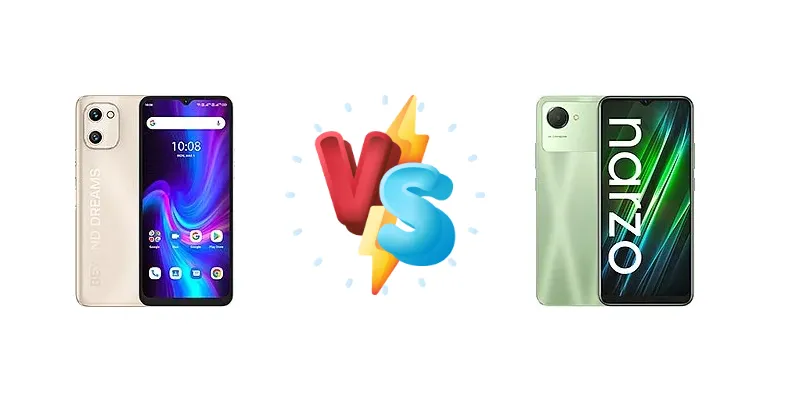
Umidigi F3 SE vs Realme Narzo 50i Prime: A Deep Dive into Budget Smartphone Performance
| Phones Images | |||||
|---|---|---|---|---|---|
|
🏆 Quick Verdict
For the average user prioritizing basic smartphone functions, the Realme Narzo 50i Prime edges out the Umidigi F3 SE. While performance is nearly identical due to the similar Unisoc chipsets, the Narzo 50i Prime’s inclusion of reverse wired charging adds a layer of utility absent in the F3 SE, making it a more versatile option.
| PHONES | ||
|---|---|---|
| Phone Names | Umidigi F3 SE | Realme Narzo 50i Prime |
| Network | ||
|---|---|---|
| 2G bands | GSM 850 / 900 / 1800 / 1900 | GSM 850 / 900 / 1800 / 1900 |
| 3G bands | HSDPA 800 / 850 / 900 / 1700(AWS) / 1900 / 2100 | HSDPA 850 / 900 / 2100 |
| 4G bands | 1, 2, 3, 4, 5, 7, 8, 12, 13, 17, 18, 19, 20, 25, 26, 28, 34, 38, 39, 40, 41, 66 | 1, 3, 5, 7, 8, 20, 28, 38, 40, 41 |
| Speed | HSPA, LTE | HSPA, LTE |
| Technology | GSM / HSPA / LTE | GSM / HSPA / LTE |
| Launch | ||
|---|---|---|
| Announced | 2022 | 2022, June 22 |
| Status | Available. Released 2022 | Available. Released 2022, June 27 |
| Body | ||
|---|---|---|
| Build | - | Glass front, plastic frame, plastic back |
| Dimensions | 168.3 x 76.6 x 8.8 mm (6.63 x 3.02 x 0.35 in) | 164.1 x 75.6 x 8.5 mm (6.46 x 2.98 x 0.33 in) |
| SIM | Nano-SIM + Nano-SIM | Nano-SIM + Nano-SIM |
| Weight | 185 g (6.53 oz) | 182 g (6.42 oz) |
| Display | ||
|---|---|---|
| Resolution | 720 x 1650 pixels (~269 ppi density) | 720 x 1600 pixels, 20:9 ratio (~270 ppi density) |
| Size | 6.7 inches, 106.2 cm2 (~82.3% screen-to-body ratio) | 6.5 inches, 102.0 cm2 (~82.2% screen-to-body ratio) |
| Type | IPS LCD | IPS LCD, 400 nits (typ) |
| Platform | ||
|---|---|---|
| CPU | Octa-core (2x1.8 GHz Cortex-A75 & 6x1.8 GHz Cortex-A55) | Octa-core (2x1.8 GHz Cortex-A75 & 6x1.8 GHz Cortex-A55) |
| Chipset | Unisoc T610 (12 nm) | Unisoc Tiger T612 (12 nm) |
| GPU | Mali-G52 MP2 | Mali-G57 |
| OS | Android 11 | Android 11, Realme UI Go |
| Memory | ||
|---|---|---|
| Card slot | microSDXC (uses shared SIM slot) | microSDXC (dedicated slot) |
| Internal | 128GB 4GB RAM | 32GB 3GB RAM, 64GB 4GB RAM |
| - | UFS 2.2 | |
| Main Camera | ||
|---|---|---|
| Dual | 20 MP, f/2.2, (wide), AF 8 MP, f/2.2, 120˚ (ultrawide) | - |
| Features | Dual-LED flash, HDR, panorama | LED flash, HDR, panorama |
| Single | - | 8 MP, f/2.0, 27mm (wide), 1/4.0", 1.12µm, AF |
| Video | 1080p@30fps | 1080p@30fps |
| Selfie camera | ||
|---|---|---|
| Features | - | HDR |
| Single | 8 MP, f/2.2, (wide) | 5 MP, f/2.2, 27mm (wide), 1/5.0", 1.12µm |
| Video | 1080p@30fps | 720p@30fps |
| Sound | ||
|---|---|---|
| 3.5mm jack | - | Yes |
| 35mm jack | Yes | Yes |
| Loudspeaker | Yes | Yes |
| Comms | ||
|---|---|---|
| Bluetooth | 5.0, A2DP, LE | 5.0, A2DP, LE |
| NFC | No | No |
| Positioning | GPS, GALILEO, GLONASS, BDS | GPS, GLONASS, GALILEO, BDS |
| Radio | Wireless FM radio | FM radio |
| USB | USB Type-C, OTG | microUSB 2.0, OTG |
| WLAN | Wi-Fi 802.11 b/g/n/ac, dual-band, Wi-Fi Direct | Wi-Fi 802.11 b/g/n |
| Features | ||
|---|---|---|
| Sensors | Fingerprint (side-mounted), accelerometer, proximity, compass | Accelerometer, proximity |
| Battery | ||
|---|---|---|
| Charging | 10W wired | 10W wired Reverse wired |
| Type | 5150 mAh | 5000 mAh |
| Misc | ||
|---|---|---|
| Colors | Hawaii Blue, Matte Silver, Starry Black, Sunglow Gold, Galaxy Blue | Dark Blue, Mint Green |
| Models | - | RMX3506 |
| Price | - | About 90 EUR |
Umidigi F3 SE
- Potentially lower price point
- Simple, straightforward user experience
- Adequate performance for basic tasks
- Lacks reverse charging functionality
- Likely limited software support
- Basic camera performance
Realme Narzo 50i Prime
- Reverse wired charging for added utility
- Slightly newer Unisoc T612 chipset
- Potentially better software optimization
- May be slightly more expensive
- 10W charging is slow
- Basic camera performance
Display Comparison
Neither Umidigi nor Realme provide display specifications beyond the basic panel type. Given the price point, both likely utilize LCD panels with 720p+ resolution. The absence of details like peak brightness or color gamut suggests neither phone excels in display quality. Expect adequate, but not impressive, viewing experiences. Bezels are likely substantial on both devices, contributing to a larger overall footprint.
Camera Comparison
Camera details are sparse for both devices. It's safe to assume both feature a primary camera and potentially a secondary depth or macro sensor. Given the market segment, image quality will be basic, particularly in low-light conditions. The absence of Optical Image Stabilization (OIS) on either device means relying heavily on software processing for stabilization. The usefulness of any secondary macro camera is questionable, as sensor resolution is likely very low. The Realme Narzo 50i Prime may have a slight edge due to potential software optimizations, but a significant difference in image quality is unlikely.
Performance
Both the Umidigi F3 SE and Realme Narzo 50i Prime are powered by Unisoc chipsets featuring an octa-core CPU configuration with the same core arrangement: 2x1.8 GHz Cortex-A75 and 6x1.8 GHz Cortex-A55. However, the Narzo 50i Prime utilizes the Unisoc Tiger T612, a slightly newer iteration. While the architectural differences are minimal, the T612 may offer marginally improved efficiency and potentially slightly better GPU performance. Both phones will handle basic tasks like web browsing, social media, and light app usage adequately, but will struggle with demanding games or heavy multitasking. RAM configurations are not specified, but are likely limited, further impacting multitasking capabilities.
Battery Life
Both phones feature 10W wired charging, indicating similar charging speeds. A full 0-100% charge will likely take over 2 hours. Battery capacity is not specified, but is likely in the 4000-5000 mAh range, providing all-day battery life with moderate usage. The Realme Narzo 50i Prime distinguishes itself with reverse wired charging, allowing it to function as a power bank for other devices. This is a valuable feature for users who frequently travel or rely on accessories that require charging.
Buying Guide
Buy the Umidigi F3 SE if you need a strictly no-frills smartphone focused solely on core functionality and are prioritizing the absolute lowest possible price. Buy the Realme Narzo 50i Prime if you prefer a device with added convenience features like reverse charging, allowing you to top up accessories or share power with a friend in a pinch, even if it means a slightly higher initial investment.