
Umidigi F3 SE vs. Infinix Note 30 VIP: A Detailed Comparison
| Phones Images | |||||
|---|---|---|---|---|---|
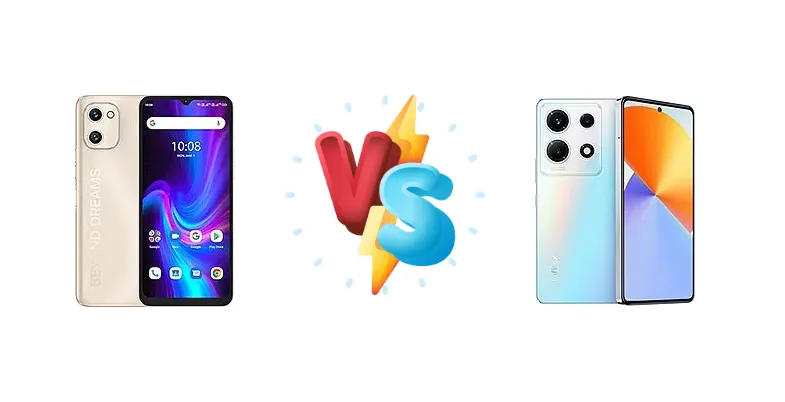
|
🏆 Quick Verdict
For the average user prioritizing performance and future-proofing, the Infinix Note 30 VIP is the clear winner. Its Dimensity 8050 chipset and blazing-fast 68W charging significantly outperform the Umidigi F3 SE’s Unisoc T610 and 10W charging, justifying the price difference.
| PHONES | ||
|---|---|---|
| Phone Names | Umidigi F3 SE | Infinix Note 30 VIP |
| Network | ||
|---|---|---|
| 2G bands | GSM 850 / 900 / 1800 / 1900 | GSM 850 / 900 / 1800 / 1900 |
| 3G bands | HSDPA 800 / 850 / 900 / 1700(AWS) / 1900 / 2100 | HSDPA 850 / 900 / 1700(AWS) / 1900 / 2100 |
| 4G bands | 1, 2, 3, 4, 5, 7, 8, 12, 13, 17, 18, 19, 20, 25, 26, 28, 34, 38, 39, 40, 41, 66 | 1, 2, 3, 4, 5, 7, 8, 12, 17, 20, 28, 38, 40, 41, 66 |
| 5G bands | - | 1, 3, 5, 7, 8, 12, 20, 28, 38, 40, 41, 66, 77, 78 SA/NSA |
| Speed | HSPA, LTE | HSPA, LTE, 5G |
| Technology | GSM / HSPA / LTE | GSM / HSPA / LTE / 5G |
| Launch | ||
|---|---|---|
| Announced | 2022 | 2023, June 12 |
| Status | Available. Released 2022 | Available. Released 2023, June 13 |
| Body | ||
|---|---|---|
| Build | - | Glass front, plastic frame, glass back |
| Dimensions | 168.3 x 76.6 x 8.8 mm (6.63 x 3.02 x 0.35 in) | 162.7 x 75.9 x 8.2 mm (6.41 x 2.99 x 0.32 in) |
| SIM | Nano-SIM + Nano-SIM | Nano-SIM + Nano-SIM |
| Weight | 185 g (6.53 oz) | 190 g (6.70 oz) |
| Display | ||
|---|---|---|
| Resolution | 720 x 1650 pixels (~269 ppi density) | 1080 x 2400 pixels, 20:9 ratio (~395 ppi density) |
| Size | 6.7 inches, 106.2 cm2 (~82.3% screen-to-body ratio) | 6.67 inches, 107.4 cm2 (~87.0% screen-to-body ratio) |
| Type | IPS LCD | AMOLED, 1B colors, 120Hz, 900 nits (peak) |
| Platform | ||
|---|---|---|
| CPU | Octa-core (2x1.8 GHz Cortex-A75 & 6x1.8 GHz Cortex-A55) | Octa-core (1x3.0 GHz Cortex-A78 & 3x2.6 GHz Cortex-A78 & 4x2.0 GHz Cortex-A55) |
| Chipset | Unisoc T610 (12 nm) | Mediatek Dimensity 8050 (6 nm) |
| GPU | Mali-G52 MP2 | Mali-G77 MC9 |
| OS | Android 11 | Android 13, XOS 13 |
| Memory | ||
|---|---|---|
| Card slot | microSDXC (uses shared SIM slot) | microSDXC (dedicated slot) |
| Internal | 128GB 4GB RAM | 256GB 8GB RAM, 256GB 12GB RAM |
| Main Camera | ||
|---|---|---|
| Dual | 20 MP, f/2.2, (wide), AF 8 MP, f/2.2, 120˚ (ultrawide) | - |
| Features | Dual-LED flash, HDR, panorama | Quad-LED flash, HDR, panorama |
| Triple | - | 108 MP, f/1.8, (wide), 1/1.67", PDAF 2 MP, f/2.4 2 MP, f/2.4 |
| Video | 1080p@30fps | 4K@30fps, 1080p@30/60fps |
| Selfie camera | ||
|---|---|---|
| Features | - | Dual-LED flash |
| Single | 8 MP, f/2.2, (wide) | 32 MP, f/2.5, (wide) |
| Video | 1080p@30fps | 1080p@30fps |
| Sound | ||
|---|---|---|
| 35mm jack | Yes | Yes |
| Loudspeaker | Yes | Yes, with stereo speakers |
| Comms | ||
|---|---|---|
| Bluetooth | 5.0, A2DP, LE | Yes |
| NFC | No | Yes (market/region dependent) |
| Positioning | GPS, GALILEO, GLONASS, BDS | GPS |
| Radio | Wireless FM radio | FM radio |
| USB | USB Type-C, OTG | USB Type-C 2.0, OTG |
| WLAN | Wi-Fi 802.11 b/g/n/ac, dual-band, Wi-Fi Direct | Wi-Fi 802.11 a/b/g/n/ac/6, dual-band |
| Features | ||
|---|---|---|
| Sensors | Fingerprint (side-mounted), accelerometer, proximity, compass | Fingerprint (under display, optical), accelerometer, gyro, proximity, compass |
| Battery | ||
|---|---|---|
| Charging | 10W wired | 68W wired, PD3.0, PPS, 80% in 30 min, bypass charging 50W wireless, 50% in 30 min Reverse wired Reverse wireless |
| Type | 5150 mAh | 5000 mAh |
| Misc | ||
|---|---|---|
| Colors | Hawaii Blue, Matte Silver, Starry Black, Sunglow Gold, Galaxy Blue | Magic Black, Glacier White, Racing Edition |
| Models | - | X6710 |
| Price | - | About 280 EUR |
Umidigi F3 SE
- Extremely affordable price point
- Functional for basic smartphone tasks
- Simple and straightforward user experience
- Slow charging speed (10W)
- Underpowered processor for demanding apps
- Likely lower-quality display
Infinix Note 30 VIP
- Blazing-fast 68W wired and 50W wireless charging
- Powerful Mediatek Dimensity 8050 processor
- Likely superior display quality and camera performance
- Higher price compared to the Umidigi F3 SE
- May have more bloatware
- Larger size and weight
Display Comparison
Context data lacks display specifics for both devices. However, given the Note 30 VIP’s positioning, it likely features a higher resolution and refresh rate panel than the F3 SE. The VIP’s price point suggests a potential AMOLED display, offering superior contrast and color accuracy compared to the F3 SE’s likely LCD panel. Bezels are also expected to be slimmer on the VIP, contributing to a more immersive viewing experience.
Camera Comparison
Without detailed camera specs, a direct comparison is limited. However, the Note 30 VIP, being a more premium device, likely features a larger main sensor and more sophisticated image processing algorithms. While both phones may include multiple lenses, the VIP’s sensor size and aperture will be critical for low-light performance. The F3 SE will likely rely heavily on software processing to compensate for a smaller sensor, potentially resulting in less detail and more noise in challenging conditions. We can assume the VIP will offer a more versatile and higher-quality camera experience.
Performance
The performance gap between these devices is substantial. The Infinix Note 30 VIP’s Mediatek Dimensity 8050, built on a 6nm process, is a significant leap over the Umidigi F3 SE’s Unisoc T610 (12nm). The Dimensity 8050’s CPU configuration – 1x3.0 GHz Cortex-A78, 3x2.6 GHz Cortex-A78, and 4x2.0 GHz Cortex-A55 – provides considerably more processing power than the F3 SE’s 2x1.8 GHz Cortex-A75 & 6x1.8 GHz Cortex-A55. This translates to faster app launches, smoother multitasking, and a more enjoyable gaming experience on the VIP. The 6nm node also implies better thermal efficiency, reducing the likelihood of performance throttling under sustained load.
Battery Life
The Infinix Note 30 VIP’s charging capabilities are a standout feature. Its 68W wired charging, supporting PD3.0 and PPS, can reportedly reach 80% charge in just 30 minutes, a massive advantage over the Umidigi F3 SE’s slow 10W charging. The addition of 50W wireless charging and reverse charging capabilities further enhances the VIP’s convenience. While battery capacity isn’t specified, the VIP’s fast charging mitigates concerns about a potentially smaller battery size, allowing for quick top-ups throughout the day. The F3 SE’s 10W charging will require significantly longer to reach a full charge, making it less ideal for users who frequently need to replenish their battery.
Buying Guide
Buy the Umidigi F3 SE if you need a functional, extremely affordable smartphone for basic tasks like calls, messaging, and light social media use, and aren't concerned with demanding applications or fast charging. Buy the Infinix Note 30 VIP if you prioritize a smooth user experience, faster app loading times, gaming capabilities, and the convenience of incredibly quick wired and wireless charging.