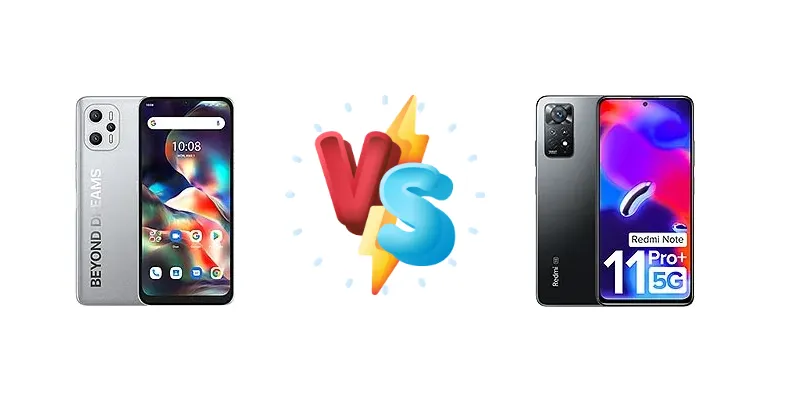
The sub-$300 5G smartphone market is fiercely competitive. The Umidigi F3 Pro and Xiaomi Redmi Note 11 Pro+ 5G (India) both aim to deliver a compelling experience, but they take different approaches. The Umidigi focuses on a balanced feature set, while the Redmi Note 11 Pro+ prioritizes charging speed and a more established brand reputation. This comparison dissects their key differences to help you choose.
🏆 Quick Verdict
For the average user prioritizing convenience and rapid power-ups, the Xiaomi Redmi Note 11 Pro+ 5G (India) is the clear winner. Its 67W charging significantly outperforms the Umidigi F3 Pro’s 18W, making it ideal for those constantly on the go. However, the Umidigi offers a competitive chipset for the price.
| Network |
|---|
| 2G bands | GSM 850 / 900 / 1800 / 1900 | GSM 850 / 900 / 1800 / 1900 - SIM 1 & SIM 2 |
| 3G bands | HSDPA 850 / 900 / 1700(AWS) / 1900 / 2100 | HSDPA 850 / 900 / 1900 / 2100 |
| 4G bands | 1, 2, 3, 4, 5, 7, 8, 12, 13, 17, 18, 19, 20, 25, 26, 28, 34, 38, 39, 40, 41, 66 | 1, 3, 5, 8, 40, 41 |
| 5G bands | 1, 2, 3, 5, 7, 8, 20, 25, 28, 38, 40, 41, 66, 77, 78 SA/NSA | 1, 3, 5, 8, 28, 40, 78 SA/NSA |
| Speed | HSPA, LTE, 5G | HSPA, LTE-A (CA), 5G |
| Technology | GSM / CDMA / HSPA / LTE / 5G | GSM / HSPA / LTE / 5G |
| Launch |
|---|
| Announced | 2023 | 2022, March 09 |
| Status | Available. Released 2023 | Available. Released 2022, March 15 |
| Body |
|---|
| Build | - | Glass front (Gorilla Glass 5), glass back |
| Dimensions | 165.6 x 76.4 x 9.6 mm (6.52 x 3.01 x 0.38 in) | 164.2 x 76.1 x 8.1 mm (6.46 x 3.00 x 0.32 in) |
| SIM | Nano-SIM + Nano-SIM | Hybrid Dual SIM (Nano-SIM, dual stand-by) |
| Weight | 195 g (6.88 oz) | 202 g (7.13 oz) |
| | - | IP53, dust and splash resistant |
| Display |
|---|
| Protection | - | Corning Gorilla Glass 5 |
| Resolution | 1080 x 2408 pixels, 20:9 ratio (~400 ppi density) | 1080 x 2400 pixels, 20:9 ratio (~395 ppi density) |
| Size | 6.6 inches, 104.9 cm2 (~82.9% screen-to-body ratio) | 6.67 inches, 107.4 cm2 (~86.0% screen-to-body ratio) |
| Type | IPS LCD | Super AMOLED, 120Hz, 700 nits, 1200 nits (peak) |
| Platform |
|---|
| CPU | Octa-core (2x2.2 GHz Cortex-A76 & 6x2.0 GHz Cortex-A55) | Octa-core (2x2.2 GHz Kryo 660 Gold & 6x1.7 GHz Kryo 660 Silver) |
| Chipset | Mediatek Dimensity 700 (7 nm) | Qualcomm SM6375 Snapdragon 695 5G (6 nm) |
| GPU | Mali-G57 MC2 | Adreno 619 |
| OS | Android 13 | Android 11, MIUI 13 |
| Memory |
|---|
| Card slot | microSDXC (uses shared SIM slot) | microSDXC (uses shared SIM slot) |
| Internal | 256GB 8GB RAM | 64GB 6GB RAM, 128GB 6GB RAM, 128GB 8GB RAM, 256GB 8GB RAM |
| | - | UFS 2.2 |
| Main Camera |
|---|
| Features | Quad-LED flash, HDR, panorama | LED flash, HDR, panorama |
| Triple | 48 MP, f/1.8, (wide), AF
8 MP, f/2.2, 120˚ (ultrawide)
5 MP (macro) | 108 MP, f/1.9, 26mm (wide), 1/1.52", 0.7µm, PDAF
8 MP, f/2.2, 118˚ (ultrawide)
2 MP, f/2.4, (macro) |
| Video | 1440p@30fps, 1080p@30fps | 1080p@30fps |
| Selfie camera |
|---|
| Single | 16 MP, f/2.2, (wide) | 16 MP, f/2.5, (wide), 1/3.06" 1.0µm |
| Video | 720p@30fps | 1080p@30fps |
| Sound |
|---|
| 3.5mm jack | - | Yes |
| 35mm jack | Yes | - |
| Loudspeaker | Yes, with stereo speakers | Yes, with stereo speakers |
| | - | 24-bit/192kHz audio |
| Comms |
|---|
| Bluetooth | 5.1, A2DP, LE | 5.1, A2DP, LE |
| Infrared port | - | Yes |
| NFC | Yes | No |
| Positioning | GPS, GALILEO, GLONASS, BDS | GPS, GLONASS, BDS, GALILEO |
| Radio | FM radio | Unspecified |
| USB | USB Type-C, OTG | USB Type-C 2.0, OTG |
| WLAN | Wi-Fi 802.11 a/b/g/n/ac, dual-band, Wi-Fi Direct | Wi-Fi 802.11 a/b/g/n/ac, dual-band, Wi-Fi Direct |
| Features |
|---|
| Sensors | Fingerprint (side-mounted), accelerometer, proximity, compass | Fingerprint (side-mounted), accelerometer, gyro, proximity, compass |
| Battery |
|---|
| Charging | 18W wired | 67W wired, PD3.0, QC3, 50% in 15 min, 100% in 42 min (advertised) |
| Type | 6150 mAh | Li-Po 5000 mAh, non-removable |
| Misc |
|---|
| Colors | Starry Black, Matte Silver | Mirage Blue, Phantom White, Stealth Black |
| Models | - | 2201116SI |
| Price | About 160 EUR | About 250 EUR |
Umidigi F3 Pro
- Competitive price point
- Capable Dimensity 700 chipset for everyday tasks
- Potentially good value for money
- Slow 18W charging
- Limited brand recognition
- Potentially less refined software experience
Xiaomi Redmi Note 11 Pro+ 5G (India)
- Ultra-fast 67W charging
- More efficient Snapdragon 695 chipset
- Established brand reputation (Xiaomi)
- Slightly higher price
- Potential for MIUI bloatware
- May not offer significantly better performance in all scenarios
Display Comparison
Neither device boasts a standout display. While specific display specs (resolution, panel type) are missing for the Umidigi F3 Pro, the Redmi Note 11 Pro+ 5G likely features a Super AMOLED panel, common for Xiaomi's mid-range offerings. The key differentiator here is charging, not display quality. Both will likely offer adequate viewing experiences for everyday use, but neither is geared towards professional content creation or color-critical work.
Camera Comparison
Without detailed camera specs for the Umidigi F3 Pro, a direct comparison is limited. However, Xiaomi typically equips its 'Pro+' models with more capable camera systems. The Redmi Note 11 Pro+ 5G (India) likely features a higher-resolution main sensor and more sophisticated image processing algorithms. While both phones will likely include standard features like portrait mode and night mode, the Redmi Note 11 Pro+ is expected to deliver superior image quality, particularly in challenging lighting conditions. The presence of OIS (Optical Image Stabilization) on the Redmi Note 11 Pro+ would further enhance its camera capabilities.
Performance
The chipset choice is the core of this comparison. The Xiaomi Redmi Note 11 Pro+ 5G (India) utilizes the Qualcomm Snapdragon 695 5G (6nm), while the Umidigi F3 Pro features the MediaTek Dimensity 700 (7nm). The 6nm process of the Snapdragon 695 generally translates to better power efficiency compared to the 7nm Dimensity 700. While both CPUs have a similar peak clock speed (2.2 GHz for the Cortex-A76 and Kryo 660 Gold cores), the Snapdragon 695’s architecture and process node give it a slight edge in sustained performance and thermal management. This means the Redmi Note 11 Pro+ is less likely to throttle under prolonged gaming or heavy multitasking.
Battery Life
This is where the Redmi Note 11 Pro+ 5G (India) truly shines. Its 67W wired charging is a game-changer, capable of charging from 0-100% in a claimed 42 minutes. The Umidigi F3 Pro’s 18W charging is significantly slower, requiring considerably more time to fully replenish the battery. While battery capacity isn't specified for the Umidigi, the Redmi Note 11 Pro+’s battery size is likely in the 4000-5000 mAh range. The faster charging speed effectively mitigates any potential disadvantage from a slightly smaller battery capacity, offering a more convenient user experience.
Buying Guide
Buy the Umidigi F3 Pro if you need a solid all-rounder with a capable Dimensity 700 chipset and aren't heavily reliant on ultra-fast charging. It's a good choice for users who prioritize value and don't mind a slower charging experience. Buy the Xiaomi Redmi Note 11 Pro+ 5G (India) if you prefer blazing-fast 67W charging, a more refined software experience (typically associated with Xiaomi), and are willing to pay a slight premium for the convenience.
Frequently Asked Questions
❓ Will the Snapdragon 695 in the Redmi Note 11 Pro+ 5G overheat during extended gaming sessions?
The Snapdragon 695, built on a 6nm process, is generally more thermally efficient than the Dimensity 700. While some throttling is inevitable during prolonged gaming, the Redmi Note 11 Pro+ 5G is less likely to experience significant performance drops due to overheating compared to the Umidigi F3 Pro.
❓ How much faster is the 67W charging on the Redmi Note 11 Pro+ 5G compared to the 18W charging on the Umidigi F3 Pro?
The 67W charging on the Redmi Note 11 Pro+ 5G is significantly faster. Xiaomi advertises a 0-100% charge in 42 minutes, while the Umidigi F3 Pro’s 18W charging will likely take well over two hours to achieve a full charge. This difference is crucial for users who need to quickly top up their battery.
❓ Does the Redmi Note 11 Pro+ 5G (India) support VoLTE/VoWiFi on all Indian carriers?
Support for VoLTE and VoWiFi can vary depending on the carrier. It's crucial to check compatibility with your specific carrier before purchasing. Xiaomi typically provides a list of supported carriers on their Indian website.