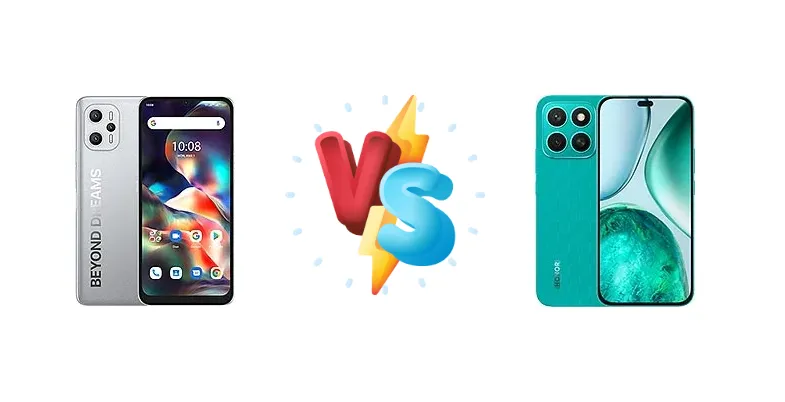
The sub-$200 smartphone market is fiercely competitive. The Umidigi F3 Pro and Honor X8c both aim to deliver 5G connectivity and essential features at an accessible price point. However, they take different approaches to achieving this, with the F3 Pro leveraging MediaTek's Dimensity 700 and the X8c opting for Qualcomm's Snapdragon 685. This comparison dives deep into the architectural differences and real-world implications of these choices.
🏆 Quick Verdict
For the average user prioritizing fast charging and potentially smoother everyday performance, the Honor X8c is the better choice. Its 35W charging significantly reduces downtime, and the Snapdragon 685's 6nm process offers a slight efficiency advantage. However, the Umidigi F3 Pro remains a viable option for those seeking a slightly more powerful CPU core configuration.
| Network |
|---|
| 2G bands | GSM 850 / 900 / 1800 / 1900 | GSM 850 / 900 / 1800 / 1900 |
| 3G bands | HSDPA 850 / 900 / 1700(AWS) / 1900 / 2100 | HSDPA 850 / 900 / 1900 / 2100 |
| 4G bands | 1, 2, 3, 4, 5, 7, 8, 12, 13, 17, 18, 19, 20, 25, 26, 28, 34, 38, 39, 40, 41, 66 | LTE |
| 5G bands | 1, 2, 3, 5, 7, 8, 20, 25, 28, 38, 40, 41, 66, 77, 78 SA/NSA | - |
| Speed | HSPA, LTE, 5G | HSPA, LTE |
| Technology | GSM / CDMA / HSPA / LTE / 5G | GSM / HSPA / LTE |
| Launch |
|---|
| Announced | 2023 | 2025, January 14 |
| Status | Available. Released 2023 | Available. Released 2025, January 20 |
| Body |
|---|
| Build | - | Glass front, plastic frame, plastic back or silicone polymer back (eco leather) |
| Dimensions | 165.6 x 76.4 x 9.6 mm (6.52 x 3.01 x 0.38 in) | 161.1 x 74.6 x 7.1 mm (6.34 x 2.94 x 0.28 in) |
| SIM | Nano-SIM + Nano-SIM | Nano-SIM + Nano-SIM |
| Weight | 195 g (6.88 oz) | 174 g (6.14 oz) |
| Display |
|---|
| Resolution | 1080 x 2408 pixels, 20:9 ratio (~400 ppi density) | 1080 x 2412 pixels, 20:9 ratio (~394 ppi density) |
| Size | 6.6 inches, 104.9 cm2 (~82.9% screen-to-body ratio) | 6.7 inches, 108.0 cm2 (~89.9% screen-to-body ratio) |
| Type | IPS LCD | AMOLED, 120Hz, 1200 nits (HBM), 2800 nits (peak) |
| Platform |
|---|
| CPU | Octa-core (2x2.2 GHz Cortex-A76 & 6x2.0 GHz Cortex-A55) | Octa-core (4x2.8 GHz Cortex-A73 & 4x1.9 GHz Cortex-A53) |
| Chipset | Mediatek Dimensity 700 (7 nm) | Qualcomm SM6225 Snapdragon 685 (6 nm) |
| GPU | Mali-G57 MC2 | Adreno 610 |
| OS | Android 13 | Android 15, MagicOS 9 |
| Memory |
|---|
| Card slot | microSDXC (uses shared SIM slot) | No |
| Internal | 256GB 8GB RAM | 128GB 6GB RAM, 128GB 8GB RAM, 256GB 8GB RAM, 512GB 8GB RAM |
| Main Camera |
|---|
| Dual | - | 108 MP, f/1.8, 24mm (wide), 1/1.67", PDAF, OIS
5 MP, f/2.2, (ultrawide) |
| Features | Quad-LED flash, HDR, panorama | LED flash, HDR, panorama |
| Triple | 48 MP, f/1.8, (wide), AF
8 MP, f/2.2, 120˚ (ultrawide)
5 MP (macro) | - |
| Video | 1440p@30fps, 1080p@30fps | 1080p@30fps, gyro-EIS |
| Selfie camera |
|---|
| Single | 16 MP, f/2.2, (wide) | 50 MP, f/2.1, (wide) |
| Video | 720p@30fps | 1080p@30fps |
| Sound |
|---|
| 35mm jack | Yes | No |
| Loudspeaker | Yes, with stereo speakers | Yes |
| Comms |
|---|
| Bluetooth | 5.1, A2DP, LE | 5.0/5.1, A2DP, LE |
| NFC | Yes | Yes (market/region dependent) |
| Positioning | GPS, GALILEO, GLONASS, BDS | GPS, GLONASS, GALILEO, BDS |
| Radio | FM radio | No |
| USB | USB Type-C, OTG | USB Type-C 2.0, OTG |
| WLAN | Wi-Fi 802.11 a/b/g/n/ac, dual-band, Wi-Fi Direct | Wi-Fi 802.11 a/b/g/n/ac, dual-band, Wi-Fi Direct |
| Features |
|---|
| Sensors | Fingerprint (side-mounted), accelerometer, proximity, compass | Fingerprint (under display, optical), accelerometer, gyro, compass, proximity (ultrasonic) |
| Battery |
|---|
| Charging | 18W wired | 35W wired |
| Type | 6150 mAh | Li-Po 5000 mAh |
| Misc |
|---|
| Colors | Starry Black, Matte Silver | Marrs Green, Midnight Black, Moonlight White, Cloud Purple |
| Models | - | ABR-LX1, ABR-LX2, ABR-LX3 |
| Price | About 160 EUR | € 190.78 / $ 213.42 / £ 159.00 |
Umidigi F3 Pro
- Potentially higher peak CPU performance due to Cortex-A76 cores.
- 5G connectivity for faster data speeds.
- Competitive price point.
- Slower 18W charging.
- 7nm process may result in slightly higher power consumption.
- Likely less optimized software experience.
Honor X8c
- Faster 35W wired charging.
- More power-efficient 6nm Snapdragon 685 chipset.
- Potentially smoother everyday performance due to optimized software.
- Cortex-A73 cores are older architecture than A76.
- May not match the F3 Pro in sustained peak CPU performance.
- Camera quality is likely similar to the F3 Pro.
Display Comparison
Neither device boasts a standout display. Given the lack of display specifications in the provided data, we can assume both likely utilize LCD panels common in this price bracket. The focus here will be on performance, not visual fidelity. Bezels are likely comparable, and color accuracy will be standard for the segment. The absence of high refresh rates is expected.
Camera Comparison
Without detailed camera specifications, a direct comparison is limited. Both phones likely feature multi-camera setups, but the quality will heavily depend on sensor size and image processing. It's reasonable to assume both will include a primary sensor, an ultrawide, and potentially a macro lens. The absence of OIS (Optical Image Stabilization) is highly probable in this price range. Image processing will likely lean towards vibrant colors and boosted contrast to appeal to a wider audience. The Snapdragon 685’s ISP (Image Signal Processor) may offer slightly better noise reduction capabilities due to its newer architecture.
Performance
The core difference lies in the chipsets. The Umidigi F3 Pro’s Dimensity 700 (7nm) features a dual-cluster configuration with 2x 2.2 GHz Cortex-A76 cores for peak performance and 6x 2.0 GHz Cortex-A55 cores for efficiency. The Honor X8c’s Snapdragon 685 (6nm) employs a different strategy: 4x 2.8 GHz Cortex-A73 cores and 4x 1.9 GHz Cortex-A53 cores. While the Snapdragon 685 has a higher clock speed on its performance cores, the Dimensity 700’s Cortex-A76 cores are architecturally more advanced, offering better instructions per clock (IPC). However, the 6nm process of the Snapdragon 685 provides a potential edge in power efficiency and thermal management, potentially leading to less throttling under sustained load. This benefits users who play mobile games or use demanding apps for extended periods.
Battery Life
The Honor X8c’s 35W wired charging is a significant advantage over the Umidigi F3 Pro’s 18W charging. This translates to substantially faster charging times, allowing users to quickly replenish the battery. While the battery capacity isn’t specified for either device, the Snapdragon 685’s 6nm process contributes to better power efficiency, potentially offsetting a slightly smaller battery capacity compared to the F3 Pro. Users who frequently find themselves needing to top up their phone throughout the day will greatly benefit from the X8c’s faster charging.
Buying Guide
Buy the Umidigi F3 Pro if you frequently engage in tasks that benefit from burst CPU performance, like compiling code or running specific benchmark tests, and are willing to trade off charging speed. Buy the Honor X8c if you prioritize all-day battery life, quick top-ups with its 35W charging, and a generally more responsive user experience for common tasks like social media and web browsing.
Frequently Asked Questions
❓ Will the Snapdragon 685 in the Honor X8c struggle with graphically demanding games like PUBG Mobile?
While the Snapdragon 685 isn't a gaming powerhouse, it's capable of running PUBG Mobile at medium settings with reasonable frame rates. The 6nm process helps with thermal throttling, allowing for more sustained performance than the Dimensity 700 might achieve under similar load. Expect to adjust graphics settings for optimal balance between visual quality and smoothness.
❓ How much faster is the 35W charging on the Honor X8c compared to the 18W charging on the Umidigi F3 Pro?
The 35W charging on the Honor X8c will significantly reduce charging times. While exact 0-100% times depend on battery capacity (which isn't specified), you can expect the X8c to charge considerably faster – potentially shaving off 30-60 minutes compared to the F3 Pro. This is a major convenience factor for users who need to quickly top up their battery.
❓ Does the Dimensity 700 in the Umidigi F3 Pro offer a noticeable advantage for multitasking?
The Dimensity 700's Cortex-A76 cores provide a performance boost for single-threaded tasks and quick app switching. However, the Snapdragon 685's optimized software and efficient architecture can mitigate this advantage in everyday multitasking scenarios. The difference will likely be subtle for most users.