
Umidigi F3 5G vs Realme 9 Pro+: A Detailed Comparison of 5G Smartphones
| Phones Images | |||||
|---|---|---|---|---|---|
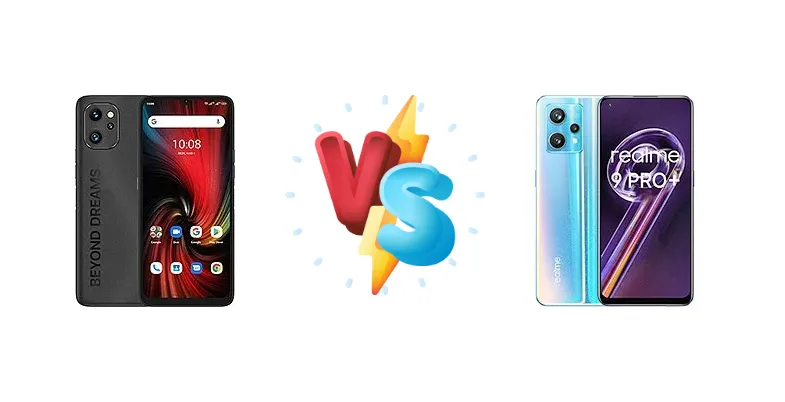
|
🏆 Quick Verdict
For the average user prioritizing value and basic 5G functionality, the Umidigi F3 5G offers a compelling package. However, the Realme 9 Pro+ is the clear winner for those demanding faster performance, significantly quicker charging, and a potentially more refined user experience, justifying its higher price point.
| PHONES | ||
|---|---|---|
| Phone Names | Umidigi F3 5G | Realme 9 Pro+ |
| Network | ||
|---|---|---|
| 2G bands | GSM 850 / 900 / 1800 / 1900 | GSM 850 / 900 / 1800 / 1900 - SIM 1 & SIM 2 |
| 3G bands | HSDPA 800 / 850 / 900 / 1700(AWS) / 1900 / 2100 | HSDPA 850 / 900 / 1700(AWS) / 1900 / 2100 |
| 4G bands | 1, 2, 3, 4, 5, 7, 8, 12, 13, 17, 18, 19, 20, 25, 26, 28, 34, 38, 39, 40, 41, 66 | 1, 2, 3, 4, 5, 7, 8, 12, 13, 17, 18, 19, 20, 26, 28, 38, 39, 40, 41, 66 - International |
| 5G bands | 1, 2, 3, 5, 7, 8, 20, 25, 28, 38, 40, 41, 66, 77, 78 SA/NSA | 1, 3, 5, 7, 8, 20, 28, 38, 40, 41, 66, 77, 78 SA/NSA - International |
| Speed | HSPA, LTE, 5G | HSPA, LTE-A, 5G |
| Technology | GSM / CDMA / HSPA / LTE / 5G | GSM / HSPA / LTE / 5G |
| - | 1, 28, 41, 77, 78 SA/NSA - India | |
| Launch | ||
|---|---|---|
| Announced | 2022 | 2022, February 16 |
| Status | Available. Released 2022 | Available. Released 2022, February 21 |
| Body | ||
|---|---|---|
| Build | - | Glass front (Gorilla Glass 5), glass back |
| Dimensions | 168.3 x 76.6 x 8.8 mm (6.63 x 3.02 x 0.35 in) | 160.2 x 73.3 x 8 mm (6.31 x 2.89 x 0.31 in) |
| SIM | Nano-SIM + Nano-SIM | Dual SIM (Nano-SIM, dual stand-by) |
| Weight | 195 g (6.88 oz) | 182 g (6.42 oz) |
| Display | ||
|---|---|---|
| Protection | - | Corning Gorilla Glass 5 |
| Resolution | 720 x 1650 pixels (~269 ppi density) | 1080 x 2400 pixels, 20:9 ratio (~411 ppi density) |
| Size | 6.7 inches, 106.2 cm2 (~82.3% screen-to-body ratio) | 6.4 inches, 98.9 cm2 (~84.2% screen-to-body ratio) |
| Type | IPS LCD | Super AMOLED, 90Hz, 430 nits (typ), 600 nits (HBM) |
| Platform | ||
|---|---|---|
| CPU | Octa-core (2x2.2 GHz Cortex-A76 & 6x2.0 GHz Cortex-A55) | Octa-core (2x2.5 GHz Cortex-A78 & 6x2.0 GHz Cortex-A55) |
| Chipset | Mediatek Dimensity 700 (7 nm) | Mediatek Dimensity 920 (6 nm) |
| GPU | Mali-G57 MC2 | Mali-G68 MC4 |
| OS | Android 12 | Android 12, upgradable to Android 13, Realme UI 4.0 |
| Memory | ||
|---|---|---|
| Card slot | microSDXC (uses shared SIM slot) | No |
| Internal | 128GB 8GB RAM | 128GB 6GB RAM, 128GB 8GB RAM, 256GB 8GB RAM |
| - | UFS 2.2 | |
| Main Camera | ||
|---|---|---|
| Features | Dual-LED flash, HDR, panorama | LED flash, HDR, panorama |
| Single | - | 16 MP, f/2.4, 27mm (wide), 1/3.09", 1.0µm |
| Triple | 48 MP, f/1.8, (wide), 1/2", AF 8 MP, f/2.2, 120˚ (ultrawide) 5 MP (macro) | 50 MP, f/1.8, 24mm (wide), 1/1.56", 1.0µm, PDAF, OIS 8 MP, f/2.2, 119˚, 16mm (ultrawide), 1/4.0", 1.12µm 2 MP, f/2.4, (macro) |
| Video | 1080p@30fps | 4K@30fps, 1080p@30/60/120/480fps, 720p@960fps, gyro-EIS |
| Selfie camera | ||
|---|---|---|
| Features | - | HDR, panorama |
| Single | 16 MP, f/2.2, (wide) | 16 MP, f/2.4, 27mm (wide), 1/3.09", 1.0µm |
| Video | 1440p@30fps, 1080p@30fps | 1080p@30fps, gyro-EIS |
| Sound | ||
|---|---|---|
| 3.5mm jack | - | Yes |
| 35mm jack | Yes | - |
| Loudspeaker | Yes | Yes, with stereo speakers |
| - | 24-bit/192kHz audio | |
| Comms | ||
|---|---|---|
| Bluetooth | 5.1, A2DP, LE | 5.2, A2DP, LE, aptX HD |
| NFC | Yes | Yes (market/region dependent) |
| Positioning | GPS, GALILEO, GLONASS, BDS | GPS, GLONASS, BDS |
| Radio | FM radio | No |
| USB | USB Type-C, OTG | USB Type-C 2.0, OTG |
| WLAN | Wi-Fi 802.11 a/b/g/n/ac, dual-band, Wi-Fi Direct | Wi-Fi 802.11 a/b/g/n/ac/6, dual-band |
| Features | ||
|---|---|---|
| Sensors | Fingerprint (side-mounted), accelerometer, proximity, compass | Fingerprint (under display, optical), accelerometer, gyro, proximity, compass |
| Battery | ||
|---|---|---|
| Charging | 18W wired | 60W wired, PD3.0, 100% in 44 min (advertised) |
| Type | 5150 mAh | Li-Po 4500 mAh, non-removable |
| Misc | ||
|---|---|---|
| Colors | Starry Black, Matte Silver, Sunglow Gold | Midnight Black, Aurora Green, Sunrise Blue, Free Fire Limited Edition |
| Models | - | RMX3392, RMX3393 |
| Price | - | € 289.90 / $ 390.00 / ₹ 25,999 |
| SAR | - | 1.19 W/kg (head) 0.73 W/kg (body) |
| Tests | ||
|---|---|---|
| Battery life | - | Endurance rating 117h |
| Camera | - | Photo / Video |
| Display | - | Contrast ratio: Infinite (nominal) |
| Loudspeaker | - | -25.3 LUFS (Very good) |
| Performance | - | AnTuTu: 495096 (v8), 416031 (v9) GeekBench: 2335 (v5.1) GFXBench: 27fps (ES 3.1 onscreen) |
Umidigi F3 5G
- Significantly more affordable
- 5G connectivity at a budget price
- Decent battery endurance
- Slower processor and graphics
- Slow charging speed
- Likely lower quality display and camera
Realme 9 Pro+
- Faster and more powerful processor
- 60W fast charging
- Potentially superior camera system
- Higher price point
- May not offer a dramatically different experience for basic users
- Potential for more heat generation under heavy load
Display Comparison
The Realme 9 Pro+ boasts an unspecified, but likely higher quality, display with an 'Infinite' contrast ratio, suggesting a VA panel for deeper blacks. While the Umidigi F3 5G’s display specifications are absent, it’s reasonable to assume a standard IPS LCD. The Realme’s potential for superior contrast and color reproduction will be noticeable when viewing multimedia content. The lack of display details for the Umidigi suggests a focus on cost reduction in this area.
Camera Comparison
While both phones feature cameras, the Realme 9 Pro+ is expected to offer a more sophisticated imaging experience. The absence of detailed camera specs for the Umidigi F3 5G suggests a more basic setup. The Realme 9 Pro+ likely benefits from a more advanced image signal processor (ISP) within the Dimensity 920, enabling better noise reduction, dynamic range, and overall image quality. The Realme’s camera system is likely to include features like optical image stabilization (OIS), which the Umidigi likely lacks, resulting in sharper photos and smoother videos.
Performance
The core difference lies in the chipsets. The Realme 9 Pro+’s Mediatek Dimensity 920 (6nm) significantly outperforms the Umidigi F3 5G’s Dimensity 700 (7nm). The 920 features faster Cortex-A78 cores (2.5 GHz vs 2.2 GHz) and a more efficient 6nm process, translating to better CPU and GPU performance. This means smoother multitasking, faster app loading times, and a more enjoyable gaming experience on the Realme. The Dimensity 700 is adequate for basic tasks, but will struggle with graphically intensive games or demanding applications. The Realme 9 Pro+ likely benefits from faster RAM as well, though specifics are not provided.
Battery Life
The Realme 9 Pro+’s 60W wired charging is a game-changer, promising a full charge in just 44 minutes. This is a substantial advantage over the Umidigi F3 5G’s 18W charging, which will take considerably longer. While the Umidigi F3 5G has an endurance rating of 117 hours, the Realme 9 Pro+'s faster charging mitigates the impact of potentially similar battery capacity. Users who frequently find themselves needing to top up their phone will greatly appreciate the Realme’s speed.
Buying Guide
Buy the Umidigi F3 5G if you need a functional 5G smartphone on a tight budget and prioritize connectivity over raw power. It's ideal for everyday tasks, social media, and light gaming. Buy the Realme 9 Pro+ if you prefer a smoother, more responsive experience for demanding apps, gaming, and content creation, and value the convenience of 60W fast charging and potentially better camera performance.