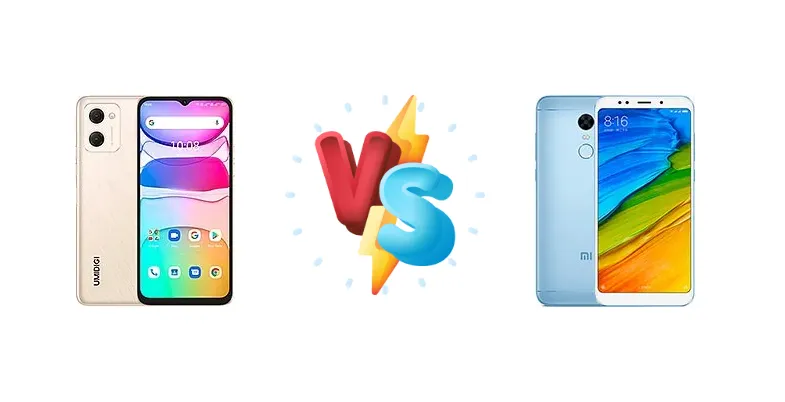
The Umidigi C2 and Xiaomi Redmi 5 Plus (also known as Redmi Note 5 in some markets) represent two approaches to the ultra-budget smartphone segment. The Redmi 5 Plus, released to acclaim, offered a strong value proposition in its time. The Umidigi C2 aims to undercut it further, but at what cost? This comparison dives deep into the specifications to determine which device delivers the best experience for the money.
🏆 Quick Verdict
For most users, the Xiaomi Redmi 5 Plus (Redmi Note 5) remains the superior choice. Its Qualcomm Snapdragon 625 chipset, built on a 14nm process, provides a noticeable performance advantage over the Umidigi C2’s MediaTek Helio A22, despite both CPUs being clocked at 2.0 GHz. While both offer 10W charging and similar battery endurance ratings, the Redmi 5 Plus’s more efficient processor translates to better real-world usability.
| Network |
|---|
| 2G bands | GSM 850 / 900 / 1800 / 1900 | GSM 850 / 900 / 1800 / 1900 - SIM 1 & SIM 2 |
| 3G bands | HSDPA 850 / 900 / 1700(AWS) / 1900 / 2100 | HSDPA 850 / 900 / 1900 / 2100 |
| 4G bands | 1, 2, 3, 4, 5, 7, 8, 12, 17, 20, 28, 38, 40, 41, 66 | 1, 3, 4, 5, 7, 8, 20, 38, 40 - Global |
| Speed | HSPA, LTE | HSPA 42.2/5.76 Mbps, LTE (2CA) Cat6 300/50 Mbps |
| Technology | GSM / HSPA / LTE | GSM / HSPA / LTE |
| | - | 1, 3, 5, 7, 8, 34, 38, 39, 40, 41 - China |
| Launch |
|---|
| Announced | 2023 | 2018, February. Released 2018, February |
| Status | Available. Released 2023 | Discontinued |
| Body |
|---|
| Build | - | Glass front, aluminum/plastic back, aluminum frame |
| Dimensions | 164 x 75.9 x 8.8 mm (6.46 x 2.99 x 0.35 in) | 158.5 x 75.5 x 8.1 mm (6.24 x 2.97 x 0.32 in) |
| SIM | Nano-SIM + Nano-SIM | Nano-SIM + Nano-SIM |
| Weight | 192 g (6.77 oz) | 180 g (6.35 oz) |
| Display |
|---|
| Resolution | 720 x 1600 pixels, 20:9 ratio (~269 ppi density) | 1080 x 2160 pixels, 18:9 ratio (~403 ppi density) |
| Size | 6.52 inches, 102.6 cm2 (~82.5% screen-to-body ratio) | 5.99 inches, 92.6 cm2 (~77.4% screen-to-body ratio) |
| Type | IPS LCD | IPS LCD |
| Platform |
|---|
| CPU | Quad-core 2.0 GHz Cortex-A53 | Octa-core 2.0 GHz Cortex-A53 |
| Chipset | Mediatek Helio A22 (12 nm) | Qualcomm MSM8953 Snapdragon 625 (14 nm) |
| GPU | PowerVR GE8320 | Adreno 506 |
| OS | Android 13 | Android 7.1.2 (Nougat), planned upgrade to Android 10, MIUI 12 |
| Memory |
|---|
| Card slot | microSDXC (uses shared SIM slot) | microSDXC (uses shared SIM slot) |
| Internal | 32GB 3GB RAM | 32GB 3GB RAM, 64GB 3GB RAM, 64GB 4GB RAM |
| | - | eMMC 5.1 |
| Main Camera |
|---|
| Dual | 13 MP, f/2.2, (wide), AF
Auxiliary lens | - |
| Features | Dual-LED flash, HDR, panorama | Dual-LED dual-tone flash, HDR, panorama |
| Single | - | 12 MP, f/2.2, 1.25 μm, dual pixel PDAF |
| Video | 1080p@30fps | 4K@30fps, 1080p@30/60fps |
| Selfie camera |
|---|
| Single | 5 MP, f/2.0, (wide) | 5 MP |
| Video | 720p@30fps | 1080p@30fps |
| Sound |
|---|
| 3.5mm jack | - | Yes |
| 35mm jack | Yes | Yes |
| Loudspeaker | Yes | Yes |
| Comms |
|---|
| Bluetooth | 5.0, A2DP, LE | 4.2, A2DP, LE |
| Infrared port | - | Yes |
| NFC | No | No |
| Positioning | GPS, GLONASS, GALILEO | GPS, GLONASS, BDS |
| Radio | No | FM radio |
| USB | USB Type-C, OTG | microUSB 2.0 |
| WLAN | Wi-Fi 802.11 b/g/n/ac, dual-band, Wi-Fi Direct | Wi-Fi 802.11 a/b/g/n, Wi-Fi Direct |
| Features |
|---|
| Sensors | Accelerometer, proximity, compass | Fingerprint (rear-mounted), accelerometer, gyro, proximity, compass |
| Battery |
|---|
| Charging | 10W wired | 10W wired |
| Type | 5150 mAh | Li-Po 4000 mAh, non-removable |
| Misc |
|---|
| Colors | Graphite Black, Dawn Gold | Black, Gold, Blue, Rose Gold |
| Models | - | MEG7, MEI7 |
| Price | - | About 180 EUR |
| SAR | - | 1.01 W/kg (head) 1.47 W/kg (body) |
| Tests |
|---|
| Audio quality | - |
Noise -29.7dB / Crosstalk -91.8dB |
| Battery life | - |
Endurance rating 104h
|
| Camera | - |
Photo / Video |
| Display | - |
Contrast ratio: 1431:1 (nominal), 2.913 (sunlight) |
| Loudspeaker | - |
Voice 71dB / Noise 72dB / Ring 87dB
|
| Performance | - |
GeekBench: 4309 (v4.4)
GFXBench: 3.4fps (ES 3.1 onscreen) |
Umidigi C2
- Potentially lower price point
- May offer newer software features (depending on updates)
- Compact form factor (assuming smaller screen size)
- Inferior processor performance
- Less efficient chipset
- Limited camera capabilities (based on market segment)
Xiaomi Redmi 5 Plus (Redmi Note 5)
- Superior processor performance (Snapdragon 625)
- More efficient chipset (14nm)
- Better camera image processing
- Older device, potentially limited software support
- Larger size may not suit all users
- May be harder to find new
Display Comparison
Both devices share a similar display contrast ratio of 1431:1 (nominal) and 2.913 (sunlight), suggesting comparable outdoor visibility. However, detailed panel specifications like brightness in nits are unavailable for the Umidigi C2. The Redmi 5 Plus’s larger 5.99-inch display (vs. the C2’s unspecified size) offers a more immersive viewing experience. Without further data on the C2’s panel technology, the Redmi 5 Plus likely provides a more refined visual experience.
Camera Comparison
Both phones feature photo and video capabilities, but detailed camera specifications are lacking for the Umidigi C2. The Redmi 5 Plus, while not a camera champion, benefits from Qualcomm’s image signal processor (ISP) within the Snapdragon 625, offering better image processing and noise reduction. Without sensor size or aperture information for the C2, it’s reasonable to assume the Redmi 5 Plus delivers superior image quality, particularly in low-light conditions. The prevalence of 2MP auxiliary sensors on budget phones suggests neither device will excel in macro or depth sensing.
Performance
The core difference lies in the chipset. The Xiaomi Redmi 5 Plus utilizes the Qualcomm Snapdragon 625, an octa-core processor built on a 14nm FinFET process. This process node is more efficient than the 12nm process used in the Umidigi C2’s MediaTek Helio A22. While both CPUs are clocked at 2.0 GHz, the Snapdragon 625’s architecture and manufacturing process deliver superior sustained performance and thermal management. The Redmi 5 Plus’s eight Cortex-A53 cores versus the C2’s four provide a significant advantage in multitasking and demanding applications.
Battery Life
Both the Umidigi C2 and Xiaomi Redmi 5 Plus boast an endurance rating of 104 hours, indicating similar battery life under typical usage. However, the Snapdragon 625’s 14nm process is more power-efficient than the Helio A22’s 12nm process. This means the Redmi 5 Plus will likely drain less battery during intensive tasks. Both devices support 10W wired charging, so charging speeds will be comparable, but the Redmi 5 Plus’s more efficient processor will allow it to reach full charge less frequently.
Buying Guide
Buy the Umidigi C2 if you absolutely need the lowest possible price and are willing to compromise on performance for basic tasks like calls, texts, and light social media. Buy the Xiaomi Redmi 5 Plus (Redmi Note 5) if you prioritize a smoother user experience, better app responsiveness, and a more capable processor for multitasking and occasional gaming. The Redmi 5 Plus is the better all-rounder, even considering its age.
Frequently Asked Questions
❓ Will the Umidigi C2 struggle with popular apps like Facebook or WhatsApp?
The Umidigi C2’s MediaTek Helio A22 processor, with only four cores, may exhibit noticeable lag and slowdown when running multiple apps or demanding social media applications. While basic functionality will be possible, the experience won’t be as smooth as on the Redmi 5 Plus.
❓ Is the Xiaomi Redmi 5 Plus still receiving software updates?
Official software support for the Xiaomi Redmi 5 Plus (Redmi Note 5) has likely ended. However, the active custom ROM community means users can still update to newer versions of Android, potentially extending the device’s lifespan and security.
❓ How much of a difference will the Snapdragon 625 make in gaming?
The Snapdragon 625 in the Redmi 5 Plus offers a significantly better gaming experience than the Helio A22 in the Umidigi C2. While neither phone is a gaming powerhouse, the Redmi 5 Plus can handle less demanding titles at playable frame rates, whereas the C2 will struggle even with basic games.