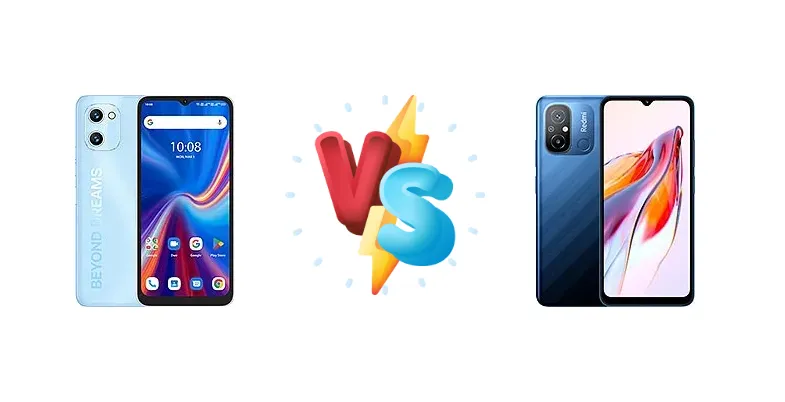
The sub-$150 smartphone market is fiercely competitive. The Umidigi C1 and Xiaomi Redmi 12C both aim to deliver essential smartphone functionality at an incredibly low price point. However, significant differences in their core hardware – specifically the chipset – dictate vastly different user experiences. This comparison dissects those differences to help you choose the right device for your needs.
🏆 Quick Verdict
For most users, the Xiaomi Redmi 12C is the better choice. Its Helio G85 chipset provides a substantial performance uplift over the Umidigi C1’s aging MT6739, making it noticeably smoother for everyday tasks and even light gaming. While both offer similar battery and charging capabilities, the Redmi 12C’s processing power justifies the price difference.
| Network |
|---|
| 2G bands | GSM 850 / 900 / 1800 / 1900 | GSM 850 / 900 / 1800 / 1900 |
| 3G bands | HSDPA 850 / 900 / 1700(AWS) / 1900 / 2100 | HSDPA 850 / 900 / 2100 |
| 4G bands | 1, 2, 3, 4, 5, 7, 8, 12, 17, 20, 28, 38, 40, 41 | 1, 3, 5, 7, 8, 20, 28, 38, 40, 41 - International |
| Speed | HSPA, LTE | HSPA, LTE |
| Technology | GSM / HSPA / LTE | GSM / CDMA / HSPA / EVDO / LTE |
| | - | CDMA2000 1xEV-DO |
| Launch |
|---|
| Announced | 2022 | 2022, December 31 |
| Status | Available. Released 2022 | Available. Released 2023, January 01 |
| Body |
|---|
| Dimensions | 164.2 x 76.4 x 8.8 mm (6.46 x 3.01 x 0.35 in) | 168.8 x 76.4 x 8.8 mm (6.65 x 3.01 x 0.35 in) |
| SIM | Nano-SIM + Nano-SIM | Nano-SIM + Nano-SIM |
| Weight | 192 g (6.77 oz) | 192 g (6.77 oz) |
| Display |
|---|
| Resolution | 720 x 1600 pixels, 20:9 ratio (~269 ppi density) | 720 x 1650 pixels (~268 ppi density) |
| Size | 6.52 inches, 102.6 cm2 (~81.8% screen-to-body ratio) | 6.71 inches, 106.5 cm2 (~82.6% screen-to-body ratio) |
| Type | IPS LCD | IPS LCD, 500 nits (typ) |
| Platform |
|---|
| CPU | Quad-core 1.5 GHz Cortex-A53 | Octa-core (2x2.0 GHz Cortex-A75 & 6x1.8 GHz Cortex-A55) |
| Chipset | Mediatek MT6739 (28 nm) | Mediatek MT6769Z Helio G85 (12 nm) |
| GPU | PowerVR GE8100 | Mali-G52 MC2 |
| OS | Android 13 | Android 12, MIUI 13 |
| Memory |
|---|
| Card slot | microSDXC (uses shared SIM slot) | microSDXC (dedicated slot) |
| Internal | 32GB 3GB RAM | 32GB 2GB RAM, 32GB 3GB RAM, 32GB 4GB RAM, 64GB 3GB RAM, 64GB 4GB RAM, 128GB 3GB RAM, 128GB 4GB RAM, 128GB 6GB RAM |
| | - | eMMC 5.1 |
| Main Camera |
|---|
| Dual | 13 MP, f/2.2, (wide), AF
Auxiliary lens | 50 MP, (wide), PDAF
0.08 MP (depth) |
| Features | Dual-LED flash | LED flash, HDR |
| Single | - | 50 MP, f/1.8, (wide), 1/2.76", PDAF
Auxiliary lens |
| Video | 1080p@30fps | 1080p@30fps |
| Selfie camera |
|---|
| Single | 5 MP, f/2.2, (wide) | 5 MP, f/2.2, (wide) |
| Video | 720p@30fps | 1080p@30fps |
| Sound |
|---|
| 3.5mm jack | - | Yes |
| 35mm jack | Yes | Yes |
| Loudspeaker | Yes | Yes |
| Comms |
|---|
| Bluetooth | 4.2, A2DP | 5.1, A2DP, LE |
| NFC | No | Yes (market/region dependent) |
| Positioning | GPS, GALILEO, GLONASS, BDS | GPS, GLONASS, BDS, GALILEO |
| Radio | No | FM radio |
| USB | USB Type-C, OTG | microUSB 2.0 |
| WLAN | Wi-Fi 802.11 b/g/n/ac, dual-band, Wi-Fi Direct | Wi-Fi 802.11 a/b/g/n/ac, dual-band, Wi-Fi Direct |
| Features |
|---|
| Sensors | Accelerometer, proximity, compass | Fingerprint (rear-mounted), accelerometer |
| | - | Virtual proximity sensing |
| Battery |
|---|
| Charging | 10W wired | 10W wired |
| Type | 5150 mAh | Li-Po 5000 mAh |
| Misc |
|---|
| Colors | Sunglow Gold, Galaxy Blue, Starry Black | Graphite Gray, Ocean Blue, Mint Green, Lavender Purple |
| Models | - | 22120RN86G, 22120RN86I, 22126RN91Y, 2212ARNC4L |
| Price | - | £ 132.99 / € 107.41 |
| SAR | - | 1.08 W/kg (head) 0.64 W/kg (body) |
| SAR EU | - | 0.98 W/kg (head) 0.99 W/kg (body) |
Umidigi C1
- Lowest possible price point
- Functional for basic communication
- Potentially longer software support (Umidigi's commitment is variable)
- Significantly slower performance
- Struggles with multitasking
- Poor gaming performance
Xiaomi Redmi 12C
- Much faster and smoother performance
- Better for multitasking and gaming
- More efficient processor for longer battery life
- Slightly higher price
- 10W charging is slow
- Software updates may be limited
Display Comparison
Neither device boasts a particularly impressive display. Details regarding panel type (IPS vs. TFT) and resolution are missing for both, but given the price point, IPS is likely on the Redmi 12C. The key difference lies in processing power impacting UI smoothness. While both will likely offer similar color accuracy, the Redmi 12C’s faster processor will translate to smoother scrolling and animations, making the display *feel* more responsive.
Camera Comparison
Both phones likely feature basic camera setups geared towards casual photography. Without specific sensor details, it’s difficult to make a definitive judgment. However, the Redmi 12C’s more powerful processor will likely enable better image processing, resulting in slightly improved image quality, particularly in low-light conditions. Expect both to struggle with dynamic range and detail. The presence of a 2MP macro lens on the Redmi 12C is largely marketing fluff; its utility is limited by the low resolution and lack of autofocus.
Performance
The performance gap is the defining factor here. The Umidigi C1’s Mediatek MT6739, built on a 28nm process, features a quad-core Cortex-A53 CPU clocked at 1.5 GHz. This is an older architecture struggling with modern workloads. Conversely, the Xiaomi Redmi 12C’s Mediatek Helio G85 (12nm) utilizes an octa-core configuration with a mix of Cortex-A75 (2x2.0 GHz) and Cortex-A55 (6x1.8 GHz) cores. The A75 cores provide a significant boost in single-core performance, crucial for app launch times and general responsiveness. The 12nm process also contributes to better power efficiency. This translates to a much smoother experience on the Redmi 12C, especially when multitasking or running multiple apps.
Battery Life
Both the Umidigi C1 and Xiaomi Redmi 12C feature 10W wired charging. While not fast by modern standards, it’s adequate for their battery capacities (details missing, but likely around 5000mAh for both). The Redmi 12C’s more efficient Helio G85 chipset will likely result in slightly better battery life, offsetting any potential difference in battery capacity. Expect both phones to last a full day with moderate usage, but heavy gaming or video streaming will drain the battery quickly.
Buying Guide
Buy the Umidigi C1 if you absolutely need the cheapest possible smartphone for basic communication – calls, texts, and very light app usage. It’s a viable option for those with minimal smartphone requirements and a tight budget. Buy the Xiaomi Redmi 12C if you prioritize a smoother, more responsive experience, even for simple tasks, and want the ability to run more demanding apps or play casual games without significant lag. The Redmi 12C offers a better long-term user experience.
Frequently Asked Questions
❓ Will the Redmi 12C be able to run popular social media apps like TikTok and Instagram smoothly?
Yes, the Helio G85 in the Redmi 12C is capable of running TikTok and Instagram without significant lag. While it won't offer a flagship-level experience, it will provide a much smoother and more enjoyable experience compared to the Umidigi C1's MT6739, which may struggle with these apps.
❓ Is the Umidigi C1 a good option for a first smartphone for a senior citizen?
The Umidigi C1 could be considered for a senior citizen who only needs basic functionality like calls, texts, and perhaps simple photo taking. However, its slow performance might be frustrating for even basic tasks. The Redmi 12C, while slightly more expensive, offers a much more user-friendly experience due to its faster processor.
❓ Can the Xiaomi Redmi 12C handle any mobile games?
The Redmi 12C can handle casual mobile games like Candy Crush or Subway Surfers without issue. More demanding games like PUBG Mobile will be playable at lower settings and frame rates. The MT6739 in the Umidigi C1 will struggle significantly with even basic mobile games.
❓ What about software updates? Which phone is more likely to receive them?
Software update support is a known weakness in this price segment. Xiaomi generally provides more consistent (though still limited) software updates than Umidigi. However, don't expect either phone to receive major Android version updates for an extended period.