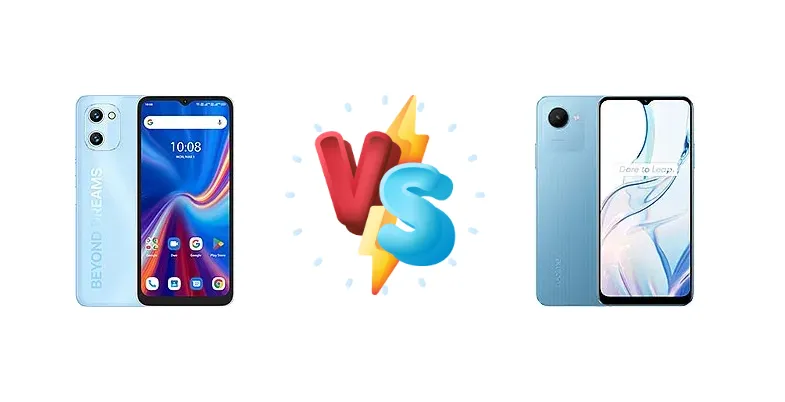
The Umidigi C1 and Realme C30s represent the ultra-budget end of the smartphone spectrum, targeting users prioritizing affordability above all else. While both aim to deliver basic smartphone functionality, significant differences in their core processing power and architecture dictate which device offers a smoother, more responsive experience. This comparison dissects these differences to determine the best value.
🏆 Quick Verdict
For the average user, the Realme C30s emerges as the better choice. Its octa-core Cortex-A55 CPU provides a noticeable performance advantage over the Umidigi C1’s quad-core Cortex-A53, resulting in snappier app loading and multitasking, despite both phones sharing the same 10W charging.
| Network |
|---|
| 2G bands | GSM 850 / 900 / 1800 / 1900 | GSM 850 / 900 / 1800 / 1900 |
| 3G bands | HSDPA 850 / 900 / 1700(AWS) / 1900 / 2100 | HSDPA 850 / 900 / 2100 |
| 4G bands | 1, 2, 3, 4, 5, 7, 8, 12, 17, 20, 28, 38, 40, 41 | 1, 3, 5, 8, 38, 40, 41 |
| Speed | HSPA, LTE | HSPA, LTE |
| Technology | GSM / HSPA / LTE | GSM / HSPA / LTE |
| Launch |
|---|
| Announced | 2022 | 2022, September 14 |
| Status | Available. Released 2022 | Available. Released 2022, September 23 |
| Body |
|---|
| Build | - | Glass front, plastic frame, plastic back |
| Dimensions | 164.2 x 76.4 x 8.8 mm (6.46 x 3.01 x 0.35 in) | 164.2 x 75.7 x 8.5 mm (6.46 x 2.98 x 0.33 in) |
| SIM | Nano-SIM + Nano-SIM | Nano-SIM + Nano-SIM |
| Weight | 192 g (6.77 oz) | 186 g (6.56 oz) |
| Display |
|---|
| Resolution | 720 x 1600 pixels, 20:9 ratio (~269 ppi density) | 720 x 1600 pixels, 20:9 ratio (~270 ppi density) |
| Size | 6.52 inches, 102.6 cm2 (~81.8% screen-to-body ratio) | 6.5 inches, 102.0 cm2 (~82.1% screen-to-body ratio) |
| Type | IPS LCD | IPS LCD |
| Platform |
|---|
| CPU | Quad-core 1.5 GHz Cortex-A53 | Octa-core 1.6 GHz Cortex-A55 |
| Chipset | Mediatek MT6739 (28 nm) | - |
| GPU | PowerVR GE8100 | IMG8322 |
| OS | Android 13 | Android 12, Realme UI Go |
| Memory |
|---|
| Card slot | microSDXC (uses shared SIM slot) | microSDXC (dedicated slot) |
| Internal | 32GB 3GB RAM | 32GB 2GB RAM, 32GB 3GB RAM, 64GB 3GB RAM, 64GB 4GB RAM |
| Main Camera |
|---|
| Dual | 13 MP, f/2.2, (wide), AF
Auxiliary lens | - |
| Features | Dual-LED flash | LED flash, HDR, panorama |
| Single | - | 8 MP, (wide), 1/4.0", 1.12µm |
| Video | 1080p@30fps | 1080p@30fps |
| Selfie camera |
|---|
| Features | - | HDR |
| Single | 5 MP, f/2.2, (wide) | 5 MP, (wide), 1/5.0", 1.12µm |
| Video | 720p@30fps | 720p@30fps |
| Sound |
|---|
| 3.5mm jack | - | Yes |
| 35mm jack | Yes | Yes |
| Loudspeaker | Yes | Yes |
| Comms |
|---|
| Bluetooth | 4.2, A2DP | 4.2, A2DP |
| NFC | No | No |
| Positioning | GPS, GALILEO, GLONASS, BDS | GPS, GLONASS |
| Radio | No | Unspecified |
| USB | USB Type-C, OTG | microUSB 2.0, OTG |
| WLAN | Wi-Fi 802.11 b/g/n/ac, dual-band, Wi-Fi Direct | Wi-Fi 802.11 b/g/n |
| Features |
|---|
| Sensors | Accelerometer, proximity, compass | Fingerprint (side-mounted), accelerometer, proximity |
| Battery |
|---|
| Charging | 10W wired | 10W wired |
| Type | 5150 mAh | 5000 mAh |
| Misc |
|---|
| Colors | Sunglow Gold, Galaxy Blue, Starry Black | Stripe Blue, Stripe Black |
| Models | - | RMX3690 |
| Price | - | About 100 EUR |
Umidigi C1
- Potentially lower price point
- Functional for basic smartphone tasks
- Simple and straightforward user experience
- Outdated quad-core processor
- Less responsive performance
- Potentially shorter battery life due to inefficient chipset
Realme C30s
- Octa-core Cortex-A55 processor for smoother performance
- More efficient chipset for potentially longer battery life
- Likely benefits from more recent software optimizations
- Slightly higher price compared to the Umidigi C1
- Still limited by the ultra-budget price segment
- Camera performance likely remains basic
Display Comparison
Neither Umidigi nor Realme provide display specifications beyond size. Given the price point, both likely utilize LCD panels with modest resolutions. The absence of data prevents a detailed comparison of brightness, color accuracy, or viewing angles. However, the Realme C30s, being a more recent release, *may* benefit from slight improvements in panel quality due to manufacturing advancements, though this is speculative.
Camera Comparison
Both devices likely feature basic camera setups geared towards casual photography. Without detailed sensor information, it’s difficult to make a definitive comparison. However, the Realme C30s, benefiting from a more modern software stack, *may* offer slightly improved image processing and noise reduction. The prevalence of low-resolution auxiliary cameras (often 2MP) in this segment suggests neither phone will excel in specialized photography like macro or depth sensing.
Performance
The core difference lies in the CPU. The Realme C30s boasts an octa-core 1.6 GHz Cortex-A55 processor, while the Umidigi C1 is equipped with a quad-core 1.5 GHz Cortex-A53. The Cortex-A55 architecture is a significant improvement over the A53, offering better performance per clock cycle and improved power efficiency. This translates to faster app launches, smoother scrolling, and a more responsive overall experience on the Realme C30s. The MT6739 chipset in the Umidigi C1, built on a 28nm process, is demonstrably older and less efficient, potentially leading to more noticeable slowdowns under load.
Battery Life
Both phones share the same 10W wired charging capability, suggesting similar charging times. Battery capacity is not specified, but given the target market, both likely feature batteries in the 4000-5000 mAh range. The Realme C30s’ more efficient Cortex-A55 processor could translate to slightly longer battery life in real-world usage, as it requires less power to perform the same tasks as the Umidigi C1’s older chipset.
Buying Guide
Buy the Umidigi C1 if you absolutely need the lowest possible price and your smartphone usage is limited to basic tasks like calls, texts, and light web browsing. Buy the Realme C30s if you prioritize a more responsive user experience, even for moderately demanding apps, and are willing to spend a small premium for improved performance and future-proofing.
Frequently Asked Questions
❓ Will the Umidigi C1 struggle with popular social media apps like Facebook and Instagram?
The Umidigi C1’s quad-core processor and older architecture may result in noticeable lag and slowdowns when using demanding apps like Facebook and Instagram, especially with multiple apps open simultaneously. The Realme C30s, with its octa-core processor, will handle these apps more smoothly.
❓ Is the Realme C30s a good option for playing mobile games?
Neither the Umidigi C1 nor the Realme C30s are designed for serious mobile gaming. However, the Realme C30s’ more powerful processor will provide a slightly better experience for casual games. Expect low graphics settings and potential frame rate drops in more demanding titles.
❓ How long will it take to fully charge both phones with the 10W charger?
Given the 10W charging speed and likely battery capacities in the 4000-5000 mAh range, expect a full charge to take approximately 3-4 hours for both devices. The Realme C30s’ more efficient chipset *may* slightly reduce this time, but the difference will be minimal.