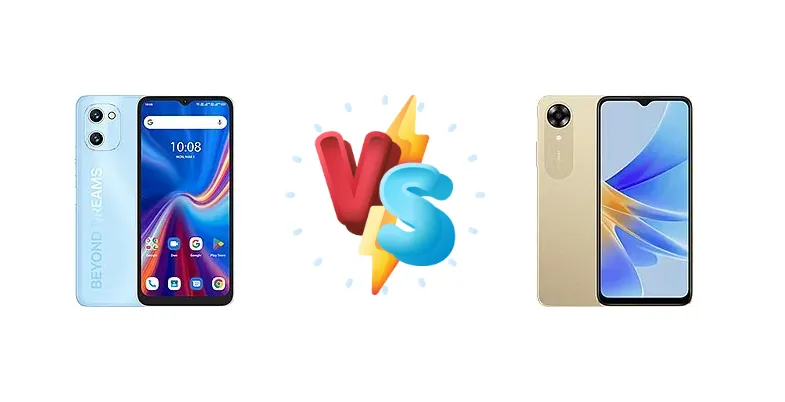
The Umidigi C1 and Oppo A17k represent the ultra-budget end of the smartphone spectrum, targeting users prioritizing affordability above all else. However, even within this segment, key differences in chipset architecture and processing power can significantly impact the user experience. This comparison dissects these differences to determine which device offers the best value.
🏆 Quick Verdict
For most users, the Oppo A17k is the superior choice. Its Helio G35 chipset, built on a more efficient 12nm process, delivers noticeably better performance than the Umidigi C1’s older MT6739. While both phones are entry-level, the A17k provides a smoother, more responsive experience for everyday tasks.
| Network |
|---|
| 2G bands | GSM 850 / 900 / 1800 / 1900 | GSM 850 / 900 / 1800 / 1900 |
| 3G bands | HSDPA 850 / 900 / 1700(AWS) / 1900 / 2100 | HSDPA 850 / 900 / 2100 |
| 4G bands | 1, 2, 3, 4, 5, 7, 8, 12, 17, 20, 28, 38, 40, 41 | 1, 3, 5, 8, 38, 40, 41 |
| Speed | HSPA, LTE | HSPA, LTE |
| Technology | GSM / HSPA / LTE | GSM / HSPA / LTE |
| Launch |
|---|
| Announced | 2022 | 2022, October 13 |
| Status | Available. Released 2022 | Available. Released 2022, October 18 |
| Body |
|---|
| Dimensions | 164.2 x 76.4 x 8.8 mm (6.46 x 3.01 x 0.35 in) | 164.2 x 75.6 x 8.3 mm (6.46 x 2.98 x 0.33 in) |
| SIM | Nano-SIM + Nano-SIM | Nano-SIM + Nano-SIM |
| Weight | 192 g (6.77 oz) | 189 g (6.67 oz) |
| | - | IPX4 water resistance |
| Display |
|---|
| Protection | - | Panda Glass |
| Resolution | 720 x 1600 pixels, 20:9 ratio (~269 ppi density) | 720 x 1612 pixels, 20:9 ratio (~269 ppi density) |
| Size | 6.52 inches, 102.6 cm2 (~81.8% screen-to-body ratio) | 6.56 inches, 103.4 cm2 (~83.3% screen-to-body ratio) |
| Type | IPS LCD | IPS LCD, 480 nits (typ), 600 nits (HBM) |
| Platform |
|---|
| CPU | Quad-core 1.5 GHz Cortex-A53 | Octa-core (4x2.3 GHz Cortex-A53 & 4x1.8 GHz Cortex-A53) |
| Chipset | Mediatek MT6739 (28 nm) | Mediatek MT6765 Helio G35 (12 nm) |
| GPU | PowerVR GE8100 | PowerVR GE8320 |
| OS | Android 13 | Android 12, ColorOS 12.1 |
| Memory |
|---|
| Card slot | microSDXC (uses shared SIM slot) | microSDXC |
| Internal | 32GB 3GB RAM | 64GB 3GB RAM |
| | - | eMMC 5.1 |
| Main Camera |
|---|
| Dual | 13 MP, f/2.2, (wide), AF
Auxiliary lens | - |
| Features | Dual-LED flash | LED flash, panorama |
| Single | - | 8 MP, f/2.0, (wide), AF |
| Video | 1080p@30fps | 1080p@30fps |
| Selfie camera |
|---|
| Single | 5 MP, f/2.2, (wide) | 5 MP, f/2.2, (wide) |
| Video | 720p@30fps | 1080p@30fps |
| Sound |
|---|
| 3.5mm jack | - | Yes |
| 35mm jack | Yes | Yes |
| Loudspeaker | Yes | Yes |
| Comms |
|---|
| Bluetooth | 4.2, A2DP | 5.3, A2DP, LE, aptX HD |
| NFC | No | No |
| Positioning | GPS, GALILEO, GLONASS, BDS | GPS, GLONASS, BDS, GALILEO |
| Radio | No | Unspecified |
| USB | USB Type-C, OTG | microUSB 2.0, OTG |
| WLAN | Wi-Fi 802.11 b/g/n/ac, dual-band, Wi-Fi Direct | Wi-Fi 802.11 a/b/g/n/ac, dual-band |
| Features |
|---|
| Sensors | Accelerometer, proximity, compass | Fingerprint (side-mounted), accelerometer, proximity, compass |
| Battery |
|---|
| Charging | 10W wired | - |
| Type | 5150 mAh | Li-Po 5000 mAh |
| Misc |
|---|
| Colors | Sunglow Gold, Galaxy Blue, Starry Black | Navy Blue, Gold |
| Models | - | CPH2471 |
| Price | - | About 130 EUR |
Umidigi C1
- Lowest possible price point
- Functional for basic communication
- Compact and lightweight
- Outdated and slow processor
- Poor multitasking performance
- Limited software support
Oppo A17k
- More powerful and efficient processor
- Smoother user experience
- Better multitasking capabilities
- Slightly higher price
- Still limited camera performance
- Slow charging speed
Display Comparison
Neither Umidigi nor Oppo provide detailed display specifications. Given the price point, both likely utilize LCD panels with 720p+ resolutions. However, the lack of information prevents a direct comparison of brightness, color accuracy, or viewing angles. Expect both displays to be adequate for basic use but not exceptional. Bezels are likely to be substantial on both devices, maximizing screen real estate within a compact form factor.
Camera Comparison
Detailed camera specifications are unavailable for either device. However, given the market segment, expect basic camera setups. The focus should not be on image quality, but rather on functionality. Both phones likely feature a primary camera and potentially a secondary depth sensor. Image processing will be limited, and low-light performance will be poor. The absence of Optical Image Stabilization (OIS) on either device further limits their photographic capabilities. Any 2MP macro cameras included should be considered largely marketing features with limited practical utility.
Performance
The core difference lies in the chipsets. The Umidigi C1’s Mediatek MT6739, fabricated on a 28nm process, features a quad-core Cortex-A53 CPU clocked at 1.5 GHz. This older architecture struggles with multitasking and demanding applications. Conversely, the Oppo A17k boasts the Mediatek MT6765 Helio G35, built on a more efficient 12nm process. Its octa-core configuration – four Cortex-A53 cores at 2.3 GHz and four at 1.8 GHz – provides a significant performance boost. The higher clock speeds and additional cores translate to faster app loading times, smoother scrolling, and improved responsiveness. The 12nm process also contributes to better thermal management, reducing the likelihood of throttling under sustained load.
Battery Life
Battery capacity details are missing for both devices. However, the Oppo A17k’s 12nm Helio G35 chipset offers a power efficiency advantage over the Umidigi C1’s 28nm MT6739. This means the A17k is likely to achieve comparable or better battery life despite potentially having a similar capacity. Both phones feature 10W wired charging, indicating relatively slow charging speeds. Expect several hours to fully charge from 0-100%.
Buying Guide
Buy the Umidigi C1 if you absolutely need the lowest possible price and your usage is limited to basic communication – calls, texts, and very light web browsing. It’s a functional device for those with minimal smartphone needs. Buy the Oppo A17k if you want a more capable device for social media, occasional gaming, and a generally smoother user experience, even if it means spending a little more. The A17k’s improved processor makes it a more future-proof option.
Frequently Asked Questions
❓ Will the Oppo A17k handle popular social media apps like Facebook and Instagram smoothly?
Yes, the Helio G35 chipset in the Oppo A17k provides sufficient processing power for smooth operation of most social media applications. While it won't offer a flagship-level experience, it will handle scrolling, image loading, and video playback without significant lag, unlike the Umidigi C1 which may struggle.
❓ Is the Umidigi C1 suitable for playing mobile games?
The Umidigi C1 is not well-suited for gaming. The MT6739 chipset is underpowered for even basic mobile games, and you'll likely experience significant frame rate drops and lag. The Oppo A17k, while not a gaming phone, offers a marginally better experience for casual gaming due to its more powerful processor.
❓ What Android version do these phones ship with, and will they receive updates?
Both devices likely ship with Android Go Edition, a lightweight version of Android designed for low-end hardware. Software update support is typically limited on phones in this price range. Expect minimal or no major Android version updates, and security patches may be infrequent. The Oppo A17k, being from a larger brand, *might* receive slightly more consistent updates, but this is not guaranteed.
❓ How much storage do these phones typically offer, and is it expandable?
Both phones typically come with 32GB of internal storage, which is quite limited. Fortunately, both devices support microSD card expansion, allowing you to add more storage for photos, videos, and apps. This is crucial given the limited internal space.