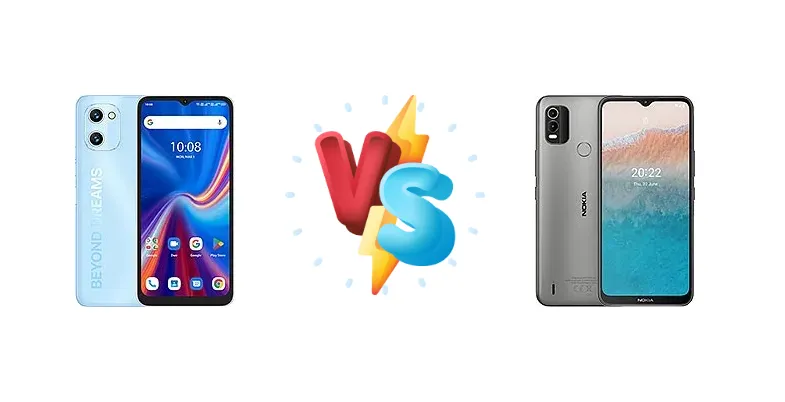
The Umidigi C1 and Nokia C21 Plus represent the extreme end of the smartphone price spectrum, targeting users who prioritize affordability above all else. Both devices aim to deliver a functional Android experience without breaking the bank, but they take different approaches to achieving this goal, primarily in their core processing power. This comparison will dissect the key differences to help you determine which device best suits your needs.
🏆 Quick Verdict
For the average user, the Nokia C21 Plus is the better choice. While both phones share a 10W charging rate and similar price points, the Nokia’s Unisoc SC9863A octa-core processor provides a noticeable performance advantage over the Umidigi C1’s quad-core Mediatek MT6739, resulting in a smoother user experience.
| Network |
|---|
| 2G bands | GSM 850 / 900 / 1800 / 1900 | GSM 850 / 900 / 1800 / 1900 |
| 3G bands | HSDPA 850 / 900 / 1700(AWS) / 1900 / 2100 | HSDPA 850 / 900 / 2100 |
| 4G bands | 1, 2, 3, 4, 5, 7, 8, 12, 17, 20, 28, 38, 40, 41 | LTE |
| Speed | HSPA, LTE | HSPA 42.2/5.76 Mbps, LTE Cat4 150/50 Mbps |
| Technology | GSM / HSPA / LTE | GSM / HSPA / LTE |
| | - | HSDPA 850 / 900 / 1700(AWS) / 1900 / 2100 |
| Launch |
|---|
| Announced | 2022 | 2022, February 28 |
| Status | Available. Released 2022 | Available. Released 2022, April 29 |
| Body |
|---|
| Build | - | Glass front, aluminum frame, plastic back |
| Dimensions | 164.2 x 76.4 x 8.8 mm (6.46 x 3.01 x 0.35 in) | 164.8 x 75.9 x 8.6 mm (6.49 x 2.99 x 0.34 in) |
| SIM | Nano-SIM + Nano-SIM | · Nano-SIM· Nano-SIM + Nano-SIM |
| Weight | 192 g (6.77 oz) | 178 g or 191 g (6.28 oz) |
| | - | Splash protection |
| Display |
|---|
| Protection | - | Scratch-resistant glass |
| Resolution | 720 x 1600 pixels, 20:9 ratio (~269 ppi density) | 720 x 1600 pixels, 20:9 ratio (~269 ppi density) |
| Size | 6.52 inches, 102.6 cm2 (~81.8% screen-to-body ratio) | 6.52 inches, 102.6 cm2 (~82.1% screen-to-body ratio) |
| Type | IPS LCD | IPS LCD |
| Platform |
|---|
| CPU | Quad-core 1.5 GHz Cortex-A53 | Octa-core (4x1.6 GHz Cortex-A55 & 4x1.2 GHz Cortex-A55) |
| Chipset | Mediatek MT6739 (28 nm) | Unisoc SC9863A (28 nm) |
| GPU | PowerVR GE8100 | IMG8322 |
| OS | Android 13 | Android 11 (Go edition) |
| Memory |
|---|
| Card slot | microSDXC (uses shared SIM slot) | microSDXC (dedicated slot) |
| Internal | 32GB 3GB RAM | 32GB 2GB RAM, 32GB 3GB RAM, 64GB 2GB RAM, 64GB 3GB RAM, 64GB 4GB RAM |
| | - | eMMC 5.1 |
| Main Camera |
|---|
| Dual | 13 MP, f/2.2, (wide), AF
Auxiliary lens | 13 MP, (wide), AF
Auxiliary lens |
| Features | Dual-LED flash | LED flash, HDR, panorama |
| Single | - | 5 MP |
| Video | 1080p@30fps | 1080p@30fps |
| Selfie camera |
|---|
| Features | - | LED flash |
| Single | 5 MP, f/2.2, (wide) | 5 MP |
| Video | 720p@30fps | 720p |
| Sound |
|---|
| 3.5mm jack | - | Yes |
| 35mm jack | Yes | Yes |
| Loudspeaker | Yes | Yes |
| Comms |
|---|
| Bluetooth | 4.2, A2DP | 4.2, A2DP |
| NFC | No | No |
| Positioning | GPS, GALILEO, GLONASS, BDS | GPS |
| Radio | No | FM radio |
| USB | USB Type-C, OTG | microUSB 2.0 |
| WLAN | Wi-Fi 802.11 b/g/n/ac, dual-band, Wi-Fi Direct | Wi-Fi 802.11 b/g/n |
| Features |
|---|
| Sensors | Accelerometer, proximity, compass | Fingerprint (rear-mounted), accelerometer, proximity |
| Battery |
|---|
| Charging | 10W wired | 10W wired |
| Type | 5150 mAh | Li-Ion 4000/5050 mAh |
| Misc |
|---|
| Colors | Sunglow Gold, Galaxy Blue, Starry Black | Dark Cyan, Warm Gray |
| Models | - | TA-1433, TA-1431, TA-1426, TA-1424 |
| Price | - | About 120 EUR |
| SAR | - | 0.57 W/kg (head) 0.65 W/kg (body) |
| SAR EU | - | 0.40 W/kg (head) 0.99 W/kg (body) |
Umidigi C1
- Potentially lower price point (depending on retailer)
- Simple and straightforward Android experience
- Compact and lightweight design
- Quad-core processor struggles with multitasking
- Limited performance for modern apps
- May experience lag and slowdowns
Nokia C21 Plus
- Octa-core processor offers smoother performance
- Better multitasking capabilities
- More responsive user interface
- 10W charging is slow
- Camera quality is likely basic
- May still struggle with graphically intensive games
Display Comparison
Neither Umidigi nor Nokia provide detailed display specifications beyond resolution. Given the price point, both likely utilize IPS LCD panels. The focus here isn't on display quality, but rather on the processing power needed to drive the UI smoothly. Bezels are expected to be substantial on both devices, maximizing screen real estate within a compact form factor. Color accuracy and brightness are likely to be average, suitable for indoor use but potentially washed out in direct sunlight.
Camera Comparison
Both phones are expected to feature basic camera setups. Detailed sensor information is lacking, but it’s safe to assume both will include a primary camera and potentially a secondary depth or macro sensor. Given the target market, image quality will be adequate for casual snapshots in good lighting conditions, but expect limited performance in low light. Focusing on megapixel counts would be misleading; the image signal processor (ISP) within the chipset plays a more crucial role, and the Nokia’s more powerful processor likely provides a slight edge in image processing.
Performance
The core difference lies in the chipsets. The Umidigi C1’s Mediatek MT6739 is a quad-core processor built on a 28nm process. In contrast, the Nokia C21 Plus boasts the Unisoc SC9863A, an octa-core processor (4x1.6 GHz Cortex-A55 & 4x1.2 GHz Cortex-A55) also on a 28nm node. The octa-core configuration of the Nokia provides a significant advantage in multitasking and handling more demanding applications. While both use Cortex-A53/A55 cores, the sheer number of cores on the Nokia translates to better parallel processing capabilities. This means smoother app switching and a more responsive user interface. The MT6739 will likely struggle with even moderate multitasking.
Battery Life
Both devices feature 10W wired charging, indicating similar charging speeds. Actual battery life will depend on usage patterns, but the Nokia C21 Plus’s more efficient octa-core processor may contribute to slightly longer battery endurance, even if the battery capacities are similar (which is not specified in the provided data). The 10W charging rate means a full charge will take a considerable amount of time – likely several hours – regardless of which phone you choose.
Buying Guide
Buy the Umidigi C1 if you need a basic smartphone for extremely light tasks like calls, texts, and occasional WhatsApp messaging, and are prioritizing the absolute lowest possible price. Buy the Nokia C21 Plus if you prefer a more responsive experience for everyday tasks like browsing, social media, and light multitasking, and value the benefits of an octa-core processor even within this budget segment.
Frequently Asked Questions
❓ Will the Nokia C21 Plus handle popular social media apps like Facebook and Instagram smoothly?
Yes, the Nokia C21 Plus’s octa-core processor is significantly better equipped to handle the demands of social media apps compared to the Umidigi C1’s quad-core chip. You should experience smoother scrolling, faster loading times, and fewer instances of lag while using these apps.
❓ Is the Unisoc SC9863A processor in the Nokia C21 Plus known for overheating?
The Unisoc SC9863A is a low-power processor designed for efficiency, not high performance. Overheating is unlikely to be a significant issue, even during extended use. Both phones utilize a 28nm process, which is less efficient than newer nodes, but the processor's low TDP mitigates the risk of thermal throttling.
❓ Can either of these phones run multiple apps simultaneously without slowing down?
The Nokia C21 Plus is better suited for multitasking. While neither phone is a multitasking powerhouse, the octa-core processor allows for smoother switching between a few apps. The Umidigi C1 will likely struggle with even two or three apps open at once, leading to noticeable slowdowns.