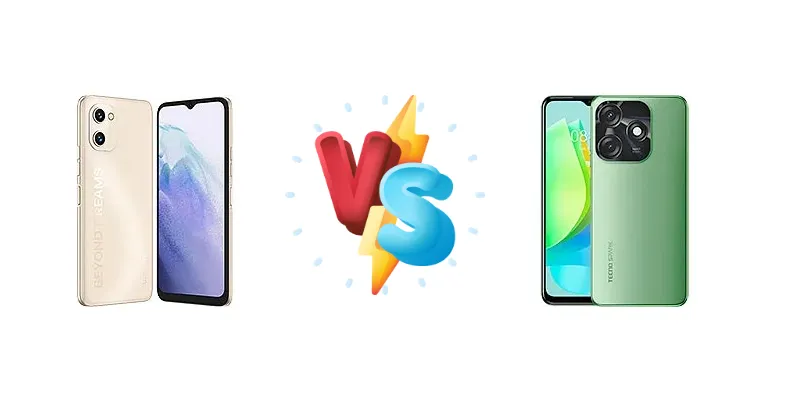
The sub-$150 smartphone market is fiercely competitive. The Umidigi C1 Plus and Tecno Spark 10C both aim to deliver essential smartphone functionality at an accessible price point, but they take different approaches to achieving this. The C1 Plus relies on a tried-and-true MediaTek chipset, while the Spark 10C opts for the newer, more efficient Unisoc T606. This comparison will dissect their key differences to help you choose the right device.
🏆 Quick Verdict
For most users, the Tecno Spark 10C is the better choice. Its Unisoc T606 chipset, featuring a more modern architecture with Cortex-A75 cores, provides a noticeable performance uplift over the Umidigi C1 Plus’s older Mediatek MT8766. The 18W charging is also a significant advantage, offsetting the potentially smaller battery capacity (not specified in provided data).
| Network |
|---|
| 2G bands | GSM 850 / 900 / 1800 / 1900 | GSM 850 / 900 / 1800 / 1900 |
| 3G bands | HSDPA 850 / 900 / 1700(AWS) / 1900 / 2100 | HSDPA 850 / 900 / 2100 |
| 4G bands | 1, 2, 3, 4, 5, 7, 8, 12, 17, 20, 28, 38, 40, 41 | LTE |
| Speed | HSPA, LTE | HSPA, LTE |
| Technology | GSM / HSPA / LTE | GSM / HSPA / LTE |
| Launch |
|---|
| Announced | 2023 | 2023, March 23 |
| Status | Available. Released 2023 | Available. Released 2023, March 29 |
| Body |
|---|
| Build | - | Glass front, plastic frame, plastic back |
| Dimensions | 164.2 x 76.4 x 8.8 mm (6.46 x 3.01 x 0.35 in) | 163.9 x 75.5 x 8.5 mm (6.45 x 2.97 x 0.33 in) |
| SIM | Nano-SIM + Nano-SIM | Nano-SIM + Nano-SIM |
| Weight | 192 g (6.77 oz) | - |
| Display |
|---|
| Resolution | 720 x 1600 pixels, 20:9 ratio (~269 ppi density) | 720 x 1612 pixels, 20:9 ratio (~267 ppi density) |
| Size | 6.52 inches, 102.6 cm2 (~81.8% screen-to-body ratio) | 6.6 inches, 104.6 cm2 (~84.6% screen-to-body ratio) |
| Type | IPS LCD | IPS LCD, 90Hz |
| Platform |
|---|
| CPU | Quad-core 1.5 GHz Cortex-A53 | Octa-core (2x1.6 GHz Cortex-A75 & 6x1.6 GHz Cortex-A55) |
| Chipset | Mediatek MT8766 | Unisoc T606 (12 nm) |
| GPU | PowerVR GE8300 | Mali-G57 MP1 |
| OS | Android 13 | Android 12, HIOS 8.6 |
| Memory |
|---|
| Card slot | microSDXC (uses shared SIM slot) | microSDXC (dedicated slot) |
| Internal | 32GB 3GB RAM | 64GB 4GB RAM, 128GB 4GB RAM, 128GB 8GB RAM |
| Main Camera |
|---|
| Dual | 13 MP, f/2.2, (wide), AF
Auxiliary lens | 16 MP, (wide), PDAF
0.08 MP, (depth) |
| Features | Dual-LED flash | Dual-LED flash, HDR, panorama |
| Single | - | 16 MP, (wide), PDAF
Auxiliary lens |
| Video | 1080p@30fps | 1080p@30fps |
| Selfie camera |
|---|
| Features | - | Dual-LED flash |
| Single | 5 MP, f/2.2, (wide) | 8 MP, (wide) |
| Video | 720p@30fps | 1080p@30fps |
| Sound |
|---|
| 3.5mm jack | - | Yes |
| 35mm jack | Yes | Yes |
| Loudspeaker | Yes | Yes |
| Comms |
|---|
| Bluetooth | 4.2, A2DP | Yes |
| NFC | No | No |
| Positioning | GPS, GLONASS, GALILEO, BDS | GPS |
| Radio | No | FM radio |
| USB | USB Type-C, OTG | USB Type-C 2.0 |
| WLAN | Wi-Fi 802.11 b/g/n/ac, dual-band, Wi-Fi Direct | Wi-Fi 802.11 a/b/g/n/ac, dual-band |
| Features |
|---|
| Sensors | Fingerprint (side-mounted), accelerometer, proximity, compass | Fingerprint (side-mounted), accelerometer, proximity, compass |
| Battery |
|---|
| Charging | 10W wired | 18W wired |
| Type | 5150 mAh | 5000 mAh |
| Misc |
|---|
| Colors | Starry Black, Sunglow Gold | Black, Blue, Green |
| Models | - | KI5k, KI5m |
| Price | - | ₹ 9,990 |
Umidigi C1 Plus
- Potentially lower price point.
- Simple and straightforward user experience.
- Reliable MediaTek chipset (though dated).
- Outdated processor architecture.
- Slow charging speed (10W).
- Likely limited multitasking capabilities.
Tecno Spark 10C
- More powerful and efficient Unisoc T606 chipset.
- Faster 18W wired charging.
- Improved multitasking and app responsiveness.
- May be slightly more expensive.
- Unisoc chipset may have less software optimization compared to MediaTek.
- Potential for bloatware (typical of Tecno).
Display Comparison
Neither device’s display specifications are provided, so a direct comparison is limited. However, given the price bracket, both likely utilize IPS LCD panels. The absence of details like resolution or refresh rate suggests a focus on cost reduction. Bezels are likely to be substantial on both, and color accuracy will likely be standard for this segment. The user experience will likely be similar in terms of visual fidelity.
Camera Comparison
Without sensor details, a detailed camera comparison is impossible. However, it’s safe to assume both phones feature basic camera setups geared towards casual photography. The prevalence of 2MP macro lenses in this segment suggests both devices likely include one, but their utility is limited due to the small sensor size and lack of optical image stabilization (OIS). Image processing will likely be software-driven, prioritizing scene recognition over nuanced detail. The device with the larger primary sensor (if known) would have an advantage in low-light conditions.
Performance
The core difference lies in the chipsets. The Umidigi C1 Plus’s Mediatek MT8766 utilizes a quad-core Cortex-A53 configuration clocked at 1.5 GHz. This is an older architecture, designed for efficiency but lacking in raw processing power. The Tecno Spark 10C’s Unisoc T606, built on a 12nm process, boasts an octa-core setup with 2x 1.6 GHz Cortex-A75 cores and 6x 1.6 GHz Cortex-A55 cores. The Cortex-A75 cores represent a significant architectural leap, offering substantially improved single-core performance – crucial for responsive app launches and smoother UI navigation. This translates to a more fluid experience for everyday tasks on the Tecno Spark 10C.
Battery Life
Battery capacity isn’t specified for either device. However, the Tecno Spark 10C’s 18W wired charging is a clear advantage over the Umidigi C1 Plus’s 10W charging. Even with a similar battery capacity, the Spark 10C will significantly reduce charging times. The more efficient Unisoc T606 chipset may also contribute to better battery life during typical usage, offsetting any potential capacity differences.
Buying Guide
Buy the Umidigi C1 Plus if you prioritize absolute lowest cost and are comfortable with a more basic user experience. It's suitable for users who primarily need a phone for calls, texts, and very light app usage. Buy the Tecno Spark 10C if you value smoother multitasking, faster app loading times, and quicker charging. This phone is better suited for users who consume media, browse the web, and occasionally play casual games.
Frequently Asked Questions
❓ Will the Unisoc T606 in the Tecno Spark 10C handle popular social media apps like TikTok and Instagram smoothly?
Yes, the Unisoc T606’s octa-core architecture, particularly the Cortex-A75 cores, provides sufficient processing power for smooth operation of popular social media apps. You should experience minimal lag when scrolling through feeds or recording videos, a noticeable improvement over the older Mediatek MT8766.
❓ Is the 10W charging on the Umidigi C1 Plus noticeably slow in daily use?
Yes, 10W charging is considerably slower than the 18W charging on the Tecno Spark 10C. Expect a significantly longer time to fully charge the Umidigi C1 Plus, potentially taking several hours from a low battery level. This can be inconvenient for users who need a quick power boost.
❓ Does the Tecno Spark 10C’s Unisoc chipset have any known overheating issues during prolonged use?
The Unisoc T606 is generally known for its efficiency and thermal management. While it may warm up during extended gaming sessions, it’s unlikely to experience significant overheating issues that would lead to performance throttling. The 12nm process contributes to better heat dissipation compared to older, larger node chipsets.