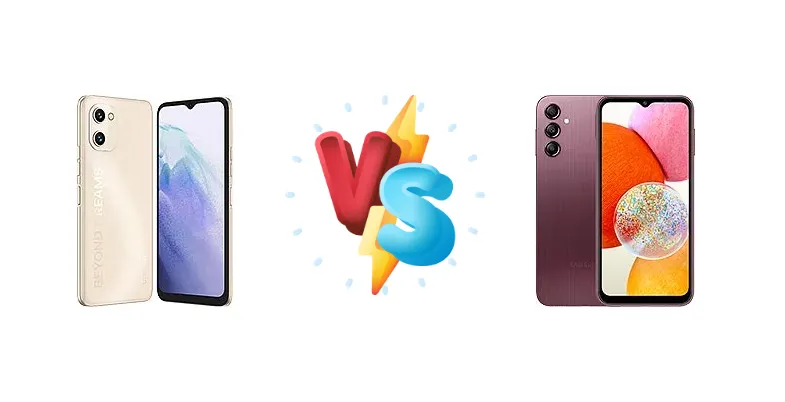
The sub-$200 smartphone market is fiercely competitive. The Umidigi C1 Plus and Samsung Galaxy A14 both aim to deliver essential smartphone functionality at an accessible price point, but they take different approaches. The C1 Plus prioritizes affordability, while the A14 attempts to balance features with Samsung’s brand recognition and software support. This comparison dissects their key differences to determine which device offers the best value.
🏆 Quick Verdict
For most users, the Samsung Galaxy A14 is the better choice. While the Umidigi C1 Plus is cheaper, the A14’s significantly more powerful processor – offering both Helio G80 and Exynos 850 variants – provides a smoother, more responsive experience, justifying the price difference. The A14 also benefits from Samsung’s software updates and broader ecosystem.
| Network |
|---|
| 2G bands | GSM 850 / 900 / 1800 / 1900 | GSM 850 / 900 / 1800 / 1900 |
| 3G bands | HSDPA 850 / 900 / 1700(AWS) / 1900 / 2100 | HSDPA 850 / 900 / 2100 |
| 4G bands | 1, 2, 3, 4, 5, 7, 8, 12, 17, 20, 28, 38, 40, 41 | 1, 3, 5, 7, 8, 20, 28, 38, 40, 41 |
| Speed | HSPA, LTE | HSPA, LTE |
| Technology | GSM / HSPA / LTE | GSM / HSPA / LTE |
| Launch |
|---|
| Announced | 2023 | 2023, February 28 |
| Status | Available. Released 2023 | Available. Released 2023, March 27 |
| Body |
|---|
| Build | - | Glass front, plastic back, plastic frame |
| Dimensions | 164.2 x 76.4 x 8.8 mm (6.46 x 3.01 x 0.35 in) | 167.7 x 78 x 9.1 mm (6.60 x 3.07 x 0.36 in) |
| SIM | Nano-SIM + Nano-SIM | · Nano-SIM· Nano-SIM + Nano-SIM |
| Weight | 192 g (6.77 oz) | 201 g (7.09 oz) |
| Display |
|---|
| Resolution | 720 x 1600 pixels, 20:9 ratio (~269 ppi density) | 1080 x 2408 pixels, 20:9 ratio (~400 ppi density) |
| Size | 6.52 inches, 102.6 cm2 (~81.8% screen-to-body ratio) | 6.6 inches, 104.9 cm2 (~80.2% screen-to-body ratio) |
| Type | IPS LCD | PLS LCD |
| Platform |
|---|
| CPU | Quad-core 1.5 GHz Cortex-A53 | Octa-core (2x2.0 GHz Cortex-A75 & 6x1.8 GHz Cortex-A55) - Version AOcta-core (4x2.0 GHz Cortex-A55 & 4x2.0 GHz Cortex-A55) - Version B |
| Chipset | Mediatek MT8766 | Mediatek MT6769 Helio G80 (12 nm) - Version AExynos 850 (8 nm) - Version B |
| GPU | PowerVR GE8300 | Mali-G52 MC2 |
| OS | Android 13 | Android 13, upgradable to Android 15, One UI 7 |
| Memory |
|---|
| Card slot | microSDXC (uses shared SIM slot) | microSDXC (dedicated slot) |
| Internal | 32GB 3GB RAM | 64GB 4GB RAM, 128GB 4GB RAM, 128GB 6GB RAM |
| Main Camera |
|---|
| Dual | 13 MP, f/2.2, (wide), AF
Auxiliary lens | - |
| Features | Dual-LED flash | LED flash, panorama, HDR |
| Single | - | 13 MP, f/2.0, (wide) |
| Triple | - | 50 MP, f/1.8, 26mm (wide), 1/2.75", 0.64µm, PDAF
5 MP, f/2.2, 17mm (ultrawide), 1/5.0", 1.12µm
2 MP (macro) |
| Video | 1080p@30fps | 1080p@30fps |
| Selfie camera |
|---|
| Single | 5 MP, f/2.2, (wide) | 13 MP, f/2.0, 26mm (wide), 1/3.1", 1.12µm |
| Video | 720p@30fps | 1080p@30fps |
| Sound |
|---|
| 3.5mm jack | - | Yes |
| 35mm jack | Yes | Yes |
| Loudspeaker | Yes | Yes |
| Comms |
|---|
| Bluetooth | 4.2, A2DP | 5.1 or 5.3, A2DP, LE |
| NFC | No | Yes (market/region dependent) |
| Positioning | GPS, GLONASS, GALILEO, BDS | GPS, GALILEO, GLONASS, BDS, QZSS |
| Radio | No | Unspecified |
| USB | USB Type-C, OTG | USB Type-C 2.0 |
| WLAN | Wi-Fi 802.11 b/g/n/ac, dual-band, Wi-Fi Direct | Wi-Fi 802.11 a/b/g/n/ac, dual-band, Wi-Fi Direct |
| Features |
|---|
| Sensors | Fingerprint (side-mounted), accelerometer, proximity, compass | Fingerprint (side-mounted), accelerometer, proximity, compass |
| Battery |
|---|
| Charging | 10W wired | 15W wired |
| Type | 5150 mAh | Li-Po 5000 mAh |
| Misc |
|---|
| Colors | Starry Black, Sunglow Gold | Black, Dark Red, Silver, Green |
| Models | - | SM-A145F, SM-A145F/DSN, SM-A145M, SM-A145M/DS, SM-A145P, SM-A145R |
| Price | - | € 85.76 / $ 147.60 / £ 79.95 |
| SAR EU | - | 0.46 W/kg (head) 1.37 W/kg (body) |
Umidigi C1 Plus
- Lowest possible price point
- Acceptable battery life for basic use
- Functional for essential smartphone tasks
- Very slow processor
- Limited software support
- Likely poor camera performance
Samsung Galaxy A14
- Significantly faster processor (Helio G80 or Exynos 850)
- Samsung’s software and update support
- Faster charging (15W)
- Higher price than the Umidigi C1 Plus
- Display quality is not exceptional
- 2MP macro camera is largely ineffective
Display Comparison
Neither device boasts a standout display. Specifics regarding panel type (IPS vs. LCD) and resolution are missing for the Umidigi C1 Plus, suggesting a basic implementation. The Samsung Galaxy A14, while also likely IPS LCD, benefits from Samsung’s display tuning. The real difference lies in processing power impacting UI smoothness. The A14’s faster processor will translate to smoother scrolling and animations, even if the raw display specs are similar. Bezels are expected to be substantial on both devices given their price points.
Camera Comparison
Camera performance is likely to be similar in real-world usage, with both devices relying on budget sensors. Details regarding sensor sizes are unavailable for both, but given the price point, expectations should be tempered. The A14 likely benefits from Samsung’s image processing algorithms, potentially delivering more pleasing results in good lighting conditions. The presence of a 2MP macro camera on the A14 is largely a marketing gimmick; its image quality will be limited. The C1 Plus’s camera specs are unknown, but it’s unlikely to offer any significant advantage.
Performance
This is where the A14 pulls decisively ahead. The Umidigi C1 Plus’s Mediatek MT8766, featuring a quad-core 1.5 GHz Cortex-A53 CPU, is an entry-level chipset designed for minimal tasks. The Galaxy A14, however, offers two chipset options: the Mediatek Helio G80 (12nm) and the Exynos 850 (8nm). Both are significantly more capable. The Helio G80’s octa-core configuration (2x2.0 GHz Cortex-A75 & 6x1.8 GHz Cortex-A55) provides a substantial performance boost over the C1 Plus, while the Exynos 850, built on a smaller 8nm process, offers even better efficiency and sustained performance. The A14’s CPU architecture is far more modern, resulting in faster app loading times and smoother multitasking. The C1 Plus will struggle with demanding applications.
Battery Life
Both phones offer adequate battery life for typical usage. The A14’s 15W wired charging is a slight advantage over the C1 Plus’s 10W charging, meaning faster top-ups. While the A14’s battery capacity is not specified, Samsung generally optimizes its software for battery efficiency. The C1 Plus’s less powerful processor may also contribute to decent battery life, but the slower charging speed will be noticeable.
Buying Guide
Buy the Umidigi C1 Plus if you absolutely need the lowest possible price and your smartphone usage is limited to basic tasks like calls, texts, and light web browsing. You’re willing to accept slower performance and limited software support. Buy the Samsung Galaxy A14 if you prioritize a more fluid user experience, better performance for multitasking and casual gaming, and the assurance of Samsung’s software updates and brand reliability, even if it means spending a bit more.
Frequently Asked Questions
❓ Does the Exynos 850 chip in the Galaxy A14 overheat during prolonged gaming sessions?
The Exynos 850 is an 8nm chip, meaning it's relatively efficient. While it's not a gaming powerhouse, it's unlikely to overheat significantly during moderate gaming. Sustained, high-intensity gaming may cause some throttling, but it shouldn't lead to uncomfortable temperatures or system crashes.
❓ Is the 2MP macro camera on the Samsung Galaxy A14 worth using?
Generally, no. 2MP macro cameras on budget phones often produce images with low detail and limited dynamic range. They are primarily a marketing feature and rarely deliver satisfying results. You're better off using the main camera and cropping in for close-up shots.
❓ Can the Umidigi C1 Plus handle popular social media apps like TikTok and Instagram smoothly?
The Umidigi C1 Plus will likely struggle with smooth operation of apps like TikTok and Instagram, especially when multitasking. The MT8766 processor is underpowered for these demanding applications, leading to lag and stuttering. Basic usage is possible, but don't expect a fluid experience.
❓ How long will it take to fully charge the Samsung Galaxy A14 with the 15W charger?
A full charge from 0% to 100% with the 15W charger will likely take around 2 to 2.5 hours, depending on usage during charging. While not the fastest charging available, it's a noticeable improvement over the Umidigi C1 Plus’s 10W charging.