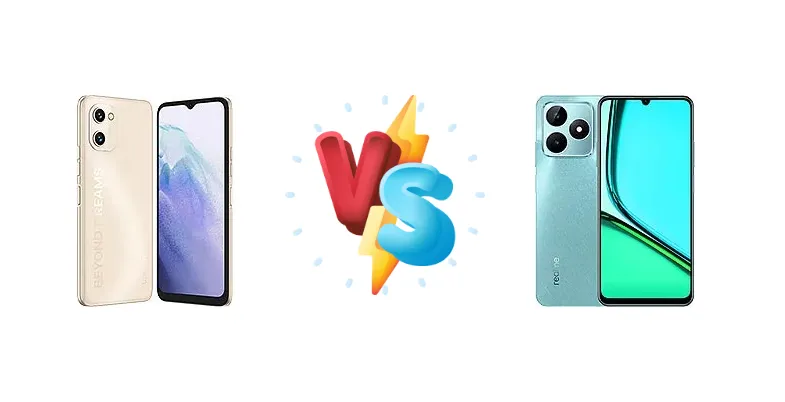
The sub-$150 smartphone market is fiercely competitive. The Umidigi C1 Plus represents a value-focused approach, while the Realme C51s aims to deliver a more refined experience with a newer chipset and faster charging. This comparison dissects the core differences to help you choose the right device for your needs.
🏆 Quick Verdict
For most users, the Realme C51s is the superior choice. Its Unisoc Tiger T612 chipset provides a noticeable performance boost over the Umidigi C1 Plus’s Mediatek MT8766, and the 33W charging is a game-changer in this price bracket. While the C1 Plus offers a lower entry price, the C51s delivers better long-term usability.
| Network |
|---|
| 2G bands | GSM 850 / 900 / 1800 / 1900 | GSM 850 / 900 / 1800 / 1900 |
| 3G bands | HSDPA 850 / 900 / 1700(AWS) / 1900 / 2100 | HSDPA 900 / 2100 |
| 4G bands | 1, 2, 3, 4, 5, 7, 8, 12, 17, 20, 28, 38, 40, 41 | 1, 3, 5, 8, 38, 40 |
| Speed | HSPA, LTE | HSPA, LTE |
| Technology | GSM / HSPA / LTE | GSM / HSPA / LTE |
| Launch |
|---|
| Announced | 2023 | 2024, March 15 |
| Status | Available. Released 2023 | Available. Released 2024, March 15 |
| Body |
|---|
| Build | - | Glass front, plastic frame, plastic back |
| Dimensions | 164.2 x 76.4 x 8.8 mm (6.46 x 3.01 x 0.35 in) | 167.2 x 76.7 x 7.5 mm (6.58 x 3.02 x 0.30 in) |
| SIM | Nano-SIM + Nano-SIM | Nano-SIM + Nano-SIM |
| Weight | 192 g (6.77 oz) | 182 g (6.42 oz) |
| Display |
|---|
| Resolution | 720 x 1600 pixels, 20:9 ratio (~269 ppi density) | 720 x 1600 pixels, 20:9 ratio (~260 ppi density) |
| Size | 6.52 inches, 102.6 cm2 (~81.8% screen-to-body ratio) | 6.74 inches, 109.7 cm2 (~85.5% screen-to-body ratio) |
| Type | IPS LCD | IPS LCD, 90Hz, 560 nits (peak) |
| Platform |
|---|
| CPU | Quad-core 1.5 GHz Cortex-A53 | Octa-core (2x1.8 GHz Cortex-A75 & 6x1.8 GHz Cortex-A55) |
| Chipset | Mediatek MT8766 | Unisoc Tiger T612 (12 nm) |
| GPU | PowerVR GE8300 | Mali-G57 |
| OS | Android 13 | Android 13, Realme UI |
| Memory |
|---|
| Card slot | microSDXC (uses shared SIM slot) | microSDXC (dedicated slot) |
| Internal | 32GB 3GB RAM | 128GB 6GB RAM |
| Main Camera |
|---|
| Dual | 13 MP, f/2.2, (wide), AF
Auxiliary lens | - |
| Features | Dual-LED flash | LED flash, HDR, panorama |
| Single | - | 50 MP, f/1.8, 27mm (wide), 1/2.76", 0.64µm, PDAF
Auxiliary lens |
| Video | 1080p@30fps | 1080p@30fps |
| Selfie camera |
|---|
| Features | - | HDR |
| Single | 5 MP, f/2.2, (wide) | 5 MP, f/2.2, 28mm (wide), 1/5.0", 1.12µm |
| Video | 720p@30fps | 720p@30fps |
| Sound |
|---|
| 35mm jack | Yes | Yes |
| Loudspeaker | Yes | Yes |
| Comms |
|---|
| Bluetooth | 4.2, A2DP | 5.0, A2DP, LE |
| NFC | No | Yes, 360˚ (market/region dependent) |
| Positioning | GPS, GLONASS, GALILEO, BDS | GPS, GLONASS, GALILEO |
| Radio | No | Unspecified |
| USB | USB Type-C, OTG | USB Type-C |
| WLAN | Wi-Fi 802.11 b/g/n/ac, dual-band, Wi-Fi Direct | Wi-Fi 802.11 a/b/g/n/ac, dual-band |
| Features |
|---|
| Sensors | Fingerprint (side-mounted), accelerometer, proximity, compass | Fingerprint (side-mounted), accelerometer, gyro, proximity, compass |
| Battery |
|---|
| Charging | 10W wired | 33W wired, 0-50% in 28 min |
| Type | 5150 mAh | 5000 mAh |
| Misc |
|---|
| Colors | Starry Black, Sunglow Gold | Shiny Green, Mighty Black |
| Models | - | RMX3765 |
| Price | - | About 100 EUR |
Umidigi C1 Plus
- Lowest possible price point
- Simple and straightforward user experience
- Potentially longer battery life due to less demanding chipset (depending on battery capacity)
- Significantly slower performance
- Extremely slow 10W charging
- Outdated chipset architecture
Realme C51s
- Faster and more responsive performance
- 33W fast charging for minimal downtime
- More modern chipset with better power efficiency
- Higher price compared to the Umidigi C1 Plus
- May not have the absolute longest battery life (offset by fast charging)
- Camera performance is still limited by the budget segment
Display Comparison
Neither device boasts a standout display. Given the price point, details like panel type and resolution are not provided. However, the focus should be on usability. The Realme C51s likely benefits from a more modern display driver, potentially offering slightly better color accuracy and viewing angles. Bezels are expected to be substantial on both devices, typical for this segment. Without specific display specs, the Realme C51s’s newer overall design suggests a marginally better visual experience.
Camera Comparison
Both devices likely feature basic camera setups geared towards casual photography. Without detailed sensor information, it’s difficult to make a definitive judgment. However, the Realme C51s, being a newer device, likely benefits from improved image processing algorithms. The prevalence of 2MP macro lenses in this segment suggests they offer limited practical value on both phones. The Realme C51s’s image processing pipeline is likely more refined, potentially delivering better dynamic range and noise reduction in challenging lighting conditions.
Performance
The Realme C51s’s Unisoc Tiger T612 (12nm) is the clear winner here. Its octa-core configuration (2x1.8 GHz Cortex-A75 & 6x1.8 GHz Cortex-A55) offers a substantial advantage over the Umidigi C1 Plus’s quad-core 1.5 GHz Cortex-A53. The Cortex-A75 cores in the T612 provide significantly more processing power for demanding tasks, resulting in snappier app launches and smoother multitasking. The 12nm process node also contributes to better power efficiency compared to the older Mediatek chipset. Users will notice a tangible difference in responsiveness with the Realme C51s.
Battery Life
While battery capacity isn’t specified, the Realme C51s’s 33W wired charging is a massive advantage. The ability to charge from 0-50% in just 28 minutes drastically reduces downtime compared to the Umidigi C1 Plus’s slow 10W charging. Even if the C1 Plus has a slightly larger battery capacity, the C51s’s faster charging will likely result in a more convenient user experience. The faster charging also suggests a more modern power management IC (PMIC) within the C51s, potentially contributing to improved battery health over the long term.
Buying Guide
Buy the Umidigi C1 Plus if you absolutely need the lowest possible price and your smartphone usage is limited to basic tasks like calls, texts, and light social media. Buy the Realme C51s if you prioritize smoother performance for multitasking, occasional gaming, and appreciate the convenience of significantly faster charging – even if it means spending a bit more upfront.
Frequently Asked Questions
❓ Is the Unisoc Tiger T612 in the Realme C51s powerful enough for playing games like PUBG Mobile?
The Unisoc Tiger T612 can handle PUBG Mobile, but you’ll likely need to play on medium settings to maintain a stable frame rate. It’s not a gaming powerhouse, but it’s a significant step up from the Umidigi C1 Plus’s chipset and will provide a playable experience for casual gamers.
❓ How much faster is the 33W charging on the Realme C51s compared to the 10W charging on the Umidigi C1 Plus in real-world use?
The difference is substantial. The Realme C51s can reach 50% charge in approximately 28 minutes, while the Umidigi C1 Plus will take well over two hours to achieve the same level. This means you can quickly top up your Realme C51s during short breaks, whereas the Umidigi C1 Plus requires overnight charging for full usability.
❓ Will the Umidigi C1 Plus struggle with common apps like Facebook, WhatsApp, and Chrome?
The Umidigi C1 Plus will be able to run these apps, but you may experience noticeable lag and slowdowns, especially when multitasking. The older chipset and limited processing power will struggle with demanding tasks, leading to a less fluid user experience.
❓ Does the Realme C51s support software updates, and for how long?
Realme generally provides at least two major Android updates and three years of security patches for its C-series devices. While not guaranteed, the C51s is likely to receive ongoing software support, improving security and potentially adding new features over time. Umidigi’s update track record is less consistent.