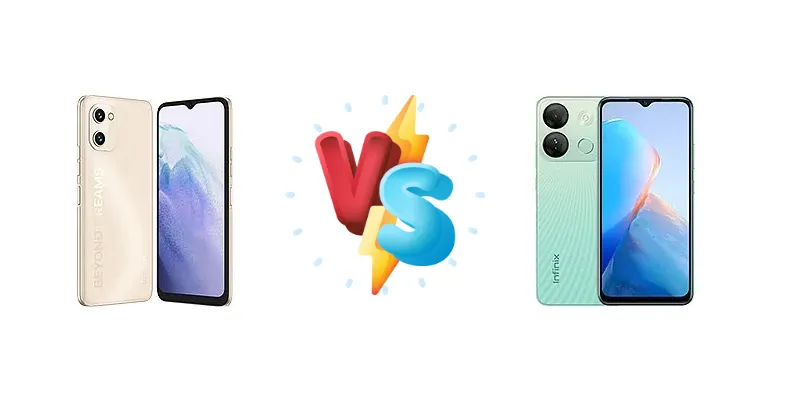
The sub-$150 smartphone market is fiercely competitive, and the Umidigi C1 Plus and Infinix Smart 7 HD represent two contenders vying for the attention of budget-conscious consumers. While both devices offer basic smartphone functionality, key differences in their processing power and architecture dictate which phone delivers a smoother, more responsive user experience.
🏆 Quick Verdict
For the average user prioritizing responsiveness and multitasking, the Infinix Smart 7 HD is the better choice. Its octa-core CPU provides a noticeable performance advantage over the Umidigi C1 Plus’s quad-core processor, making everyday tasks feel snappier. However, the C1 Plus remains a viable option for extremely basic usage.
| Network |
|---|
| 2G bands | GSM 850 / 900 / 1800 / 1900 | GSM 850 / 900 / 1800 / 1900 |
| 3G bands | HSDPA 850 / 900 / 1700(AWS) / 1900 / 2100 | HSDPA 850 / 900 / 2100 |
| 4G bands | 1, 2, 3, 4, 5, 7, 8, 12, 17, 20, 28, 38, 40, 41 | 1, 3, 5, 8, 38, 40, 41 |
| Speed | HSPA, LTE | HSPA, LTE |
| Technology | GSM / HSPA / LTE | GSM / HSPA / LTE |
| | - | 1, 2, 3, 4, 5, 7, 8, 20, 28, 38, 40, 41 |
| Launch |
|---|
| Announced | 2023 | 2023, April 14 |
| Status | Available. Released 2023 | Available. Released 2023, April 14 |
| Body |
|---|
| Build | - | Glass front, plastic back, plastic frame |
| Dimensions | 164.2 x 76.4 x 8.8 mm (6.46 x 3.01 x 0.35 in) | 163.9 x 75.5 x 8.7 mm (6.45 x 2.97 x 0.34 in) |
| SIM | Nano-SIM + Nano-SIM | Nano-SIM + Nano-SIM |
| Weight | 192 g (6.77 oz) | 196.5 g (6.95 oz) |
| Display |
|---|
| Resolution | 720 x 1600 pixels, 20:9 ratio (~269 ppi density) | 720 x 1612 pixels, 20:9 ratio (~267 ppi density) |
| Size | 6.52 inches, 102.6 cm2 (~81.8% screen-to-body ratio) | 6.6 inches, 104.6 cm2 (~84.6% screen-to-body ratio) |
| Type | IPS LCD | IPS LCD, 500 nits |
| Platform |
|---|
| CPU | Quad-core 1.5 GHz Cortex-A53 | Octa-core 1.6 GHz |
| Chipset | Mediatek MT8766 | - |
| GPU | PowerVR GE8300 | - |
| OS | Android 13 | Android 12 (Go edition) |
| Memory |
|---|
| Card slot | microSDXC (uses shared SIM slot) | microSDXC (dedicated slot) |
| Internal | 32GB 3GB RAM | 64GB 2GB RAM |
| | - | UFS 2.1 |
| Main Camera |
|---|
| Dual | 13 MP, f/2.2, (wide), AF
Auxiliary lens | 8 MP, f/2.0
0.08 MP, (depth) |
| Features | Dual-LED flash | Dual-LED flash, HDR, panorama |
| Single | - | 8 MP, f/2.0
Auxiliary lens |
| Video | 1080p@30fps | 1080p@30fps |
| Selfie camera |
|---|
| Features | - | LED flash |
| Single | 5 MP, f/2.2, (wide) | 5 MP, f/2.0 |
| Video | 720p@30fps | 720p@30fps |
| Sound |
|---|
| 3.5mm jack | - | Yes |
| 35mm jack | Yes | Yes |
| Loudspeaker | Yes | Yes |
| Comms |
|---|
| Bluetooth | 4.2, A2DP | 5.0, A2DP, LE |
| NFC | No | No |
| Positioning | GPS, GLONASS, GALILEO, BDS | GPS |
| Radio | No | FM radio |
| USB | USB Type-C, OTG | microUSB 2.0, OTG |
| WLAN | Wi-Fi 802.11 b/g/n/ac, dual-band, Wi-Fi Direct | Wi-Fi 802.11 b/g/n |
| Features |
|---|
| Sensors | Fingerprint (side-mounted), accelerometer, proximity, compass | Fingerprint (rear-mounted), accelerometer, proximity |
| Battery |
|---|
| Charging | 10W wired | 10W wired |
| Type | 5150 mAh | 5000 mAh |
| Misc |
|---|
| Colors | Starry Black, Sunglow Gold | Ink Black, Silk Blue, Jade White, Green Apple |
| Models | - | X6516 |
| Price | - | About 110 EUR |
Umidigi C1 Plus
- Potentially lower price point (depending on retailer)
- Simpler user experience for basic tasks
- Reliable for core communication features
- Significantly slower performance compared to the Infinix
- Struggles with multitasking and demanding apps
- Likely limited software support
Infinix Smart 7 HD
- Faster and more responsive performance with octa-core CPU
- Better multitasking capabilities
- More versatile for a wider range of apps
- May be slightly more expensive than the Umidigi
- 10W charging is relatively slow
- Camera quality likely similar to the Umidigi
Display Comparison
Neither device boasts a standout display. Given the context data focuses on processing, we can infer both likely utilize standard IPS LCD panels common in this price bracket. Expect 720p+ resolution on both. The absence of any mention of refresh rates or brightness suggests both will offer a basic viewing experience, adequate for indoor use but potentially washed out in direct sunlight. Bezels are likely to be substantial on both devices, maximizing screen real estate is not a priority at this price point.
Camera Comparison
Without detailed camera specifications, it’s safe to assume both phones feature basic camera setups geared towards casual photography. The market segment suggests primary sensors will likely be in the 8-13MP range. Any additional sensors (likely a depth or macro lens) will be of low resolution and limited utility. Image processing will be basic, prioritizing speed over image quality. Users shouldn’t expect exceptional low-light performance or detailed images from either device.
Performance
The core difference lies in the CPU. The Infinix Smart 7 HD’s octa-core 1.6 GHz processor represents a significant leap over the Umidigi C1 Plus’s quad-core 1.5 GHz Mediatek MT8766. While both utilize Cortex-A53 cores, the doubling of core count in the Infinix allows for better parallel processing, resulting in smoother multitasking and faster app loading times. The MT8766, while adequate for basic tasks, will struggle with demanding applications or running multiple apps simultaneously. The lack of information on RAM capacity makes it difficult to assess the full impact, but the CPU difference is the dominant factor.
Battery Life
Both devices feature 10W wired charging, indicating similar charging speeds – expect around 2.5-3.5 hours for a full charge. Battery capacity is not specified, but given the price point, both likely house batteries in the 4000-5000 mAh range. The more efficient octa-core processor in the Infinix Smart 7 HD *may* translate to slightly better battery life under moderate usage, but the difference is unlikely to be substantial. Real-world battery performance will heavily depend on usage patterns.
Buying Guide
Buy the Umidigi C1 Plus if you need a phone for absolutely essential communication – calls, texts, and very light app usage – and prioritize simplicity. It’s a good fit for first-time smartphone users or those needing a secondary device for emergencies. Buy the Infinix Smart 7 HD if you prefer a phone capable of handling multiple apps, occasional gaming, and a generally more fluid user interface. It’s better suited for users who want a more versatile experience without breaking the bank.
Frequently Asked Questions
❓ Will the Infinix Smart 7 HD be able to run popular social media apps like Facebook and Instagram smoothly?
Yes, the octa-core processor in the Infinix Smart 7 HD should handle Facebook, Instagram, and similar social media apps without significant lag. While it won't offer a flagship-level experience, it will provide a much smoother experience than the quad-core Umidigi C1 Plus, especially when switching between apps.
❓ Is the Umidigi C1 Plus suitable for someone who primarily uses their phone for making calls and sending text messages?
Absolutely. The Umidigi C1 Plus is perfectly adequate for basic communication tasks like calls and texts. Its quad-core processor is sufficient for these functions, and its simplicity may be appealing to users who don't require advanced features or performance.
❓ Can either of these phones handle basic mobile games like Candy Crush or Subway Surfers?
The Infinix Smart 7 HD will provide a noticeably better gaming experience for casual games like Candy Crush or Subway Surfers. The octa-core processor will result in fewer frame drops and smoother gameplay compared to the Umidigi C1 Plus, which may struggle with even these relatively simple titles.
❓ How long will it take to fully charge either phone from 0%?
With both phones utilizing 10W charging, expect a full charge to take approximately 2.5 to 3.5 hours. The charging speed is relatively slow compared to modern fast-charging technologies, so it's best to charge overnight.