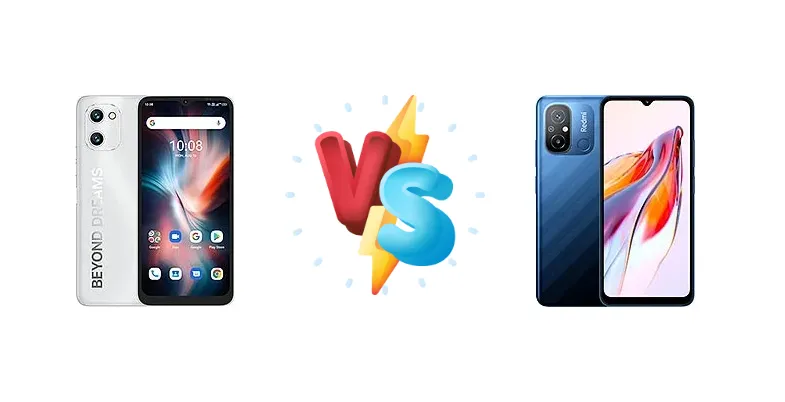
The sub-$150 smartphone market is fiercely competitive. Both the Umidigi C1 Max and Xiaomi Redmi 12C aim to deliver essential smartphone functionality at an incredibly accessible price point. However, they take slightly different approaches, primarily in their chipset choices. This comparison dissects those differences and more, helping you determine which device best suits your needs.
🏆 Quick Verdict
For most users, the Xiaomi Redmi 12C offers a slight edge due to its more powerful Helio G85 chipset, translating to a smoother experience in demanding apps and games. While the Umidigi C1 Max is a capable device, the Redmi 12C’s performance advantage justifies the often minimal price difference.
| Network |
|---|
| 2G bands | GSM 850 / 900 / 1800 / 1900 | GSM 850 / 900 / 1800 / 1900 |
| 3G bands | HSDPA 850 / 900 / 1700(AWS) / 1900 / 2100 | HSDPA 850 / 900 / 2100 |
| 4G bands | 1, 2, 3, 4, 5, 7, 8, 12, 17, 20, 28, 38, 40, 41 | 1, 3, 5, 7, 8, 20, 28, 38, 40, 41 - International |
| Speed | HSPA, LTE | HSPA, LTE |
| Technology | GSM / HSPA / LTE | GSM / CDMA / HSPA / EVDO / LTE |
| | - | CDMA2000 1xEV-DO |
| Launch |
|---|
| Announced | 2022 | 2022, December 31 |
| Status | Available. Released 2022 | Available. Released 2023, January 01 |
| Body |
|---|
| Dimensions | 164.2 x 76.4 x 8.8 mm (6.46 x 3.01 x 0.35 in) | 168.8 x 76.4 x 8.8 mm (6.65 x 3.01 x 0.35 in) |
| SIM | Nano-SIM + Nano-SIM | Nano-SIM + Nano-SIM |
| Weight | 192 g (6.77 oz) | 192 g (6.77 oz) |
| Display |
|---|
| Resolution | 720 x 1600 pixels, 20:9 ratio (~269 ppi density) | 720 x 1650 pixels (~268 ppi density) |
| Size | 6.52 inches, 102.6 cm2 (~81.8% screen-to-body ratio) | 6.71 inches, 106.5 cm2 (~82.6% screen-to-body ratio) |
| Type | IPS LCD | IPS LCD, 500 nits (typ) |
| Platform |
|---|
| CPU | Octa-core (2x1.8 GHz Cortex-A75 & 6x1.8 GHz Cortex-A55) | Octa-core (2x2.0 GHz Cortex-A75 & 6x1.8 GHz Cortex-A55) |
| Chipset | Unisoc T610 (12 nm) | Mediatek MT6769Z Helio G85 (12 nm) |
| GPU | Mali-G52 MP2 | Mali-G52 MC2 |
| OS | Android 12 | Android 12, MIUI 13 |
| Memory |
|---|
| Card slot | microSDXC (uses shared SIM slot) | microSDXC (dedicated slot) |
| Internal | 128GB 6GB RAM | 32GB 2GB RAM, 32GB 3GB RAM, 32GB 4GB RAM, 64GB 3GB RAM, 64GB 4GB RAM, 128GB 3GB RAM, 128GB 4GB RAM, 128GB 6GB RAM |
| | - | eMMC 5.1 |
| Main Camera |
|---|
| Dual | 50 MP, f/1.8, (wide), AF
Auxiliary lens | 50 MP, (wide), PDAF
0.08 MP (depth) |
| Features | Dual-LED flash, HDR, panorama | LED flash, HDR |
| Single | - | 50 MP, f/1.8, (wide), 1/2.76", PDAF
Auxiliary lens |
| Video | 1080p@30fps | 1080p@30fps |
| Selfie camera |
|---|
| Single | 8 MP, f/2.2, (wide) | 5 MP, f/2.2, (wide) |
| Video | 720p@30fps | 1080p@30fps |
| Sound |
|---|
| 3.5mm jack | - | Yes |
| 35mm jack | Yes | Yes |
| Loudspeaker | Yes | Yes |
| Comms |
|---|
| Bluetooth | 5.0, A2DP, LE | 5.1, A2DP, LE |
| NFC | No | Yes (market/region dependent) |
| Positioning | GPS, GALILEO, GLONASS, BDS | GPS, GLONASS, BDS, GALILEO |
| Radio | No | FM radio |
| USB | USB Type-C, OTG | microUSB 2.0 |
| WLAN | Wi-Fi 802.11 a/b/g/n/ac, dual-band, Wi-Fi Direct | Wi-Fi 802.11 a/b/g/n/ac, dual-band, Wi-Fi Direct |
| Features |
|---|
| Sensors | Fingerprint (side-mounted), accelerometer, proximity | Fingerprint (rear-mounted), accelerometer |
| | - | Virtual proximity sensing |
| Battery |
|---|
| Charging | 10W wired | 10W wired |
| Type | 5150 mAh | Li-Po 5000 mAh |
| Misc |
|---|
| Colors | Starry Black, Galaxy Blue | Graphite Gray, Ocean Blue, Mint Green, Lavender Purple |
| Models | - | 22120RN86G, 22120RN86I, 22126RN91Y, 2212ARNC4L |
| Price | - | £ 132.99 / € 107.41 |
| SAR | - | 1.08 W/kg (head) 0.64 W/kg (body) |
| SAR EU | - | 0.98 W/kg (head) 0.99 W/kg (body) |
Umidigi C1 Max
- Potentially lower price point
- Stable performance for basic tasks
- Unisoc chipset offers a different experience for those seeking alternatives to MediaTek
- Less powerful chipset compared to the Redmi 12C
- May struggle with demanding apps and games
- Limited future-proofing
Xiaomi Redmi 12C
- More powerful Helio G85 chipset
- Smoother performance in apps and games
- Better suited for multitasking
- May be slightly more expensive
- 10W charging is slow
- Software updates may be limited
Display Comparison
Neither device boasts a standout display. Both are likely utilizing LCD panels, common in this price bracket. Without specific details on brightness or color gamut, the display experience will likely be similar – adequate for indoor use but potentially washed out in direct sunlight. The focus here isn't on visual fidelity, but on basic functionality.
Camera Comparison
Both phones likely feature basic camera setups. Without detailed sensor information, it’s safe to assume both rely on primary sensors around the 13MP mark, supplemented by auxiliary lenses of limited utility. Image quality will be heavily reliant on software processing, and neither phone is expected to excel in low-light conditions. The Redmi 12C’s slightly more powerful ISP (integrated signal processor) within the Helio G85 may offer a marginal improvement in image processing speed and quality, but the difference will be minimal.
Performance
The core difference lies in the chipsets. The Xiaomi Redmi 12C’s MediaTek Helio G85 (12nm) features a slightly higher clocked CPU (2.0 GHz vs 1.8 GHz on the Umidigi’s Unisoc T610). While both utilize the same Cortex-A75 and A55 core configuration, the higher clock speed on the G85 provides a tangible performance boost, particularly in GPU-intensive tasks. This means smoother scrolling, faster app loading times, and a more enjoyable gaming experience on the Redmi 12C. The Unisoc T610 in the C1 Max is still capable, but will exhibit more noticeable slowdowns under heavy load.
Battery Life
Both devices are equipped with 10W wired charging, indicating similar charging speeds – expect around 2.5-3 hours for a full charge. Battery capacity isn’t specified, but typical capacities for phones in this segment range from 5000mAh to 6000mAh. The actual battery life will depend on usage patterns, but the slightly more efficient Helio G85 in the Redmi 12C might translate to marginally longer runtimes, offsetting any potential capacity differences.
Buying Guide
Buy the Umidigi C1 Max if you prioritize a consistently stable, if slightly slower, experience and are less concerned with pushing the phone’s performance limits. It’s ideal for basic communication, social media, and light web browsing. Buy the Xiaomi Redmi 12C if you want a phone that can handle more demanding tasks like casual gaming or running multiple apps simultaneously, and you value a bit more headroom for future software updates.
Frequently Asked Questions
❓ Will the Redmi 12C’s Helio G85 handle popular games like PUBG Mobile or Call of Duty Mobile?
The Helio G85 is capable of running PUBG Mobile and Call of Duty Mobile at medium settings with reasonable frame rates. However, don't expect a flagship-level gaming experience. You may need to lower graphics settings for smoother gameplay, especially during intense firefights. The Umidigi C1 Max will struggle more with these titles.
❓ How does the Unisoc T610 in the Umidigi C1 Max compare to the MediaTek Helio G85 in terms of software support and updates?
Historically, MediaTek chipsets have enjoyed broader software support and more frequent updates from manufacturers compared to Unisoc. While this isn't a hard and fast rule, Redmi (Xiaomi) generally provides more consistent software updates for its devices than Umidigi. This means the Redmi 12C is more likely to receive security patches and potentially even minor Android version updates.
❓ Is the 10W charging on either phone a significant drawback?
Yes, 10W charging is relatively slow by today's standards. It will take over two and a half hours to fully charge either device. However, given the likely battery capacities (5000-6000mAh), overnight charging is a viable solution, mitigating the slow charging speed.