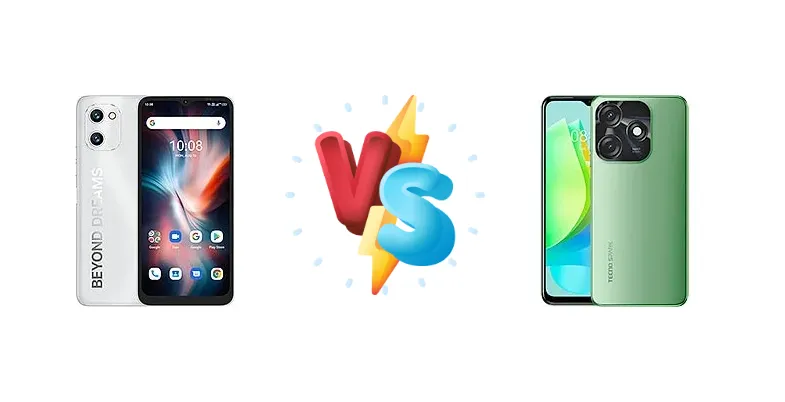
The Umidigi C1 Max and Tecno Spark 10C represent the fiercely competitive sub-$150 smartphone market. Both devices leverage Unisoc chipsets to deliver an affordable Android experience, but subtle differences in processing power and charging capabilities could make one a better fit for your needs. This comparison dissects those differences, focusing on real-world performance implications.
🏆 Quick Verdict
For most users, the Tecno Spark 10C emerges as the slightly better choice. While the Umidigi C1 Max boasts a marginally faster CPU clock speed, the Tecno’s 18W charging significantly reduces downtime, a crucial advantage in this price bracket. The difference in CPU performance is unlikely to be noticeable in everyday tasks.
| Network |
|---|
| 2G bands | GSM 850 / 900 / 1800 / 1900 | GSM 850 / 900 / 1800 / 1900 |
| 3G bands | HSDPA 850 / 900 / 1700(AWS) / 1900 / 2100 | HSDPA 850 / 900 / 2100 |
| 4G bands | 1, 2, 3, 4, 5, 7, 8, 12, 17, 20, 28, 38, 40, 41 | LTE |
| Speed | HSPA, LTE | HSPA, LTE |
| Technology | GSM / HSPA / LTE | GSM / HSPA / LTE |
| Launch |
|---|
| Announced | 2022 | 2023, March 23 |
| Status | Available. Released 2022 | Available. Released 2023, March 29 |
| Body |
|---|
| Build | - | Glass front, plastic frame, plastic back |
| Dimensions | 164.2 x 76.4 x 8.8 mm (6.46 x 3.01 x 0.35 in) | 163.9 x 75.5 x 8.5 mm (6.45 x 2.97 x 0.33 in) |
| SIM | Nano-SIM + Nano-SIM | Nano-SIM + Nano-SIM |
| Weight | 192 g (6.77 oz) | - |
| Display |
|---|
| Resolution | 720 x 1600 pixels, 20:9 ratio (~269 ppi density) | 720 x 1612 pixels, 20:9 ratio (~267 ppi density) |
| Size | 6.52 inches, 102.6 cm2 (~81.8% screen-to-body ratio) | 6.6 inches, 104.6 cm2 (~84.6% screen-to-body ratio) |
| Type | IPS LCD | IPS LCD, 90Hz |
| Platform |
|---|
| CPU | Octa-core (2x1.8 GHz Cortex-A75 & 6x1.8 GHz Cortex-A55) | Octa-core (2x1.6 GHz Cortex-A75 & 6x1.6 GHz Cortex-A55) |
| Chipset | Unisoc T610 (12 nm) | Unisoc T606 (12 nm) |
| GPU | Mali-G52 MP2 | Mali-G57 MP1 |
| OS | Android 12 | Android 12, HIOS 8.6 |
| Memory |
|---|
| Card slot | microSDXC (uses shared SIM slot) | microSDXC (dedicated slot) |
| Internal | 128GB 6GB RAM | 64GB 4GB RAM, 128GB 4GB RAM, 128GB 8GB RAM |
| Main Camera |
|---|
| Dual | 50 MP, f/1.8, (wide), AF
Auxiliary lens | 16 MP, (wide), PDAF
0.08 MP, (depth) |
| Features | Dual-LED flash, HDR, panorama | Dual-LED flash, HDR, panorama |
| Single | - | 16 MP, (wide), PDAF
Auxiliary lens |
| Video | 1080p@30fps | 1080p@30fps |
| Selfie camera |
|---|
| Features | - | Dual-LED flash |
| Single | 8 MP, f/2.2, (wide) | 8 MP, (wide) |
| Video | 720p@30fps | 1080p@30fps |
| Sound |
|---|
| 3.5mm jack | - | Yes |
| 35mm jack | Yes | Yes |
| Loudspeaker | Yes | Yes |
| Comms |
|---|
| Bluetooth | 5.0, A2DP, LE | Yes |
| NFC | No | No |
| Positioning | GPS, GALILEO, GLONASS, BDS | GPS |
| Radio | No | FM radio |
| USB | USB Type-C, OTG | USB Type-C 2.0 |
| WLAN | Wi-Fi 802.11 a/b/g/n/ac, dual-band, Wi-Fi Direct | Wi-Fi 802.11 a/b/g/n/ac, dual-band |
| Features |
|---|
| Sensors | Fingerprint (side-mounted), accelerometer, proximity | Fingerprint (side-mounted), accelerometer, proximity, compass |
| Battery |
|---|
| Charging | 10W wired | 18W wired |
| Type | 5150 mAh | 5000 mAh |
| Misc |
|---|
| Colors | Starry Black, Galaxy Blue | Black, Blue, Green |
| Models | - | KI5k, KI5m |
| Price | - | ₹ 9,990 |
Umidigi C1 Max
- Slightly faster CPU clock speed (T610)
- Potentially lower price (depending on retailer)
- Standard Android experience
- Slower 10W charging
- Limited information on display quality
- Likely similar camera performance to Tecno
Tecno Spark 10C
- Faster 18W charging
- Potentially more optimized software
- Generally more aggressive image processing
- Slightly slower CPU clock speed (T606)
- May include pre-installed bloatware
- Limited information on display quality
Display Comparison
Neither Umidigi nor Tecno provide display specifications beyond resolution. Given the price point, both likely utilize IPS LCD panels. The absence of details like peak brightness or color gamut suggests a focus on cost reduction. Expect similar viewing experiences in typical indoor lighting, but neither will excel in direct sunlight. Bezels are likely to be substantial on both devices, consistent with their budget positioning.
Camera Comparison
Camera details are sparse for both devices. It’s safe to assume both feature a primary camera and potentially a depth or macro sensor. Without sensor size or aperture information, a direct comparison is impossible. The image processing algorithms employed by Tecno are generally more aggressive in sharpening and color boosting, which may appeal to some users. However, low-light performance will likely be poor on both devices due to the limitations of their sensors and processors. The absence of Optical Image Stabilization (OIS) is expected at this price point.
Performance
Both the Umidigi C1 Max and Tecno Spark 10C are powered by Unisoc 12nm octa-core processors. However, the C1 Max utilizes the T610 with a 2x1.8 GHz Cortex-A75 and 6x1.8 GHz Cortex-A55 configuration, while the Spark 10C features the T606 with a 2x1.6 GHz Cortex-A75 and 6x1.6 GHz Cortex-A55 setup. The 0.2 GHz clock speed difference, while measurable, translates to a minimal real-world performance gain for the C1 Max. The T606’s slightly lower clock speed is unlikely to cause noticeable lag in everyday tasks. Both chips will struggle with demanding 3D games, but are adequate for social media and basic apps. RAM configurations are not specified, but are likely to be similar, further minimizing performance differences.
Battery Life
Battery capacity is not specified for either device. However, the Tecno Spark 10C’s 18W wired charging is a significant advantage over the Umidigi C1 Max’s 10W charging. This means the Spark 10C will recharge considerably faster, reducing downtime. Even with a similar battery capacity, the faster charging speed makes the Tecno more convenient for users who frequently use their phone throughout the day. A full charge on the C1 Max will take significantly longer, potentially requiring overnight charging.
Buying Guide
Buy the Umidigi C1 Max if you prioritize a slightly higher theoretical CPU clock speed and are comfortable with slower charging. This phone suits users who primarily use their device for static tasks like reading or messaging. Buy the Tecno Spark 10C if you value faster charging and a more responsive overall experience, especially if you frequently use power-hungry apps or play mobile games. It’s the better option for users on the go.
Frequently Asked Questions
❓ Will the Unisoc T606 in the Tecno Spark 10C struggle with multitasking?
The Unisoc T606 is designed for entry-level smartphones. While it can handle basic multitasking (switching between apps like messaging, web browsing, and music), running multiple demanding applications simultaneously may result in noticeable slowdowns. Keeping fewer apps open in the background will improve performance.
❓ How long will it take to fully charge the Umidigi C1 Max with its 10W charger?
With a 10W charger, a full charge from 0% on the Umidigi C1 Max will likely take between 3 to 4 hours, depending on battery capacity. This is significantly slower than the Tecno Spark 10C’s 18W charging, which could potentially achieve a full charge in around 2 hours.
❓ Does the Tecno Spark 10C have a dedicated microSD card slot for storage expansion?
While not explicitly stated in the provided specifications, Tecno phones in this price range typically include a dedicated microSD card slot. This allows users to expand the internal storage for photos, videos, and other files. Check the product listing or user manual for confirmation.
❓ Is the difference in CPU clock speed between the T610 and T606 noticeable in everyday use?
The 0.2 GHz difference in CPU clock speed is unlikely to be perceptible during typical smartphone usage, such as browsing the web, checking email, or using social media apps. The overall system performance is more influenced by RAM, storage speed, and software optimization.