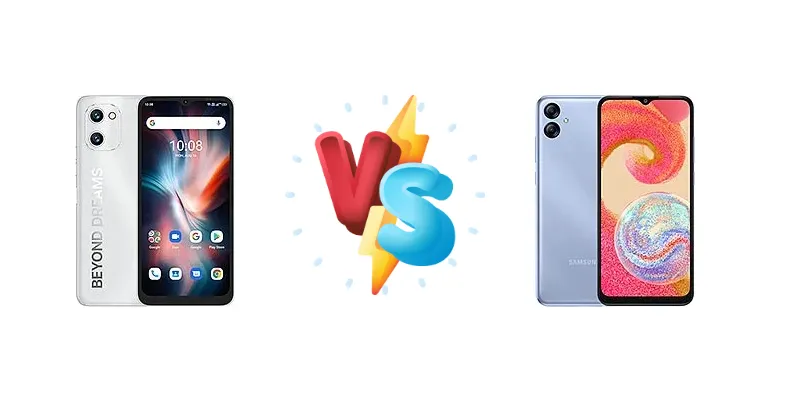
The sub-$150 smartphone market is fiercely competitive. Both the Umidigi C1 Max and the Samsung Galaxy A04e aim to deliver essential smartphone functionality at an accessible price point. However, they take different approaches to achieving this, primarily through their chipset choices. This comparison dissects those differences and determines which device offers the best value for your money.
🏆 Quick Verdict
For the average user prioritizing responsiveness and future-proofing, the Umidigi C1 Max emerges as the better choice. Its Unisoc T610 chipset, utilizing Cortex-A75 cores, provides a noticeable performance edge over the Samsung Galaxy A04e’s older Helio P35, despite the A04e’s slightly higher clock speeds on some cores.
| Network |
|---|
| 2G bands | GSM 850 / 900 / 1800 / 1900 | GSM 850 / 900 / 1800 / 1900 |
| 3G bands | HSDPA 850 / 900 / 1700(AWS) / 1900 / 2100 | HSDPA 850 / 900 / 2100 |
| 4G bands | 1, 2, 3, 4, 5, 7, 8, 12, 17, 20, 28, 38, 40, 41 | 1, 3, 5, 7, 8, 20, 28, 38, 40, 41 |
| Speed | HSPA, LTE | HSPA, LTE |
| Technology | GSM / HSPA / LTE | GSM / HSPA / LTE |
| Launch |
|---|
| Announced | 2022 | 2022, October 21 |
| Status | Available. Released 2022 | Available. Released 2022, November 07 |
| Body |
|---|
| Build | - | Glass front, plastic back, plastic frame |
| Dimensions | 164.2 x 76.4 x 8.8 mm (6.46 x 3.01 x 0.35 in) | 164.2 x 75.9 x 9.1 mm (6.46 x 2.99 x 0.36 in) |
| SIM | Nano-SIM + Nano-SIM | · Nano-SIM· Nano-SIM + Nano-SIM |
| Weight | 192 g (6.77 oz) | 188 g (6.63 oz) |
| Display |
|---|
| Resolution | 720 x 1600 pixels, 20:9 ratio (~269 ppi density) | 720 x 1600 pixels, 20:9 ratio (~270 ppi density) |
| Size | 6.52 inches, 102.6 cm2 (~81.8% screen-to-body ratio) | 6.5 inches, 102.0 cm2 (~81.8% screen-to-body ratio) |
| Type | IPS LCD | PLS LCD |
| Platform |
|---|
| CPU | Octa-core (2x1.8 GHz Cortex-A75 & 6x1.8 GHz Cortex-A55) | Octa-core (4x2.3 GHz Cortex-A53 & 4x1.8 GHz Cortex-A53) |
| Chipset | Unisoc T610 (12 nm) | Mediatek MT6765 Helio P35 (12 nm) |
| GPU | Mali-G52 MP2 | PowerVR GE8320 |
| OS | Android 12 | Android 12, One UI Core 4.1 |
| Memory |
|---|
| Card slot | microSDXC (uses shared SIM slot) | microSDXC (dedicated slot) |
| Internal | 128GB 6GB RAM | 32GB 2GB RAM, 32GB 3GB RAM, 32GB 4GB RAM, 64GB 2GB RAM, 64GB 3GB RAM, 64GB 4GB RAM, 128GB 4GB RAM |
| Main Camera |
|---|
| Dual | 50 MP, f/1.8, (wide), AF
Auxiliary lens | 13 MP, f/2.2, (wide), AF
Auxiliary lens |
| Features | Dual-LED flash, HDR, panorama | LED flash |
| Single | - | 5 MP, f/2.2 |
| Video | 1080p@30fps | 1080p@30fps |
| Selfie camera |
|---|
| Single | 8 MP, f/2.2, (wide) | 5 MP, f/2.2 |
| Video | 720p@30fps | Yes |
| Sound |
|---|
| 3.5mm jack | - | Yes |
| 35mm jack | Yes | Yes |
| Loudspeaker | Yes | Yes |
| Comms |
|---|
| Bluetooth | 5.0, A2DP, LE | 5.0, A2DP, LE |
| NFC | No | No |
| Positioning | GPS, GALILEO, GLONASS, BDS | GPS, GLONASS, GALILEO, BDS |
| Radio | No | Unspecified |
| USB | USB Type-C, OTG | USB Type-C 2.0, OTG |
| WLAN | Wi-Fi 802.11 a/b/g/n/ac, dual-band, Wi-Fi Direct | Wi-Fi 802.11 b/g/n, Wi-Fi Direct |
| Features |
|---|
| Sensors | Fingerprint (side-mounted), accelerometer, proximity | Accelerometer, proximity |
| Battery |
|---|
| Charging | 10W wired | - |
| Type | 5150 mAh | Li-Po 5000 mAh |
| Misc |
|---|
| Colors | Starry Black, Galaxy Blue | Black, Copper, Light Blue |
| Models | - | SM-A042F, SM-A042F/DS, SM-A042M, SM-A042M/DS |
| Price | - | ₹ 7,999 |
| SAR EU | - | 0.29 W/kg (head) 1.11 W/kg (body) |
Umidigi C1 Max
- More modern chipset architecture (Cortex-A75 cores)
- Potentially smoother multitasking
- Better long-term performance
- Slower 10W charging
- Less brand recognition
Samsung Galaxy A04e
- Established brand reputation
- Potentially wider accessory availability
- Slightly higher clock speeds on some cores
- Older chipset architecture (Cortex-A53 cores)
- Less responsive performance in demanding tasks
- Limited future-proofing
Display Comparison
Neither device boasts a standout display. Both are likely utilizing LCD panels, common in this price bracket. Specifics like resolution and brightness are not provided, but we can assume they are similar – around 720p+ and adequate for indoor use. The lack of high refresh rates or advanced panel technologies like LTPO is expected. The user experience will likely be comparable in terms of visual fidelity.
Camera Comparison
Camera performance is likely to be similar, with both devices relying on basic sensors. Without specific sensor size or aperture information, it’s difficult to make a definitive judgment. However, the inclusion of a 2MP macro camera on the A04e is largely a marketing gimmick, offering limited practical benefit. Image processing will likely be more refined on the Samsung device due to its brand’s established software optimization, but the core hardware limitations will be apparent in low-light conditions.
Performance
The core difference lies in the chipsets. The Umidigi C1 Max’s Unisoc T610 features two Cortex-A75 cores clocked at 1.8 GHz, paired with six Cortex-A55 cores, also at 1.8 GHz. This architecture provides a significant advantage in multi-tasking and demanding applications compared to the Samsung Galaxy A04e’s MediaTek Helio P35. The Helio P35 uses four Cortex-A53 cores at 2.3 GHz and another four at 1.8 GHz. While the A53 cores have a higher clock speed, the A75 cores in the T610 offer superior individual performance. This translates to smoother app launches and less lag during general use. The T610’s 12nm process node is also comparable to the Helio P35’s, suggesting similar thermal efficiency.
Battery Life
Battery life will depend heavily on usage patterns. Both devices likely feature batteries in the 4000-5000 mAh range, typical for this segment. The Umidigi C1 Max is limited to 10W wired charging, which is slower than what some competitors offer. The A04e’s charging speed is also likely around 10W. Therefore, while the A04e might not have a significantly larger battery, the slower charging speeds on both devices mean that topping up will take a considerable amount of time.
Buying Guide
Buy the Umidigi C1 Max if you need a phone that feels more responsive for everyday tasks like browsing and social media, and if you anticipate keeping the device for more than a year. Buy the Samsung Galaxy A04e if you prioritize brand recognition and a potentially wider availability of accessories, and if your usage is extremely light, consisting primarily of calls and basic messaging.
Frequently Asked Questions
❓ Will the Unisoc T610 in the Umidigi C1 Max handle popular games like PUBG Mobile?
The Unisoc T610 can run PUBG Mobile, but expect to play at lower graphics settings and frame rates to maintain a stable experience. The Helio P35 in the A04e will struggle even more with demanding games, requiring even lower settings.
❓ Is the Samsung Galaxy A04e likely to receive more software updates than the Umidigi C1 Max?
Samsung generally provides longer software support for its devices. While neither phone is guaranteed extensive updates, the A04e is more likely to receive at least one major Android version update compared to the Umidigi C1 Max.
❓ Does the Helio P35 chipset in the Samsung Galaxy A04e tend to overheat during prolonged use?
The Helio P35 is known to throttle under sustained load, meaning performance will decrease to prevent overheating. While not a catastrophic issue, it can lead to noticeable lag during extended gaming sessions or video recording.