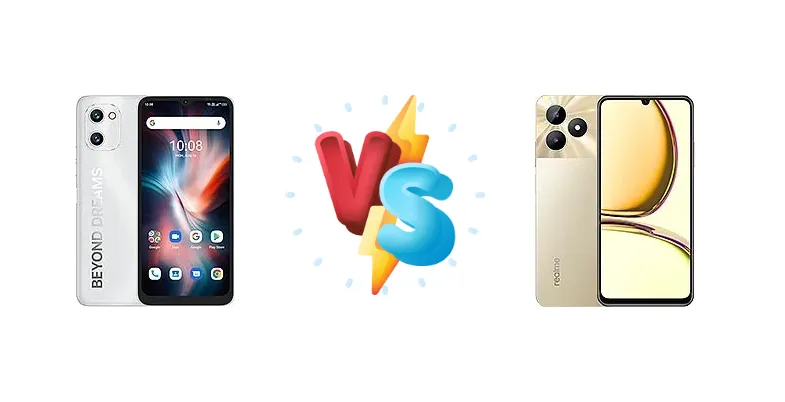
The sub-$150 smartphone market is fiercely competitive. Both the Umidigi C1 Max and the Realme C53 (India) aim to deliver essential smartphone functionality at an incredibly accessible price point. While both leverage Unisoc chipsets, key differences in charging speed and potential software optimization create a compelling head-to-head.
🏆 Quick Verdict
For the average user prioritizing faster charging and a more established brand reputation, the Realme C53 (India) is the better choice. Its 18W charging significantly reduces downtime compared to the Umidigi C1 Max’s 10W. However, the C1 Max remains a viable option for those on a tighter budget.
| Network |
|---|
| 2G bands | GSM 850 / 900 / 1800 / 1900 | GSM 850 / 900 / 1800 / 1900 |
| 3G bands | HSDPA 850 / 900 / 1700(AWS) / 1900 / 2100 | HSDPA 850 / 900 / 2100 |
| 4G bands | 1, 2, 3, 4, 5, 7, 8, 12, 17, 20, 28, 38, 40, 41 | 1, 3, 5, 8, 38, 40, 41 |
| Speed | HSPA, LTE | HSPA, LTE |
| Technology | GSM / HSPA / LTE | GSM / HSPA / LTE |
| Launch |
|---|
| Announced | 2022 | 2023, July 19 |
| Status | Available. Released 2022 | Available. Released 2023, July 26 |
| Body |
|---|
| Build | - | Glass front, plastic frame, plastic back |
| Dimensions | 164.2 x 76.4 x 8.8 mm (6.46 x 3.01 x 0.35 in) | 167.2 x 76.7 x 8 mm (6.58 x 3.02 x 0.31 in) |
| SIM | Nano-SIM + Nano-SIM | Nano-SIM + Nano-SIM |
| Weight | 192 g (6.77 oz) | 186 g (6.56 oz) |
| Display |
|---|
| Resolution | 720 x 1600 pixels, 20:9 ratio (~269 ppi density) | 1080 x 2400 pixels, 20:9 ratio (~390 ppi density) |
| Size | 6.52 inches, 102.6 cm2 (~81.8% screen-to-body ratio) | 6.74 inches, 109.7 cm2 (~85.5% screen-to-body ratio) |
| Type | IPS LCD | IPS LCD, 90Hz, 560 nits (peak) |
| Platform |
|---|
| CPU | Octa-core (2x1.8 GHz Cortex-A75 & 6x1.8 GHz Cortex-A55) | Octa-core (2x1.8 GHz Cortex-A75 & 6x1.8 GHz Cortex-A55) |
| Chipset | Unisoc T610 (12 nm) | Unisoc Tiger T612 (12 nm) |
| GPU | Mali-G52 MP2 | Mali-G57 |
| OS | Android 12 | Android 13, Realme UI |
| Memory |
|---|
| Card slot | microSDXC (uses shared SIM slot) | microSDXC (dedicated slot) |
| Internal | 128GB 6GB RAM | 64GB 6GB RAM, 128GB 4GB RAM, 128GB 6GB RAM |
| Main Camera |
|---|
| Dual | 50 MP, f/1.8, (wide), AF
Auxiliary lens | 108 MP, (wide), PDAF
Auxiliary lens |
| Features | Dual-LED flash, HDR, panorama | LED flash, HDR, panorama |
| Video | 1080p@30fps | 1080p@30fps |
| Selfie camera |
|---|
| Features | - | HDR |
| Single | 8 MP, f/2.2, (wide) | 8 MP, (wide) |
| Video | 720p@30fps | 720p@30fps |
| Sound |
|---|
| 35mm jack | Yes | Yes |
| Loudspeaker | Yes | Yes |
| Comms |
|---|
| Bluetooth | 5.0, A2DP, LE | 5.0, A2DP, LE |
| NFC | No | No |
| Positioning | GPS, GALILEO, GLONASS, BDS | GPS, GLONASS, GALILEO |
| Radio | No | Unspecified |
| USB | USB Type-C, OTG | USB Type-C 2.0 |
| WLAN | Wi-Fi 802.11 a/b/g/n/ac, dual-band, Wi-Fi Direct | Wi-Fi 802.11 a/b/g/n/ac, dual-band |
| Features |
|---|
| Sensors | Fingerprint (side-mounted), accelerometer, proximity | Fingerprint (side-mounted), accelerometer, gyro, proximity, compass |
| Battery |
|---|
| Charging | 10W wired | 18W wired |
| Type | 5150 mAh | 5000 mAh |
| Misc |
|---|
| Colors | Starry Black, Galaxy Blue | Gold, Black |
| Models | - | RMX3762 |
| Price | - | About 110 EUR |
Umidigi C1 Max
- Potentially lower price point
- Functional smartphone experience
- Unisoc T610 provides adequate performance for basic tasks
- Slow 10W charging
- Limited brand recognition
- Likely less refined software experience
Realme C53 (India)
- Faster 18W charging
- More established brand (Realme)
- Potentially optimized software (Realme UI)
- May be slightly more expensive
- Unisoc T612 performance gains are marginal
- Camera quality likely similar to Umidigi
Display Comparison
Neither Umidigi nor Realme provide detailed display specifications beyond the panel type. Given the price bracket, both likely utilize IPS LCD panels. The absence of information regarding peak brightness, color gamut coverage, or refresh rates suggests a focus on cost reduction. Bezels are expected to be noticeable on both devices, impacting the overall screen-to-body ratio. Color accuracy will likely be standard for this segment, prioritizing power efficiency over professional-grade color reproduction.
Camera Comparison
Camera details are sparse for both devices. The focus in this price range is rarely on photographic excellence. Expect a primary camera on both, but image quality will heavily depend on sensor size and software processing – details not provided. The inclusion of 2MP macro or depth sensors on either device should be viewed as marketing features rather than significant photographic enhancements. The Realme C53 may benefit from Realme’s image processing algorithms, potentially offering slightly more refined results, but substantial differences are unlikely.
Performance
Both the Umidigi C1 Max and the Realme C53 (India) are powered by Unisoc processors featuring the same CPU configuration: an octa-core setup with 2x1.8 GHz Cortex-A75 cores and 6x1.8 GHz Cortex-A55 cores. However, the Realme C53 utilizes the slightly newer Unisoc Tiger T612. While the core architecture is identical, the 'Tiger' designation often indicates minor optimizations in GPU performance and power efficiency. This means the Realme C53 may offer a marginally smoother experience in graphically demanding tasks. Both devices will likely be paired with 3-4GB of RAM, sufficient for basic multitasking but potentially limiting for heavy app usage. Thermal management will be passive, relying on the phone's chassis to dissipate heat, potentially leading to throttling during prolonged gaming sessions.
Battery Life
Battery capacity is not specified for either device, but both will likely fall in the 5000mAh range, typical for this price segment. The key differentiator is charging speed. The Realme C53 (India) supports 18W wired charging, enabling significantly faster top-ups compared to the Umidigi C1 Max’s 10W charging. This translates to a noticeable difference in usability – the Realme C53 can gain a substantial charge in a short period, while the Umidigi C1 Max will require considerably more time to reach full capacity. For users who frequently find themselves needing to quickly recharge, the Realme C53 is the clear winner.
Buying Guide
Buy the Umidigi C1 Max if you need a functional smartphone with a focus on minimizing upfront cost and are willing to accept slower charging speeds. Buy the Realme C53 (India) if you prefer a quicker charging experience, a more polished software experience (typically associated with Realme UI), and the peace of mind that comes with a more widely recognized brand.
Frequently Asked Questions
❓ Is the Unisoc Tiger T612 in the Realme C53 (India) a significant upgrade over the T610 in the Umidigi C1 Max for gaming?
While the T612 is newer, the performance difference is likely minimal. Both chips share the same CPU configuration. The T612 may offer a slight GPU boost, resulting in marginally better frame rates in some games, but don't expect a dramatic improvement. Both phones are best suited for casual gaming rather than demanding titles.
❓ How long will it take to fully charge the Umidigi C1 Max with its 10W charger?
Given the likely 5000mAh battery capacity and 10W charging, a full charge from 0% will likely take between 3-4 hours. This is a significant drawback compared to the Realme C53’s 18W charging, which can significantly reduce charging times.
❓ Does the Realme C53 (India) support software updates and security patches?
Realme generally provides software updates and security patches for its devices, though the frequency and duration of support can vary. Expect at least a couple of major Android version updates and regular security patches, but long-term support is not guaranteed in this price segment.
❓ What type of charging port do both phones use?
Both the Umidigi C1 Max and the Realme C53 (India) almost certainly use a USB-C port for charging and data transfer, which is standard for modern smartphones.