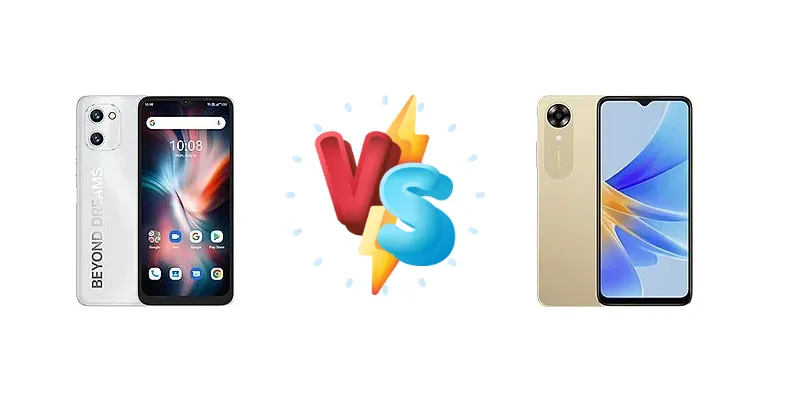
The Umidigi C1 Max and Oppo A17k represent two compelling options in the ultra-budget smartphone space. Both aim to deliver essential functionality at a low price point, but they achieve this with different approaches to chipset selection and overall design. This comparison will dissect their key specifications to determine which device offers the best value for your money.
🏆 Quick Verdict
For the average user prioritizing consistent performance in everyday tasks, the Umidigi C1 Max emerges as the stronger contender. Its Unisoc T610 chipset, featuring Cortex-A75 cores, provides a noticeable advantage over the Oppo A17k’s Helio G35, despite the latter’s slightly higher clock speeds on its A53 cores.
| Network |
|---|
| 2G bands | GSM 850 / 900 / 1800 / 1900 | GSM 850 / 900 / 1800 / 1900 |
| 3G bands | HSDPA 850 / 900 / 1700(AWS) / 1900 / 2100 | HSDPA 850 / 900 / 2100 |
| 4G bands | 1, 2, 3, 4, 5, 7, 8, 12, 17, 20, 28, 38, 40, 41 | 1, 3, 5, 8, 38, 40, 41 |
| Speed | HSPA, LTE | HSPA, LTE |
| Technology | GSM / HSPA / LTE | GSM / HSPA / LTE |
| Launch |
|---|
| Announced | 2022 | 2022, October 13 |
| Status | Available. Released 2022 | Available. Released 2022, October 18 |
| Body |
|---|
| Dimensions | 164.2 x 76.4 x 8.8 mm (6.46 x 3.01 x 0.35 in) | 164.2 x 75.6 x 8.3 mm (6.46 x 2.98 x 0.33 in) |
| SIM | Nano-SIM + Nano-SIM | Nano-SIM + Nano-SIM |
| Weight | 192 g (6.77 oz) | 189 g (6.67 oz) |
| | - | IPX4 water resistance |
| Display |
|---|
| Protection | - | Panda Glass |
| Resolution | 720 x 1600 pixels, 20:9 ratio (~269 ppi density) | 720 x 1612 pixels, 20:9 ratio (~269 ppi density) |
| Size | 6.52 inches, 102.6 cm2 (~81.8% screen-to-body ratio) | 6.56 inches, 103.4 cm2 (~83.3% screen-to-body ratio) |
| Type | IPS LCD | IPS LCD, 480 nits (typ), 600 nits (HBM) |
| Platform |
|---|
| CPU | Octa-core (2x1.8 GHz Cortex-A75 & 6x1.8 GHz Cortex-A55) | Octa-core (4x2.3 GHz Cortex-A53 & 4x1.8 GHz Cortex-A53) |
| Chipset | Unisoc T610 (12 nm) | Mediatek MT6765 Helio G35 (12 nm) |
| GPU | Mali-G52 MP2 | PowerVR GE8320 |
| OS | Android 12 | Android 12, ColorOS 12.1 |
| Memory |
|---|
| Card slot | microSDXC (uses shared SIM slot) | microSDXC |
| Internal | 128GB 6GB RAM | 64GB 3GB RAM |
| | - | eMMC 5.1 |
| Main Camera |
|---|
| Dual | 50 MP, f/1.8, (wide), AF
Auxiliary lens | - |
| Features | Dual-LED flash, HDR, panorama | LED flash, panorama |
| Single | - | 8 MP, f/2.0, (wide), AF |
| Video | 1080p@30fps | 1080p@30fps |
| Selfie camera |
|---|
| Single | 8 MP, f/2.2, (wide) | 5 MP, f/2.2, (wide) |
| Video | 720p@30fps | 1080p@30fps |
| Sound |
|---|
| 3.5mm jack | - | Yes |
| 35mm jack | Yes | Yes |
| Loudspeaker | Yes | Yes |
| Comms |
|---|
| Bluetooth | 5.0, A2DP, LE | 5.3, A2DP, LE, aptX HD |
| NFC | No | No |
| Positioning | GPS, GALILEO, GLONASS, BDS | GPS, GLONASS, BDS, GALILEO |
| Radio | No | Unspecified |
| USB | USB Type-C, OTG | microUSB 2.0, OTG |
| WLAN | Wi-Fi 802.11 a/b/g/n/ac, dual-band, Wi-Fi Direct | Wi-Fi 802.11 a/b/g/n/ac, dual-band |
| Features |
|---|
| Sensors | Fingerprint (side-mounted), accelerometer, proximity | Fingerprint (side-mounted), accelerometer, proximity, compass |
| Battery |
|---|
| Charging | 10W wired | - |
| Type | 5150 mAh | Li-Po 5000 mAh |
| Misc |
|---|
| Colors | Starry Black, Galaxy Blue | Navy Blue, Gold |
| Models | - | CPH2471 |
| Price | - | About 130 EUR |
Umidigi C1 Max
- More powerful CPU architecture (Cortex-A75 cores)
- Potentially better multitasking performance
- Likely longer battery life due to processor efficiency
- Less established brand recognition
- Software updates may be less frequent
Oppo A17k
- Well-known brand (Oppo)
- Potentially more refined software experience
- Wider availability in some markets
- Less powerful CPU (Cortex-A53 cores)
- May struggle with demanding apps
- Potentially shorter battery life
Display Comparison
Neither device boasts a standout display. Both are likely utilizing LCD panels, common in this price bracket. Without specific display specs, it's reasonable to assume similar resolutions (likely 720p+). The real difference lies in the processing power needed to drive the display, which we'll cover in the performance section. Bezels are expected to be substantial on both, maximizing screen real estate within a budget.
Camera Comparison
Both phones likely feature basic camera setups. Without detailed sensor information, it’s safe to assume the primary cameras are in the 8-13MP range. The Oppo A17k’s marketing often highlights its camera, but this is often achieved through software processing rather than superior hardware. The presence of a 2MP macro camera on either device is largely a marketing gimmick, offering limited practical benefit. Image quality will be heavily dependent on software optimization and lighting conditions, but the Umidigi C1 Max’s slightly more powerful processor could allow for faster image processing.
Performance
The core of the difference lies in the chipsets. The Umidigi C1 Max’s Unisoc T610 utilizes a big.LITTLE architecture with 2x 1.8 GHz Cortex-A75 cores and 6x 1.8 GHz Cortex-A55 cores. This configuration provides a significant boost in single-core and multi-core performance compared to the Oppo A17k’s MediaTek Helio G35, which relies on 4x 2.3 GHz Cortex-A53 cores and 4x 1.8 GHz Cortex-A53 cores. While the Helio G35 has a higher peak clock speed, the A53 architecture is less efficient and offers lower IPC (Instructions Per Clock) than the A75. This translates to smoother app launches and better responsiveness on the Umidigi C1 Max. The Unisoc T610’s 12nm process node is comparable to the Helio G35’s, suggesting similar thermal characteristics, but the more efficient architecture will likely result in better sustained performance.
Battery Life
Battery capacity is not specified for either device, but both likely house batteries in the 4000-5000 mAh range, typical for this segment. The Umidigi C1 Max’s more efficient processor will likely translate to longer battery life during typical usage. Both devices feature slow 10W wired charging, meaning a full charge will take several hours. The difference in charging time will be minimal given the similar wattage and likely comparable battery capacities.
Buying Guide
Buy the Umidigi C1 Max if you need a phone capable of handling multitasking and moderately demanding apps without significant slowdowns. Its CPU architecture is better suited for sustained workloads. Buy the Oppo A17k if you prioritize a well-established brand reputation and a potentially more refined software experience, accepting a trade-off in raw processing power. The A17k is best for very basic usage like calls, texts, and light social media.
Frequently Asked Questions
❓ Will the Unisoc T610 in the Umidigi C1 Max handle popular games like PUBG Mobile?
While the Unisoc T610 can run PUBG Mobile, expect to play at lower graphics settings and frame rates to maintain a stable experience. The Helio G35 in the Oppo A17k will likely struggle even more with demanding games, requiring even lower settings.
❓ How significant is the difference in CPU performance between the Cortex-A75 and Cortex-A53 cores?
The Cortex-A75 cores found in the Umidigi C1 Max offer a substantial performance improvement over the Cortex-A53 cores in the Oppo A17k. The A75 cores have higher IPC (Instructions Per Clock) and are more efficient, resulting in faster app launches, smoother multitasking, and better overall responsiveness.
❓ Does the Oppo A17k have any software features that the Umidigi C1 Max lacks?
Oppo’s ColorOS is known for its feature set and customization options. While Umidigi’s software is functional, it typically lacks the polish and extensive features found in ColorOS. However, this can also be a benefit for users who prefer a cleaner, more stock Android experience.
❓ Given the 10W charging, how long will it take to fully charge either phone?
Expect a full charge from 0% to 100% to take approximately 3-4 hours with the 10W charging on both the Umidigi C1 Max and Oppo A17k. The charging speed is a significant limitation on both devices.