
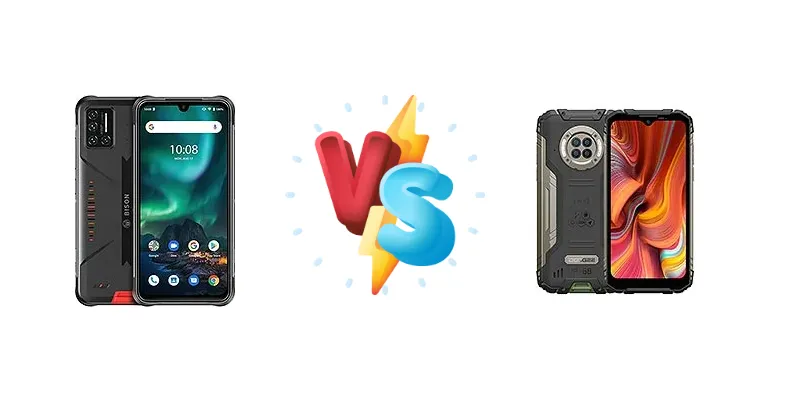
Umidigi Bison vs Doogee S96 Pro: A Deep Dive into Rugged Smartphone Performance
| Phones Images | |||||
|---|---|---|---|---|---|
|
🏆 Quick Verdict
For the average user prioritizing basic functionality and extended battery life, the Umidigi Bison offers a compelling value. However, the Doogee S96 Pro is the clear winner for those needing more processing power for gaming or multitasking, thanks to its superior Helio G90 chipset and faster 24W charging.
| PHONES | ||
|---|---|---|
| Phone Names | Umidigi Bison | Doogee S96 Pro |
| Network | ||
|---|---|---|
| 2G bands | GSM 850 / 900 / 1800 / 1900 | GSM 850 / 900 / 1800 / 1900 |
| 3G bands | HSDPA 800 / 850 / 900 / 1700(AWS) / 1900 / 2100 | HSDPA 800 / 850 / 900 / 1700(AWS) / 1900 / 2100 |
| 4G bands | 1, 2, 3, 4, 5, 7, 8, 12, 13, 17, 18, 19, 20, 26, 28, 34, 38, 39, 40, 41, 66 | 1, 2, 3, 4, 5, 7, 8, 12, 13, 17, 18, 19, 20, 25, 26, 28, 38, 40, 66 |
| Speed | HSPA, LTE | HSPA, LTE |
| Technology | GSM / HSPA / LTE | GSM / CDMA / HSPA / LTE |
| Launch | ||
|---|---|---|
| Announced | 2020. Released 2020 | 2020, October 26. Released 2020, November |
| Status | Discontinued | Discontinued |
| Body | ||
|---|---|---|
| Dimensions | 162.5 x 79.9 x 12.8 mm (6.40 x 3.15 x 0.50 in) | 167 x 81.4 x 15.5 mm (6.57 x 3.20 x 0.61 in) |
| SIM | Nano-SIM + Nano-SIM | Nano-SIM + Nano-SIM |
| Weight | 250 g (8.82 oz) | 310 g (10.93 oz) |
| Display | ||
|---|---|---|
| Protection | Corning Gorilla Glass | Corning Gorilla Glass |
| Resolution | 1080 x 2340 pixels, 19.5:9 ratio (~409 ppi density) | 720 x 1520 pixels, 19:9 ratio (~270 ppi density) |
| Size | 6.3 inches, 97.4 cm2 (~75.0% screen-to-body ratio) | 6.22 inches, 96.6 cm2 (~71.0% screen-to-body ratio) |
| Type | IPS LCD | IPS LCD |
| Platform | ||
|---|---|---|
| CPU | Octa-core (4x2.0 GHz Cortex-A73 & 4x2.0 GHz Cortex-A53) | Octa-core (2x2.0 GHz Cortex-A76 & 6x2.0 GHz Cortex-A55) |
| Chipset | Mediatek Helio P60 (12 nm) | Mediatek MT6785 Helio G90 (12 nm) |
| GPU | Mali-G72 MP3 | Mali-G76 MC4 |
| OS | Android 10 | Android 10 |
| Memory | ||
|---|---|---|
| Card slot | microSDXC (uses shared SIM slot) | microSDXC (dedicated slot) |
| Internal | 128GB 6GB RAM | 128GB 8GB RAM |
| Main Camera | ||
|---|---|---|
| Features | Dual-LED flash, HDR, panorama | Quad-LED flash, HDR, panorama |
| Quad | 48 MP, f/1.8, (wide), 1/2.0", AF 16 MP, 120˚ (ultrawide) 5 MP (macro) Auxiliary lens | 48 MP, f/1.8, (wide), PDAF 8 MP, f/2.2, 130˚, (ultrawide) 20 MP, f/2.8, (night vision), 4 infrared night vision lights 2 MP (macro) |
| Video | 1080p@30fps | 1080p |
| Selfie camera | ||
|---|---|---|
| Single | 24 MP, f/2.0, (wide) | 16 MP, f/2.0, (wide) |
| Video | 1080p@30fps | 1080p |
| Sound | ||
|---|---|---|
| 35mm jack | Yes | Yes |
| Loudspeaker | Yes | Yes |
| Comms | ||
|---|---|---|
| Bluetooth | 4.2, A2DP | 5.0, A2DP, LE |
| NFC | Yes | Yes |
| Positioning | GPS, GLONASS, GALILEO | GPS, GLONASS, BDS, GALILEO |
| Radio | No | FM radio |
| USB | USB Type-C, OTG | USB Type-C 2.0, OTG |
| WLAN | Wi-Fi 802.11 a/b/g/n/ac, dual-band, Wi-Fi Direct | Wi-Fi 802.11 a/b/g/n/ac, dual-band |
| Features | ||
|---|---|---|
| Sensors | Fingerprint (side-mounted), accelerometer, proximity, compass, barometer | Fingerprint (side-mounted), accelerometer, gyro, proximity, compass |
| Battery | ||
|---|---|---|
| Charging | 18W wired | 24W wired 10W wireless |
| Type | 5000 mAh | 6350 mAh |
| Misc | ||
|---|---|---|
| Colors | Cyber Yellow, Lava Orange | Black, Orange, Green |
| Price | - | About 280 EUR |
Umidigi Bison
- More affordable price point
- Potentially longer battery life due to less demanding chipset
- Reliable performance for basic tasks
- Significantly slower performance compared to the S96 Pro
- Slower charging speed
- Less capable for gaming and multitasking
Doogee S96 Pro
- Superior performance with the Helio G90 chipset
- Faster 24W wired and 10W wireless charging
- Better gaming experience
- Higher price tag
- Potentially shorter battery life under heavy load
- May run slightly warmer during intensive tasks
Display Comparison
Neither device's display specifications are provided, so a direct comparison is limited. However, given the Bison's positioning, it likely utilizes a standard IPS LCD panel. The S96 Pro, being a more recent and slightly higher-tier device, may incorporate features like higher peak brightness or improved color calibration. The absence of details like resolution or refresh rate suggests both prioritize durability and battery life over cutting-edge display technology.
Camera Comparison
Without detailed camera specifications, a comprehensive comparison is difficult. However, the market segment suggests the S96 Pro likely features a more advanced camera system. While both phones likely include multiple lenses, the S96 Pro’s chipset offers superior image signal processing (ISP) capabilities, leading to better image quality, especially in low-light conditions. The Bison likely focuses on providing a functional camera for everyday use, while the S96 Pro aims for a more refined photographic experience.
Performance
The core difference lies in the chipsets. The Umidigi Bison’s Mediatek Helio P60, while a capable 12nm processor, features older Cortex-A73 cores. The Doogee S96 Pro’s Helio G90, also 12nm, utilizes newer and more efficient Cortex-A76 cores, resulting in a substantial performance advantage. The G90’s CPU architecture allows for faster single-core and multi-core performance, translating to quicker app loading times and smoother multitasking. This difference is particularly noticeable in gaming; the G90 is designed for gaming and will handle graphically intensive titles far better than the P60. The Bison's CPU configuration (4x2.0 GHz Cortex-A73 & 4x2.0 GHz Cortex-A53) is balanced, but the S96 Pro's (2x2.0 GHz Cortex-A76 & 6x2.0 GHz Cortex-A55) prioritizes peak performance.
Battery Life
Battery capacity isn't specified, but the charging speeds reveal a key difference. The Umidigi Bison’s 18W wired charging is adequate for a budget device, offering a reasonable recharge time. The Doogee S96 Pro’s 24W wired charging, coupled with 10W wireless charging, provides significantly faster and more convenient power replenishment. The wireless charging capability is a notable advantage for the S96 Pro, catering to users who prefer cable-free charging. Even with similar battery capacities, the S96 Pro’s faster charging will minimize downtime.
Buying Guide
Buy the Umidigi Bison if you need a dependable, long-lasting phone for essential tasks like communication, navigation, and basic photography, and value affordability above all else. Buy the Doogee S96 Pro if you prioritize gaming, smoother multitasking, and faster charging, and are willing to spend a bit more for a noticeable performance boost.