
Umidigi Bison X20 vs Bison Pro: Which Rugged Phone Delivers More?
| Phones Images | |||||
|---|---|---|---|---|---|
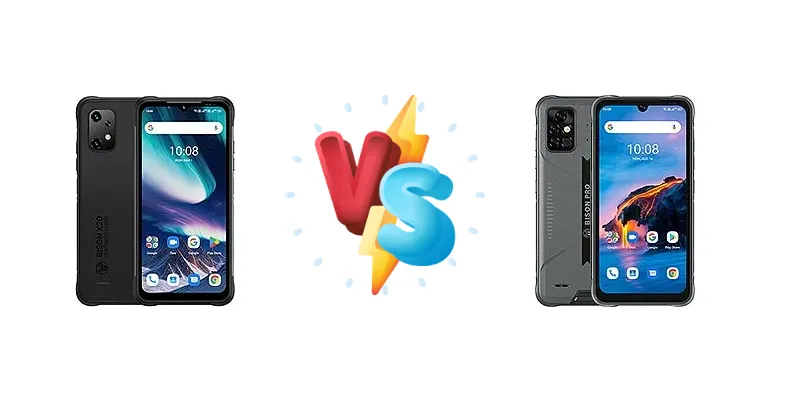
|
🏆 Quick Verdict
For most users, the Umidigi Bison Pro is the superior choice. The Helio G80 chipset provides a noticeable performance boost over the P60, particularly in gaming and multitasking, and the 18W charging significantly reduces downtime. While the X20 remains a viable option for basic use, the Pro’s improvements justify the price difference.
| PHONES | ||
|---|---|---|
| Phone Names | Umidigi Bison X20 | Umidigi Bison Pro |
| Network | ||
|---|---|---|
| 2G bands | GSM 850 / 900 / 1800 / 1900 | GSM 850 / 900 / 1800 / 1900 |
| 3G bands | HSDPA 850 / 900 / 1700(AWS) / 1900 / 2100 | HSDPA 800 / 850 / 900 / 1700(AWS) / 1900 / 2100 |
| 4G bands | 1, 2, 3, 4, 5, 7, 8, 17, 18, 19, 20, 28, 38, 40, 41 | 1, 2, 3, 4, 5, 7, 8, 12, 13, 17, 18, 19, 20, 25, 26, 28, 34, 38, 39, 40, 41, 66 |
| Speed | HSPA, LTE | HSPA, LTE |
| Technology | GSM / CDMA / HSPA / LTE | GSM / CDMA / HSPA / CDMA2000 / LTE |
| Launch | ||
|---|---|---|
| Announced | 2024 | 2021. Released 2021 |
| Status | Available. Released 2024 | Discontinued |
| Body | ||
|---|---|---|
| Dimensions | 172.1 x 83.8 x 12.9 mm (6.78 x 3.30 x 0.51 in) | 164 x 79.6 x 12.7 mm (6.46 x 3.13 x 0.5 in) |
| SIM | Nano-SIM + Nano-SIM | Nano-SIM + Nano-SIM |
| Weight | 278 g (9.81 oz) | 265 g (9.35 oz) |
| Display | ||
|---|---|---|
| Protection | - | Corning Gorilla Glass |
| Resolution | 720 x 1600 pixels, 20:9 ratio (~269 ppi density) | 1080 x 2340 pixels, 19.5:9 ratio (~409 ppi density) |
| Size | 6.53 inches, 102.9 cm2 (~71.4% screen-to-body ratio) | 6.3 inches, 97.4 cm2 (~74.6% screen-to-body ratio) |
| Type | IPS LCD | IPS LCD |
| Platform | ||
|---|---|---|
| CPU | Octa-core (4x2.0 GHz Cortex-A73 & 4x2.0 GHz Cortex-A53) | Octa-core (2x2.0 GHz Cortex-A75 & 6x1.8 GHz Cortex-A55) |
| Chipset | Mediatek Helio P60 (12 nm) | Mediatek Helio G80 (12 nm) |
| GPU | Mali-G72 MP3 | Mali-G52 MC2 |
| OS | Android 13 | Android 11 |
| Memory | ||
|---|---|---|
| Card slot | microSDXC (uses shared SIM slot) | microSDXC (uses shared SIM slot) |
| Internal | 128GB 6GB RAM | 128GB 4GB RAM, 128GB 8GB RAM |
| Main Camera | ||
|---|---|---|
| Dual | 20 MP, f/2.2, (wide) 2 MP (macro) | - |
| Features | LED flash | Dual-LED flash, HDR, panorama |
| Triple | - | 48 MP, f/1.8, (wide), 1/2.0", AF 16 MP, 117˚ (ultrawide) 5 MP (macro) |
| Video | 1080p@30fps | 1080p@30fps |
| Selfie camera | ||
|---|---|---|
| Single | 8 MP, f/2.2, (wide) | 24 MP, f/2.0, (wide) |
| Video | 720p@30fps | 1080p@30fps |
| Sound | ||
|---|---|---|
| 35mm jack | No | Yes |
| Loudspeaker | Yes | Yes |
| Comms | ||
|---|---|---|
| Bluetooth | 4.2, A2DP | 4.2, A2DP |
| NFC | Yes | Yes |
| Positioning | GPS, GLONASS, GALILEO, BDS | GPS, GLONASS, GALILEO |
| Radio | Wireless FM radio | No |
| USB | USB Type-C | USB Type-C, OTG |
| WLAN | Wi-Fi 802.11 a/b/g/n/ac, dual-band | Wi-Fi 802.11 a/b/g/n/ac, dual-band, Wi-Fi Direct |
| Features | ||
|---|---|---|
| Sensors | Fingerprint (side-mounted), accelerometer, proximity, compass | Fingerprint (side-mounted), accelerometer, proximity, compass, barometer, thermometer (skin temperature) |
| Battery | ||
|---|---|---|
| Charging | 10W wired | 18W wired |
| Type | 6000 mAh | 5000 mAh |
| Misc | ||
|---|---|---|
| Colors | Graphite Black | Storm Gray, Hack Black |
| Price | About 120 EUR | - |
Umidigi Bison X20
- Lower price point makes it highly accessible.
- Durable build quality expected from the Bison series.
- Sufficient for basic smartphone tasks.
- Helio P60 chipset feels dated and struggles with demanding apps.
- Slow 10W charging is inconvenient.
- Limited gaming performance.
Umidigi Bison Pro
- Helio G80 chipset delivers a noticeable performance boost.
- 18W fast charging reduces charging times.
- Improved gaming experience compared to the X20.
- Higher price compared to the Bison X20.
- Still utilizes an LCD panel, lacking the vibrancy of AMOLED.
- Rugged design may add bulk.
Display Comparison
Both phones likely feature similar LCD panels given their market segment, but detailed display specs (resolution, brightness) are unavailable. The focus here is on processing power, not display fidelity. Bezels are expected to be substantial on both, prioritizing durability over a modern, edge-to-edge look.
Camera Comparison
Without detailed camera specifications, a direct comparison is difficult. However, it’s reasonable to assume both phones feature similar camera setups focused on practicality rather than high-end photography. The image signal processor (ISP) within the Helio G80 may offer slightly improved image processing capabilities compared to the P60, potentially resulting in better dynamic range and noise reduction. The absence of information on sensor sizes and apertures prevents a more definitive assessment.
Performance
The core difference lies in the chipsets. The Bison Pro’s Mediatek Helio G80 utilizes two Cortex-A75 cores clocked at 2.0 GHz, alongside six Cortex-A55 cores at 1.8 GHz. This is a significant upgrade over the Bison X20’s Helio P60, which employs four Cortex-A73 cores at 2.0 GHz and four Cortex-A53 cores at 2.0 GHz. The A75 cores in the G80 offer superior single-core performance, translating to snappier app launches and smoother multitasking. The G80 also benefits from a more modern GPU, providing a better gaming experience. While both are 12nm chips, the architectural improvements in the G80 deliver a tangible performance advantage.
Battery Life
Battery capacity is not specified, but both phones are likely equipped with batteries in the 4000-5000 mAh range, typical for rugged devices. The Bison Pro’s 18W wired charging is a clear advantage over the X20’s 10W charging. This translates to significantly faster charging times, reducing downtime and improving usability. A full charge on the Bison Pro will likely take around 2-2.5 hours, while the X20 could require 3+ hours.
Buying Guide
Buy the Umidigi Bison X20 if you prioritize absolute affordability and only need a phone for essential tasks like calls, texts, and light social media. Its Helio P60 is sufficient for these workloads. Buy the Umidigi Bison Pro if you want a more responsive experience, enjoy mobile gaming, or frequently use demanding apps – the Helio G80 and faster charging will be well worth the investment.