
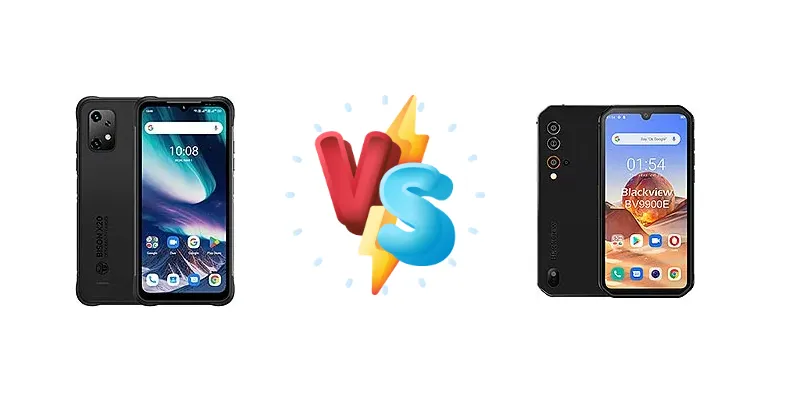
Umidigi Bison X20 vs Blackview BV9900E: A Deep Dive into Rugged Smartphone Performance
| Phones Images | |||||
|---|---|---|---|---|---|
|
🏆 Quick Verdict
For the average user prioritizing performance and future-proofing, the Blackview BV9900E is the better choice. Its Helio P90 chipset provides a noticeable performance uplift over the Bison X20’s Helio P60, and the inclusion of 15W wired and 18W wireless charging adds significant convenience. While the Bison X20 offers a lower entry price, the BV9900E’s extra capabilities justify the cost difference.
| PHONES | ||
|---|---|---|
| Phone Names | Umidigi Bison X20 | Blackview BV9900E |
| Network | ||
|---|---|---|
| 2G bands | GSM 850 / 900 / 1800 / 1900 | GSM 850 / 900 / 1800 / 1900 |
| 3G bands | HSDPA 850 / 900 / 1700(AWS) / 1900 / 2100 | HSDPA 800 / 850 / 900 / 1700(AWS) / 1900 / 2100 |
| 4G bands | 1, 2, 3, 4, 5, 7, 8, 17, 18, 19, 20, 28, 38, 40, 41 | 1, 2, 3, 4, 5, 7, 8, 12, 13, 17, 18, 19, 20, 25, 26, 28, 34, 38, 39, 40, 41, 66 |
| Speed | HSPA, LTE | HSPA, LTE |
| Technology | GSM / CDMA / HSPA / LTE | GSM / CDMA / HSPA / CDMA2000 / LTE |
| Launch | ||
|---|---|---|
| Announced | 2024 | 2020, September 10. Released 2020, September |
| Status | Available. Released 2024 | Discontinued |
| Body | ||
|---|---|---|
| Dimensions | 172.1 x 83.8 x 12.9 mm (6.78 x 3.30 x 0.51 in) | 156.5 x 78.3 x 14.2 mm (6.16 x 3.08 x 0.56 in) |
| SIM | Nano-SIM + Nano-SIM | Nano-SIM + Nano-SIM |
| Weight | 278 g (9.81 oz) | 273 g (9.63 oz) |
| Display | ||
|---|---|---|
| Protection | - | Corning Gorilla Glass 5 |
| Resolution | 720 x 1600 pixels, 20:9 ratio (~269 ppi density) | 1080 x 2280 pixels, 19:9 ratio (~432 ppi density) |
| Size | 6.53 inches, 102.9 cm2 (~71.4% screen-to-body ratio) | 5.84 inches, 85.1 cm2 (~69.5% screen-to-body ratio) |
| Type | IPS LCD | IPS LCD |
| Platform | ||
|---|---|---|
| CPU | Octa-core (4x2.0 GHz Cortex-A73 & 4x2.0 GHz Cortex-A53) | Octa-core (2x2.2 GHz Cortex-A75 & 6x2.0 GHz Cortex-A55) |
| Chipset | Mediatek Helio P60 (12 nm) | Mediatek MT6779V/CE Helio P90 (12 nm) |
| GPU | Mali-G72 MP3 | PowerVR GM9446 |
| OS | Android 13 | Android 10 |
| Memory | ||
|---|---|---|
| Card slot | microSDXC (uses shared SIM slot) | microSDXC |
| Internal | 128GB 6GB RAM | 128GB 6GB RAM |
| Main Camera | ||
|---|---|---|
| Dual | 20 MP, f/2.2, (wide) 2 MP (macro) | - |
| Features | LED flash | LED flash, HDR, panorama |
| Quad | - | 48 MP, f/1.8, (wide), PDAF 16 MP, 120˚ (ultrawide) 2 MP (macro) Auxiliary lens |
| Video | 1080p@30fps | 4K@30fps, 1080p@60fps |
| Selfie camera | ||
|---|---|---|
| Single | 8 MP, f/2.2, (wide) | 16 MP, f/2.0, (wide) |
| Video | 720p@30fps | 1080p@30fps |
| Sound | ||
|---|---|---|
| 35mm jack | No | No |
| Loudspeaker | Yes | Yes |
| Comms | ||
|---|---|---|
| Bluetooth | 4.2, A2DP | 5.0, A2DP, LE |
| NFC | Yes | Yes |
| Positioning | GPS, GLONASS, GALILEO, BDS | GPS, GLONASS, GALILEO, BDS |
| Radio | Wireless FM radio | FM radio |
| USB | USB Type-C | USB Type-C 2.0, OTG |
| WLAN | Wi-Fi 802.11 a/b/g/n/ac, dual-band | Wi-Fi 802.11 a/b/g/n/ac |
| Features | ||
|---|---|---|
| Sensors | Fingerprint (side-mounted), accelerometer, proximity, compass | Fingerprint (side-mounted), accelerometer, gyro, proximity, compass, barometer |
| Battery | ||
|---|---|---|
| Charging | 10W wired | 15W wired 18W wireless |
| Type | 6000 mAh | 4380 mAh |
| Misc | ||
|---|---|---|
| Colors | Graphite Black | Black, Silver |
| Price | About 120 EUR | About 260 EUR |
Umidigi Bison X20
- More affordable price point
- Rugged design for durability
- Functional for basic smartphone tasks
- Less powerful Helio P60 chipset
- Slower 10W wired charging only
- Likely limited multitasking capabilities
Blackview BV9900E
- More powerful Helio P90 chipset
- 15W wired and 18W wireless charging
- Improved performance for gaming and multitasking
- Higher price compared to Bison X20
- Rugged design may add bulk
- Potentially shorter battery life due to increased performance
Display Comparison
Neither device’s display specifications are provided, so a direct comparison is limited. However, given the price points, both likely utilize IPS LCD panels. The BV9900E, being the higher-tier device, *may* feature a slightly higher resolution or improved color calibration. The absence of details like refresh rate or peak brightness suggests neither phone is focused on display excellence, prioritizing durability and battery life instead. Users should expect functional, rather than stunning, visual experiences.
Camera Comparison
Without detailed camera specifications, a precise comparison is difficult. However, the chipset difference suggests the BV9900E will have a more capable image signal processor (ISP), leading to better image processing and potentially improved low-light performance. The ISP within the Helio P90 is designed to handle more complex image processing algorithms. It’s reasonable to assume the BV9900E will offer a more refined camera experience, even if the sensor sizes are similar. The prevalence of 2MP macro lenses on both devices suggests these are largely marketing features and shouldn’t be a primary consideration.
Performance
The core difference lies in the chipsets. The Blackview BV9900E’s Mediatek Helio P90 (12nm) significantly outperforms the Umidigi Bison X20’s Helio P60 (12nm). The P90 utilizes a more modern CPU architecture – 2x2.2 GHz Cortex-A75 cores and 6x2.0 GHz Cortex-A55 cores – compared to the P60’s 4x2.0 GHz Cortex-A73 and 4x2.0 GHz Cortex-A53. This translates to faster app loading times, smoother multitasking, and improved gaming performance on the BV9900E. While both are 12nm chips, the architectural improvements of the P90 provide a tangible benefit. The P90’s more powerful GPU will also handle graphically intensive tasks more effectively.
Battery Life
Battery capacity isn’t specified for either device, but the charging capabilities reveal a key difference. The Blackview BV9900E supports 15W wired charging *and* 18W wireless charging, offering significant convenience. The Umidigi Bison X20 is limited to 10W wired charging. This means the BV9900E will recharge considerably faster, especially with wireless charging as an option. Even if the Bison X20 has a slightly larger battery capacity, the faster charging of the BV9900E will likely result in less downtime.
Buying Guide
Buy the Umidigi Bison X20 if you need a highly affordable, basic rugged phone for essential tasks like calls, texts, and light app usage. It’s ideal for users who prioritize durability over demanding performance. Buy the Blackview BV9900E if you prefer a more capable rugged phone that can handle multitasking, moderate gaming, and benefits from faster charging speeds, both wired and wirelessly. This is the better option for users who want a phone that can keep up with their active lifestyle.