
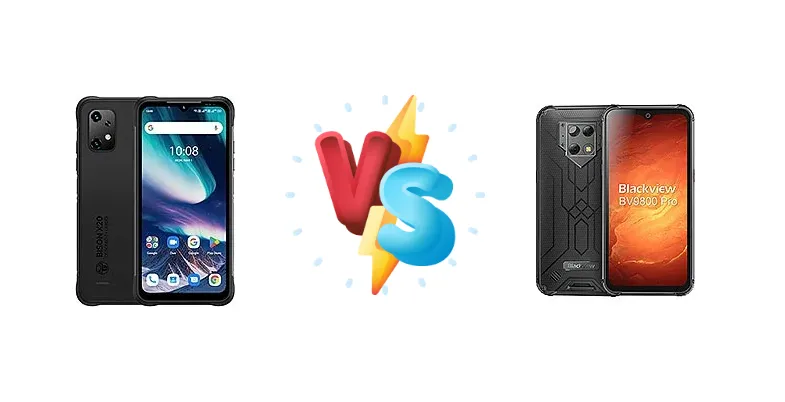
Umidigi Bison X20 vs Blackview BV9800 Pro: A Deep Dive into Rugged Mid-Rangers
| Phones Images | |||||
|---|---|---|---|---|---|
|
🏆 Quick Verdict
For the average user needing a dependable rugged phone, the Blackview BV9800 Pro is the better choice. Its Helio P70 chipset offers a slight performance advantage, and the 18W charging significantly reduces downtime compared to the Bison X20’s slower 10W charging.
| PHONES | ||
|---|---|---|
| Phone Names | Umidigi Bison X20 | Blackview BV9800 Pro |
| Network | ||
|---|---|---|
| 2G bands | GSM 850 / 900 / 1800 / 1900 | GSM 850 / 900 / 1800 / 1900 |
| 3G bands | HSDPA 850 / 900 / 1700(AWS) / 1900 / 2100 | HSDPA 800 / 850 / 900 / 1700(AWS) / 1900 / 2100 |
| 4G bands | 1, 2, 3, 4, 5, 7, 8, 17, 18, 19, 20, 28, 38, 40, 41 | 1, 2, 3, 4, 5, 6, 7, 8, 12, 13, 17, 18, 19, 20, 25, 26, 28, 34, 38, 39, 40, 41, 66 |
| Speed | HSPA, LTE | HSPA, LTE |
| Technology | GSM / CDMA / HSPA / LTE | GSM / CDMA / HSPA / CDMA2000 / LTE |
| Launch | ||
|---|---|---|
| Announced | 2024 | 2019, October 28. Released 2019, November |
| Status | Available. Released 2024 | Discontinued |
| Body | ||
|---|---|---|
| Dimensions | 172.1 x 83.8 x 12.9 mm (6.78 x 3.30 x 0.51 in) | 168.5 x 81 x 14.8 mm (6.63 x 3.19 x 0.58 in) |
| SIM | Nano-SIM + Nano-SIM | Nano-SIM + Nano-SIM |
| Weight | 278 g (9.81 oz) | 322 g (11.36 oz) |
| Display | ||
|---|---|---|
| Resolution | 720 x 1600 pixels, 20:9 ratio (~269 ppi density) | 1080 x 2340 pixels, 19.5:9 ratio (~409 ppi density) |
| Size | 6.53 inches, 102.9 cm2 (~71.4% screen-to-body ratio) | 6.3 inches, 97.4 cm2 (~71.4% screen-to-body ratio) |
| Type | IPS LCD | IPS LCD |
| Platform | ||
|---|---|---|
| CPU | Octa-core (4x2.0 GHz Cortex-A73 & 4x2.0 GHz Cortex-A53) | Octa-core (4x2.1 GHz Cortex-A73 & 4x2.0 GHz Cortex-A53) |
| Chipset | Mediatek Helio P60 (12 nm) | Mediatek MT6771V/CT Helio P70 (12 nm) |
| GPU | Mali-G72 MP3 | Mali-G72 MP3 |
| OS | Android 13 | Android 9.0 (Pie) |
| Memory | ||
|---|---|---|
| Card slot | microSDXC (uses shared SIM slot) | microSDXC |
| Internal | 128GB 6GB RAM | 128GB 6GB RAM |
| Main Camera | ||
|---|---|---|
| Dual | 20 MP, f/2.2, (wide) 2 MP (macro) | - |
| Features | LED flash | Thermal imaging, LED flash |
| Triple | - | 48 MP, (wide), PDAF 5 MP, thermal assisted camera FLIR thermal camera (Lepton module) |
| Video | 1080p@30fps | 1080p@30fps |
| Selfie camera | ||
|---|---|---|
| Single | 8 MP, f/2.2, (wide) | 16 MP, f/2.0, (wide) |
| Video | 720p@30fps | 1080p@30fps |
| Sound | ||
|---|---|---|
| 35mm jack | No | Yes |
| Loudspeaker | Yes | Yes |
| Comms | ||
|---|---|---|
| Bluetooth | 4.2, A2DP | 4.1, A2DP |
| NFC | Yes | Yes |
| Positioning | GPS, GLONASS, GALILEO, BDS | GPS, GLONASS, GALILEO |
| Radio | Wireless FM radio | FM radio |
| USB | USB Type-C | USB Type-C 2.0, OTG |
| WLAN | Wi-Fi 802.11 a/b/g/n/ac, dual-band | Wi-Fi 802.11 a/b/g/n/ac |
| Features | ||
|---|---|---|
| Sensors | Fingerprint (side-mounted), accelerometer, proximity, compass | Fingerprint (side-mounted), accelerometer, gyro, proximity, compass, barometer |
| Battery | ||
|---|---|---|
| Charging | 10W wired | 18W wired |
| Type | 6000 mAh | 6580 mAh |
| Misc | ||
|---|---|---|
| Colors | Graphite Black | Black, Orange |
| Price | About 120 EUR | About 340 EUR |
Umidigi Bison X20
- Lower price point makes it accessible.
- Rugged design provides excellent durability.
- Adequate performance for basic tasks.
- Slow 10W charging is a significant drawback.
- Helio P60 chipset is less powerful than the P70.
- Likely lower quality camera system.
Blackview BV9800 Pro
- Faster 18W charging reduces downtime.
- Helio P70 chipset offers a performance boost.
- Potentially better camera system with larger sensor.
- Higher price compared to the Umidigi Bison X20.
- Rugged design may be bulky.
- Software updates may be infrequent.
Display Comparison
Neither device’s display specifications are provided, so a direct comparison is limited. However, given the market segment, both likely utilize IPS LCD panels. The BV9800 Pro, being positioned slightly higher, may benefit from a marginally better color calibration or slightly higher peak brightness. Bezels are expected to be substantial on both, prioritizing durability over a modern, edge-to-edge design.
Camera Comparison
Without detailed camera specifications, a comprehensive comparison is difficult. Both phones likely feature multi-camera setups, but the quality will heavily depend on sensor size and image processing. It’s reasonable to assume the BV9800 Pro, being the more premium device, will have a larger primary sensor, resulting in better low-light performance and dynamic range. The inclusion of Optical Image Stabilization (OIS) on the BV9800 Pro would further enhance image quality, particularly in video recording. The presence of 2MP macro lenses on both devices is largely a marketing tactic, offering limited practical benefit due to their small sensor size and low resolution.
Performance
The Blackview BV9800 Pro’s Mediatek Helio P70 chipset represents a modest upgrade over the Umidigi Bison X20’s Helio P60. While both are 12nm chips utilizing the same Cortex-A73 and A53 core configuration, the P70’s cores clock slightly higher – 2.1 GHz vs 2.0 GHz for the A73 cores. This translates to a small but noticeable improvement in application launch times and overall system responsiveness. The P70 also features a more efficient Neural Processing Unit (NPU) for AI tasks, though the real-world impact on these devices is likely minimal. Both phones will handle everyday tasks adequately, but the BV9800 Pro will exhibit less strain during multitasking and moderately demanding games.
Battery Life
While battery capacity isn’t specified, the charging wattage is a key differentiator. The Blackview BV9800 Pro’s 18W wired charging is significantly faster than the Umidigi Bison X20’s 10W charging. This means the BV9800 Pro can replenish its battery from 0-100% much quicker, reducing downtime. Even with a similar battery capacity, the faster charging speed provides a tangible advantage for users who rely heavily on their phones throughout the day. The Bison X20’s slower charging will require a longer connection to the charger, making it less convenient for quick top-ups.
Buying Guide
Buy the Umidigi Bison X20 if you prioritize a lower initial cost and are comfortable with slower charging speeds. It’s ideal for users who need a basic, durable phone for work or outdoor activities without demanding performance. Buy the Blackview BV9800 Pro if you value faster charging, a marginally more powerful processor for smoother multitasking, and are willing to spend a bit more for a more refined user experience.