
Umidigi Bison X10S vs Bison 2 Pro: Which Rugged Phone Reigns Supreme?
| Phones Images | |||||
|---|---|---|---|---|---|
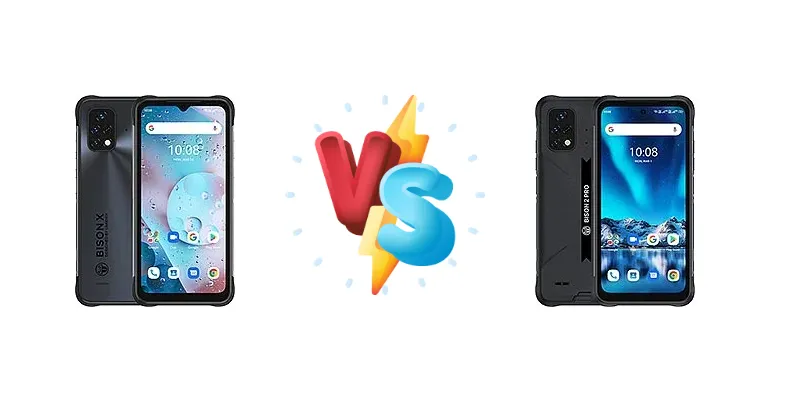
|
🏆 Quick Verdict
For the average user needing a dependable, rugged phone, the Umidigi Bison 2 Pro is the better choice. Its Mediatek Helio P90 chipset provides a significant performance uplift over the Bison X10S’s Unisoc Tiger T310, translating to smoother multitasking and a more responsive user experience, despite the slightly slower 18W charging.
| PHONES | ||
|---|---|---|
| Phone Names | Umidigi Bison X10S | Umidigi Bison 2 Pro |
| Network | ||
|---|---|---|
| 2G bands | GSM 850 / 900 / 1800 / 1900 | GSM 850 / 900 / 1800 / 1900 |
| 3G bands | HSDPA 850 / 900 / 1700(AWS) / 1900 / 2100 | HSDPA 800 / 850 / 900 / 1700(AWS) / 1900 / 2100 |
| 4G bands | 1, 2, 3, 4, 5, 7, 8, 12, 13, 17, 18, 19, 20, 25, 26, 28, 34, 38, 39, 40, 41, 66 | 1, 2, 3, 4, 5, 7, 8, 12, 13, 17, 18, 19, 20, 25, 26, 28, 34, 38, 39, 40, 41, 66 |
| Speed | HSPA, LTE | HSPA, LTE |
| Technology | GSM / HSPA / LTE | GSM / CDMA / HSPA / LTE |
| Launch | ||
|---|---|---|
| Announced | 2021. Released 2021 | 2022 |
| Status | Discontinued | Available. Released 2022 |
| Body | ||
|---|---|---|
| Dimensions | 172.1 x 83.8 x 12.9 mm (6.78 x 3.30 x 0.51 in) | 172.1 x 83.8 x 12.9 mm (6.78 x 3.30 x 0.51 in) |
| SIM | Nano-SIM + Nano-SIM | Nano-SIM + Nano-SIM |
| Weight | 279 g (9.84 oz) | 280 g (9.88 oz) |
| Display | ||
|---|---|---|
| Resolution | 720 x 1600 pixels, 20:9 ratio (~269 ppi density) | 1080 x 2400 pixels, 20:9 ratio (~405 ppi density) |
| Size | 6.53 inches, 102.9 cm2 (~71.4% screen-to-body ratio) | 6.5 inches, 102.0 cm2 (~70.7% screen-to-body ratio) |
| Type | IPS LCD | IPS LCD |
| Platform | ||
|---|---|---|
| CPU | Quad-core (1x2.0 GHz Cortex-A75 & 3x1.8 GHz Cortex-A55) | Octa-core (2x2.2 GHz Cortex-A75 & 6x2.0 GHz Cortex-A55) |
| Chipset | Unisoc Tiger T310 (12nm) | Mediatek Helio P90 (12 nm) |
| GPU | PowerVR GE8300 | PowerVR GM9446 |
| OS | Android 11 | Android 12 |
| Memory | ||
|---|---|---|
| Card slot | microSDXC (uses shared SIM slot) | microSDXC (uses shared SIM slot) |
| Internal | 32GB 4GB RAM | 256GB 8GB RAM |
| Main Camera | ||
|---|---|---|
| Features | Dual-LED flash, HDR, panorama | Dual-LED flash, HDR |
| Triple | 16 MP, f/2.2, (wide), AF 8 MP, 119˚ (ultrawide) 5 MP (macro) | 48 MP, f/2.2, (wide), AF 16 MP, f/2.2, (ultrawide) 5 MP (macro) |
| Video | 1080p@30fps | 1080p@30fps |
| Selfie camera | ||
|---|---|---|
| Single | 8 MP, f/2.2, (wide) | 24 MP, f/2.0, (wide) |
| Video | 1080p@30fps | 1080p@30fps |
| Sound | ||
|---|---|---|
| 35mm jack | Yes | Yes |
| Loudspeaker | Yes | Yes |
| Comms | ||
|---|---|---|
| Bluetooth | 5.0, A2DP, LE | 5.0, A2DP, LE |
| NFC | No | Yes |
| Positioning | GPS, GLONASS, GALILEO, BDS | GPS, GLONASS, GALILEO, BDS |
| Radio | Wireless FM radio | Wireless FM radio |
| USB | USB Type-C, OTG | USB Type-C, OTG |
| WLAN | Wi-Fi 802.11 a/b/g/n, dual-band, Wi-Fi Direct | Wi-Fi 802.11 a/b/g/n/ac, dual-band, Wi-Fi Direct |
| Features | ||
|---|---|---|
| Sensors | Accelerometer, proximity, compass | Fingerprint (side-mounted), accelerometer, proximity, compass, barometer, thermometer (skin temperature) |
| Battery | ||
|---|---|---|
| Charging | 10W wired | 18W wired |
| Type | 6150 mAh | 6150 mAh |
| Misc | ||
|---|---|---|
| Colors | Storm Grey | Black |
Umidigi Bison X10S
- Most affordable option
- Rugged design for durability
- Decent for basic smartphone tasks
- Significantly weaker performance
- Slow 10W charging
- Limited multitasking capabilities
Umidigi Bison 2 Pro
- Faster and more responsive performance
- Faster 18W charging
- Better suited for gaming and demanding apps
- Higher price point
- May experience some throttling under sustained load
- Potentially less battery life due to higher power consumption
Display Comparison
Neither Umidigi provides detailed display specifications beyond basic resolution. However, the focus on ruggedness suggests both likely utilize IPS LCD panels for durability. The lack of information prevents a detailed comparison of brightness or color accuracy. The Bison 2 Pro’s slightly higher price *could* indicate a marginally better panel, but this is speculative. Both phones prioritize function over form in this area, focusing on visibility in outdoor conditions rather than cinematic quality.
Camera Comparison
Without detailed camera specs, a direct comparison is difficult. Both phones likely feature multiple rear cameras to offer versatility, but the quality will depend heavily on sensor size and image processing. Given the price points, expect both to struggle in low-light conditions. The Bison 2 Pro’s slightly higher price *might* suggest a better primary sensor, but this is unconfirmed. It’s safe to assume both will include standard features like HDR and scene detection, but don’t expect flagship-level image quality.
Performance
The core difference lies in the chipsets. The Bison X10S’s Unisoc Tiger T310 is a quad-core processor built on a 12nm process. This is geared towards efficiency, but sacrifices raw power. The Bison 2 Pro, however, boasts the Mediatek Helio P90, an octa-core processor also on 12nm, but with a more potent configuration: 2x2.2 GHz Cortex-A75 cores and 6x2.0 GHz Cortex-A55 cores versus the X10S’s 1x2.0 GHz Cortex-A75 and 3x1.8 GHz Cortex-A55. This translates to a substantial performance advantage for the Bison 2 Pro in CPU-intensive tasks and gaming. While both use the same process node, the higher core count and clock speeds of the Helio P90 will result in significantly faster application loading and smoother multitasking. The Bison 2 Pro is the clear winner for users who demand more from their smartphone.
Battery Life
Battery capacity isn’t specified for either device, but both are likely in the 4000-5000 mAh range, typical for rugged phones. The Bison 2 Pro has a clear advantage in charging speed with 18W wired charging compared to the X10S’s 10W. This means the Bison 2 Pro will reach a full charge significantly faster, reducing downtime. While a larger battery capacity on the X10S could offset this, the faster charging of the Bison 2 Pro is a more tangible benefit for daily use.
Buying Guide
Buy the Umidigi Bison X10S if you prioritize absolute affordability and only need a phone for basic tasks like calls, texts, and light social media. Its lower price point makes it ideal for users on a tight budget or those needing a secondary, ultra-durable device. Buy the Umidigi Bison 2 Pro if you value performance and responsiveness, especially if you plan on using demanding apps, playing mobile games, or frequently multitasking. The Helio P90 offers a noticeable advantage in these scenarios, justifying the slightly higher cost.