
Umidigi Bison X10S vs Oukitel WP17: A Deep Dive into Rugged Smartphone Performance
| Phones Images | |||||
|---|---|---|---|---|---|
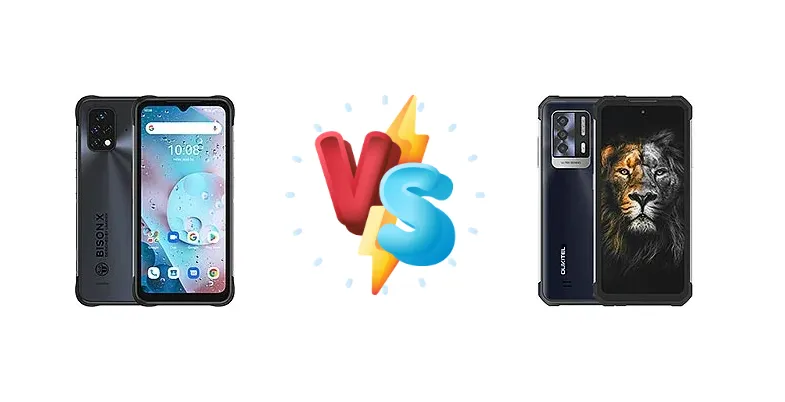
|
🏆 Quick Verdict
For the average user needing a reliable, durable phone for basic tasks and moderate use, the Oukitel WP17 emerges as the stronger choice. Its Helio G95 chipset provides a substantial performance uplift over the Bison X10S’s Tiger T310, translating to smoother multitasking and a more responsive experience, despite the slower charging.
| PHONES | ||
|---|---|---|
| Phone Names | Umidigi Bison X10S | Oukitel WP17 |
| Network | ||
|---|---|---|
| 2G bands | GSM 850 / 900 / 1800 / 1900 | GSM 850 / 900 / 1800 / 1900 |
| 3G bands | HSDPA 850 / 900 / 1700(AWS) / 1900 / 2100 | HSDPA 850 / 900 / 1700(AWS) / 1900 / 2100 |
| 4G bands | 1, 2, 3, 4, 5, 7, 8, 12, 13, 17, 18, 19, 20, 25, 26, 28, 34, 38, 39, 40, 41, 66 | 1, 2, 3, 4, 5, 7, 8, 12, 13, 17, 18, 19, 20, 25, 26, 28, 66 |
| Speed | HSPA, LTE | HSPA, LTE |
| Technology | GSM / HSPA / LTE | GSM / HSPA / LTE |
| Launch | ||
|---|---|---|
| Announced | 2021. Released 2021 | 2021, October |
| Status | Discontinued | Available. Released 2021, October |
| Body | ||
|---|---|---|
| Dimensions | 172.1 x 83.8 x 12.9 mm (6.78 x 3.30 x 0.51 in) | - |
| SIM | Nano-SIM + Nano-SIM | Nano-SIM + Nano-SIM |
| Weight | 279 g (9.84 oz) | - |
| Display | ||
|---|---|---|
| Resolution | 720 x 1600 pixels, 20:9 ratio (~269 ppi density) | 1080 x 2400 pixels, 20:9 ratio (~388 ppi density) |
| Size | 6.53 inches, 102.9 cm2 (~71.4% screen-to-body ratio) | 6.78 inches, 111.0 cm2 |
| Type | IPS LCD | IPS LCD, 90Hz |
| Platform | ||
|---|---|---|
| CPU | Quad-core (1x2.0 GHz Cortex-A75 & 3x1.8 GHz Cortex-A55) | Octa-core (2x2.05 GHz Cortex-A76 & 6x2.0 GHz Cortex-A55) |
| Chipset | Unisoc Tiger T310 (12nm) | Mediatek MT6785V/CD Helio G95 (12 nm) |
| GPU | PowerVR GE8300 | Mali-G76 MC4 |
| OS | Android 11 | Android 11 |
| Memory | ||
|---|---|---|
| Card slot | microSDXC (uses shared SIM slot) | microSDXC |
| Internal | 32GB 4GB RAM | 128GB 8GB RAM |
| Main Camera | ||
|---|---|---|
| Features | Dual-LED flash, HDR, panorama | LED flash, panorama |
| Triple | 16 MP, f/2.2, (wide), AF 8 MP, 119˚ (ultrawide) 5 MP (macro) | 64 MP, f/1.8, (wide), PDAF 20 MP, f/2.0, (night vision), 4 infrared night vision lights 2 MP (macro) |
| Video | 1080p@30fps | 4K@30fps, 1080p@30fps |
| Selfie camera | ||
|---|---|---|
| Single | 8 MP, f/2.2, (wide) | 16 MP |
| Video | 1080p@30fps | Yes |
| Sound | ||
|---|---|---|
| 35mm jack | Yes | Unspecified |
| Loudspeaker | Yes | Yes |
| Comms | ||
|---|---|---|
| Bluetooth | 5.0, A2DP, LE | Yes |
| NFC | No | Yes |
| Positioning | GPS, GLONASS, GALILEO, BDS | GPS, GLONASS, GALILEO, BDS |
| Radio | Wireless FM radio | Unspecified |
| USB | USB Type-C, OTG | USB Type-C 2.0, OTG |
| WLAN | Wi-Fi 802.11 a/b/g/n, dual-band, Wi-Fi Direct | Yes |
| Features | ||
|---|---|---|
| Sensors | Accelerometer, proximity, compass | Unspecified |
| Battery | ||
|---|---|---|
| Charging | 10W wired | - |
| Type | 6150 mAh | Li-Po 8300 mAh |
| Misc | ||
|---|---|---|
| Colors | Storm Grey | Blue, Camo, Camouflage |
| Price | - | About 240 EUR |
Umidigi Bison X10S
- Likely more affordable price point.
- Potentially longer battery life if equipped with a larger capacity battery.
- Rugged design for durability.
- Significantly weaker processor performance.
- Slower app loading times and multitasking.
- Less suitable for gaming or demanding applications.
Oukitel WP17
- Faster and more responsive performance thanks to the Helio G95.
- Smoother multitasking and gaming experience.
- Potentially better image processing capabilities.
- Slower 10W charging.
- Likely a higher price point than the Bison X10S.
- May not offer significantly better battery life than the Bison X10S.
Display Comparison
Neither device’s display specifications are provided, so a direct comparison is limited. However, given the price points, both likely utilize IPS LCD panels. The Oukitel WP17, being positioned slightly higher, may benefit from a higher peak brightness for improved outdoor visibility. Bezels are likely comparable, reflecting the rugged design focus over maximizing screen real estate. Color accuracy is expected to be standard for this segment, prioritizing durability over color fidelity.
Camera Comparison
Without detailed camera specifications, a direct comparison is challenging. However, rugged phones often prioritize durability over camera quality. Both devices likely feature a primary camera for general photography, but image processing capabilities will likely differ. The G95’s ISP (Image Signal Processor) in the WP17 may offer slightly better image processing, potentially resulting in more detailed and vibrant photos. The presence of a 2MP macro camera on either device is largely a marketing tactic, offering limited practical benefit due to the small sensor size and low resolution.
Performance
The core difference lies in the chipsets. The Oukitel WP17’s MediaTek Helio G95 (12nm) is a significant upgrade over the Umidigi Bison X10S’s Unisoc Tiger T310 (12nm). The G95’s octa-core configuration (2x2.05 GHz Cortex-A76 & 6x2.0 GHz Cortex-A55) provides substantially more processing power than the T310’s quad-core setup (1x2.0 GHz Cortex-A75 & 3x1.8 GHz Cortex-A55). The Cortex-A76 cores in the G95 offer a considerable architectural advantage over the A75 cores in the T310, resulting in faster single-core performance, crucial for app responsiveness. While both are 12nm, the G95’s more efficient design and higher clock speeds translate to better overall performance. This benefits users who multitask, play mobile games, or use demanding applications.
Battery Life
Battery capacity isn’t specified for either device, but rugged phones typically prioritize large batteries. The Oukitel WP17’s 10W charging is significantly slower than what’s becoming standard, even in this price range. The Bison X10S also features 10W charging. This means longer charge times for both devices, but the WP17 will be noticeably slower. A larger battery capacity on the Bison X10S could offset the slower charging, but without that information, the WP17’s more efficient chipset may result in comparable real-world battery life despite a potentially smaller battery.
Buying Guide
Buy the Umidigi Bison X10S if you prioritize extreme value and are primarily focused on essential smartphone functions like calls, texts, and light social media use. Its lower price point makes it ideal for those needing a backup phone or a durable device for demanding work environments where replacement costs are a concern. Buy the Oukitel WP17 if you prefer a more fluid user experience, enjoy occasional gaming, or require faster app loading times. The G95 chipset offers a noticeable performance advantage for users who demand more from their smartphone.