
Umidigi Bison X10S vs Blackview BV8800: A Deep Dive into Rugged Smartphone Value
| Phones Images | |||||
|---|---|---|---|---|---|
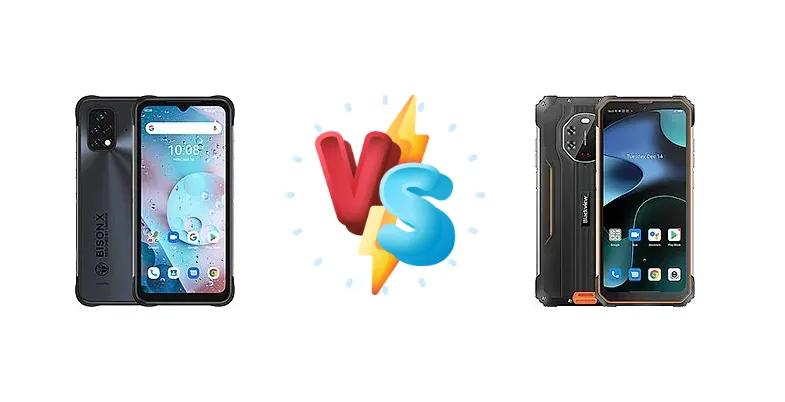
|
🏆 Quick Verdict
For the average user prioritizing affordability and basic functionality, the Umidigi Bison X10S offers a functional experience. However, the Blackview BV8800 emerges as the stronger choice, thanks to its significantly more powerful Helio G96 chipset and 33W fast charging, justifying its higher price point for those needing more performance.
| PHONES | ||
|---|---|---|
| Phone Names | Umidigi Bison X10S | Blackview BV8800 |
| Network | ||
|---|---|---|
| 2G bands | GSM 850 / 900 / 1800 / 1900 | GSM 850 / 900 / 1800 / 1900 |
| 3G bands | HSDPA 850 / 900 / 1700(AWS) / 1900 / 2100 | HSDPA 800 / 850 / 900 / 1700(AWS) / 1900 / 2100 |
| 4G bands | 1, 2, 3, 4, 5, 7, 8, 12, 13, 17, 18, 19, 20, 25, 26, 28, 34, 38, 39, 40, 41, 66 | 1, 2, 3, 4, 5, 7, 8, 12, 13, 17, 18, 19, 20, 25, 26, 28, 30, 34, 38, 39, 40, 41, 66 |
| Speed | HSPA, LTE | HSPA, LTE |
| Technology | GSM / HSPA / LTE | GSM / CDMA / HSPA / CDMA2000 / LTE |
| - | CDMA2000 1x | |
| Launch | ||
|---|---|---|
| Announced | 2021. Released 2021 | 2021, December 24 |
| Status | Discontinued | Available. Released 2022, January 10 |
| Body | ||
|---|---|---|
| Dimensions | 172.1 x 83.8 x 12.9 mm (6.78 x 3.30 x 0.51 in) | 176.2 x 83.5 x 17.7 mm (6.94 x 3.29 x 0.70 in) |
| SIM | Nano-SIM + Nano-SIM | Nano-SIM + Nano-SIM |
| Weight | 279 g (9.84 oz) | 367 g (12.95 oz) |
| - | IP68/IP69K dust/water resistant (up to 1.5m for 30 min) Drop-to-concrete resistance from up to 1.5m MIL-STD-810H compliant | |
| Display | ||
|---|---|---|
| Resolution | 720 x 1600 pixels, 20:9 ratio (~269 ppi density) | 1080 x 2408 pixels, 20:9 ratio (~401 ppi density) |
| Size | 6.53 inches, 102.9 cm2 (~71.4% screen-to-body ratio) | 6.58 inches, 104.3 cm2 (~70.9% screen-to-body ratio) |
| Type | IPS LCD | IPS LCD, 90Hz, 480 nits |
| Platform | ||
|---|---|---|
| CPU | Quad-core (1x2.0 GHz Cortex-A75 & 3x1.8 GHz Cortex-A55) | Octa-core (2x2.05 GHz Cortex-A76 & 6x2.0 GHz Cortex-A55) |
| Chipset | Unisoc Tiger T310 (12nm) | Mediatek MT6781 Helio G96 (12 nm) |
| GPU | PowerVR GE8300 | Mali-G57 MC2 |
| OS | Android 11 | Android 11, Doke-OS 3.0 |
| Memory | ||
|---|---|---|
| Card slot | microSDXC (uses shared SIM slot) | No |
| Internal | 32GB 4GB RAM | 128GB 8GB RAM |
| - | UFS 2.1 | |
| Main Camera | ||
|---|---|---|
| Features | Dual-LED flash, HDR, panorama | Dual-LED flash, HDR, panorama |
| Quad | - | 50 MP, f/1.8, (wide), PDAF 8 MP, f/2.2, 117˚ (ultrawide) 20 MP, f/1.8, (IR camera), 2 IR emitters Auxiliary lens |
| Single | - | 16 MP, f/2.0, (wide) |
| Triple | 16 MP, f/2.2, (wide), AF 8 MP, 119˚ (ultrawide) 5 MP (macro) | - |
| Video | 1080p@30fps | 1440p@30fps |
| Selfie camera | ||
|---|---|---|
| Single | 8 MP, f/2.2, (wide) | 16 MP, f/2.0, (wide) |
| Video | 1080p@30fps | 1080p@30fps |
| Sound | ||
|---|---|---|
| 3.5mm jack | - | No |
| 35mm jack | Yes | No |
| Loudspeaker | Yes | Yes |
| Comms | ||
|---|---|---|
| Bluetooth | 5.0, A2DP, LE | 5.2, A2DP, LE |
| NFC | No | Yes |
| Positioning | GPS, GLONASS, GALILEO, BDS | GPS, GLONASS, GALILEO, BDS |
| Radio | Wireless FM radio | FM radio |
| USB | USB Type-C, OTG | USB Type-C 2.0, OTG |
| WLAN | Wi-Fi 802.11 a/b/g/n, dual-band, Wi-Fi Direct | Wi-Fi 802.11 a/b/g/n/ac |
| Features | ||
|---|---|---|
| Sensors | Accelerometer, proximity, compass | Fingerprint (side-mounted), accelerometer, gyro, proximity, compass, barometer |
| Battery | ||
|---|---|---|
| Charging | 10W wired | 33W wired, 31% in 30 min, 100% in 90 min Reverse wired |
| Type | 6150 mAh | 8380 mAh |
| Misc | ||
|---|---|---|
| Colors | Storm Grey | Black, Orange, Green |
| Price | - | About 350 EUR |
| Tests | ||
|---|---|---|
| Battery life | - | Endurance rating 199h |
| Camera | - | Photo / Video |
| Display | - | Contrast ratio: 1348:1 (nominal) |
| Loudspeaker | - | -29.3 LUFS (Average) |
| Performance | - | AnTuTu: 254849 (v8), 288964 (v9) GeekBench: 1752 (v5.1) GFXBench: 10fps (ES 3.1 onscreen) |
Umidigi Bison X10S
- Highly affordable price point
- Rugged build quality for basic protection
- Acceptable battery life
- Slow 10W charging
- Underpowered Unisoc Tiger T310 chipset
- Limited performance for demanding tasks
Blackview BV8800
- Powerful MediaTek Helio G96 chipset
- Fast 33W charging with reverse wired charging
- Brighter display for outdoor visibility
- Higher price compared to the Bison X10S
- Camera details are limited
- Rugged design may be bulky for some users
Display Comparison
Both devices share a contrast ratio of 1348:1, suggesting similar panel characteristics in terms of black levels. However, the Blackview BV8800 boasts a measured peak brightness of 501 nits, providing a noticeably more visible display in direct sunlight compared to the Bison X10S, which lacks published brightness data. While both are adequate, the BV8800’s higher brightness is a clear advantage for outdoor usability.
Camera Comparison
Both phones feature 'Photo / Video' capabilities, but lack detailed camera specifications. Without sensor size or aperture information, a direct comparison is difficult. However, given the BV8800’s overall focus on features, it’s reasonable to assume a more capable camera system. The inclusion of a 2MP macro camera on many phones in this segment is largely a marketing tactic, offering limited real-world benefit due to the small sensor size and lack of optical image stabilization (OIS).
Performance
The Blackview BV8800’s MediaTek Helio G96 chipset represents a substantial leap in performance over the Umidigi Bison X10S’s Unisoc Tiger T310. The G96’s octa-core configuration (2x2.05 GHz Cortex-A76 & 6x2.0 GHz Cortex-A55) significantly outperforms the Bison X10S’s quad-core setup (1x2.0 GHz Cortex-A75 & 3x1.8 GHz Cortex-A55) in both single-core and multi-core tasks. This translates to faster app loading times, smoother multitasking, and a more responsive user experience, particularly for gaming and demanding applications. The G96’s superior GPU will also provide a better gaming experience.
Battery Life
Both devices achieve an endurance rating of 199 hours, indicating comparable battery life under similar usage conditions. However, the Blackview BV8800’s 33W wired charging is a game-changer, achieving 31% charge in 30 minutes and a full charge in 90 minutes. The Umidigi Bison X10S is limited to a slow 10W wired charge, meaning significantly longer charging times. The BV8800 also offers reverse wired charging, a useful feature for topping up accessories.
Buying Guide
Buy the Umidigi Bison X10S if you need a highly affordable, basic rugged phone for essential communication and light tasks, and aren't concerned with demanding applications. Buy the Blackview BV8800 if you prioritize smoother multitasking, gaming, faster charging, and a brighter display, and are willing to invest a bit more for a more capable rugged device.