
Umidigi Bison X10G vs X10S NFC: A Deep Dive into Rugged Functionality
| Phones Images | |||||
|---|---|---|---|---|---|
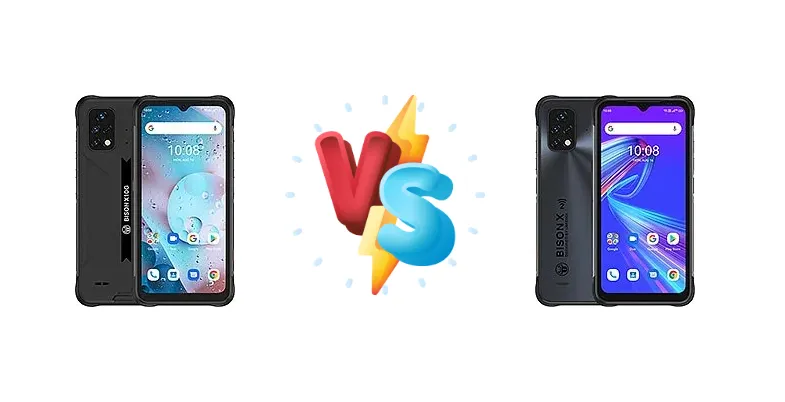
|
🏆 Quick Verdict
For most users, the Umidigi Bison X10S NFC is the superior choice. The inclusion of NFC adds significant everyday utility without compromising performance or battery life, given both phones share the same Unisoc Tiger T310 chipset and 10W charging. The small premium for NFC is well worth it.
| PHONES | ||
|---|---|---|
| Phone Names | Umidigi Bison X10G | Umidigi Bison X10S NFC |
| Network | ||
|---|---|---|
| 2G bands | GSM 850 / 900 / 1800 / 1900 | GSM 850 / 900 / 1800 / 1900 |
| 3G bands | HSDPA 850 / 900 / 1700(AWS) / 1900 / 2100 | HSDPA 850 / 900 / 1700(AWS) / 1900 / 2100 |
| 4G bands | 1, 2, 3, 4, 5, 7, 8, 12, 13, 17, 18, 19, 20, 25, 26, 28, 34, 38, 39, 40, 41, 66 | 1, 2, 3, 4, 5, 7, 8, 12, 13, 17, 18, 19, 20, 25, 26, 28, 34, 38, 39, 40, 41, 66 |
| Speed | HSPA, LTE | HSPA, LTE |
| Technology | GSM / HSPA / LTE | GSM / HSPA / LTE |
| Launch | ||
|---|---|---|
| Announced | 2021. Released 2021 | 2021. Released 2021 |
| Status | Discontinued | Discontinued |
| Body | ||
|---|---|---|
| Dimensions | 172.1 x 83.8 x 13.1 mm (6.78 x 3.30 x 0.52 in) | 172.1 x 83.8 x 12.9 mm (6.78 x 3.30 x 0.51 in) |
| SIM | Nano-SIM + Nano-SIM | Nano-SIM + Nano-SIM |
| Weight | - | 279 g (9.84 oz) |
| Display | ||
|---|---|---|
| Resolution | 720 x 1600 pixels, 20:9 ratio (~269 ppi density) | 720 x 1600 pixels, 20:9 ratio (~269 ppi density) |
| Size | 6.53 inches, 102.9 cm2 (~71.4% screen-to-body ratio) | 6.53 inches, 102.9 cm2 (~71.4% screen-to-body ratio) |
| Type | IPS LCD | IPS LCD |
| Platform | ||
|---|---|---|
| CPU | Quad-core (1x2.0 GHz Cortex-A75 & 3x1.8 GHz Cortex-A55) | Quad-core (1x2.0 GHz Cortex-A75 & 3x1.8 GHz Cortex-A55) |
| Chipset | Unisoc Tiger T310 (12nm) | Unisoc Tiger T310 (12nm) |
| GPU | PowerVR GE8300 | PowerVR GE8300 |
| OS | Android 11 | Android 11 |
| Memory | ||
|---|---|---|
| Card slot | microSDXC (uses shared SIM slot) | microSDXC (uses shared SIM slot) |
| Internal | 32GB 4GB RAM | 64GB 4GB RAM |
| Main Camera | ||
|---|---|---|
| Features | Dual-LED flash, HDR, panorama | Dual-LED flash, HDR, panorama |
| Triple | 16 MP, f/2.2, (wide), AF 8 MP, 119˚ (ultrawide) 5 MP (macro) | 16 MP, f/2.2, (wide), AF 8 MP, 119˚ (ultrawide) 5 MP (macro) |
| Video | 1080p@30fps | 1080p@30fps |
| Selfie camera | ||
|---|---|---|
| Single | 8 MP, f/2.2, (wide) | 8 MP, f/2.2, (wide) |
| Video | 1080p@30fps | 1080p@30fps |
| Sound | ||
|---|---|---|
| 35mm jack | Yes | Yes |
| Loudspeaker | Yes | Yes |
| Comms | ||
|---|---|---|
| Bluetooth | 5.0, A2DP, LE | 5.0, A2DP, LE |
| NFC | No | Yes |
| Positioning | GPS, GLONASS, GALILEO, BDS | GPS, GLONASS, GALILEO, BDS |
| Radio | Wireless FM radio | Wireless FM radio |
| USB | USB Type-C, OTG | USB Type-C, OTG |
| WLAN | Wi-Fi 802.11 a/b/g/n, dual-band, Wi-Fi Direct | Wi-Fi 802.11 a/b/g/n, dual-band, Wi-Fi Direct |
| Features | ||
|---|---|---|
| Sensors | Accelerometer, proximity, compass | Fingerprint (side-mounted), accelerometer, proximity, compass |
| Battery | ||
|---|---|---|
| Charging | 10W wired | 10W wired |
| Type | 6150 mAh | 6150 mAh |
| Misc | ||
|---|---|---|
| Colors | Hack Black | Storm Grey |
Umidigi Bison X10G
- Potentially lower price point.
- Rugged design for durability.
- Adequate performance for basic tasks.
- Lacks NFC functionality.
- Slow 10W charging.
- Limited camera capabilities.
Umidigi Bison X10S NFC
- Includes NFC for contactless payments and data transfer.
- Rugged design for durability.
- Adequate performance for basic tasks.
- Slow 10W charging.
- Limited camera capabilities.
- Slightly higher price than the X10G.
Display Comparison
Both the Bison X10G and X10S NFC likely feature similar LCD panels, given their positioning. While specific details like peak brightness and color gamut aren't provided, the focus here isn't display quality; it's ruggedness. Expect a durable, scratch-resistant screen, but not necessarily vibrant colors or high resolution. The absence of high refresh rates (like 90Hz or 120Hz) is typical for this price point, prioritizing battery efficiency over visual fluidity.
Camera Comparison
Details regarding camera sensors are limited. However, given the market segment, it's reasonable to assume both phones feature a primary camera alongside supporting lenses (likely a depth or macro sensor). The image processing capabilities of the Unisoc T310 will be a limiting factor, so don't expect exceptional image quality, particularly in low-light conditions. The absence of Optical Image Stabilization (OIS) is also probable, relying on software stabilization instead. The focus should be on capturing usable snapshots rather than professional-grade photography.
Performance
The core of both devices is the Unisoc Tiger T310 (12nm). This chipset, with its quad-core configuration – a 2.0 GHz Cortex-A75 and three 1.8 GHz Cortex-A55 cores – provides adequate performance for everyday tasks like browsing, social media, and light gaming. The 12nm process node, while not cutting-edge, offers a reasonable balance between performance and power consumption. Users shouldn't expect flagship-level speeds, but the T310 is capable of handling typical smartphone workloads. The shared chipset means performance will be virtually identical between the two models.
Battery Life
Both the Bison X10G and X10S NFC are equipped with 10W wired charging. This is a relatively slow charging speed compared to modern standards, meaning a full charge will take a significant amount of time. While the battery capacity isn't specified, the shared chipset and similar form factors suggest comparable battery life. Users should expect a full day of moderate use, but heavy users may need to top up the battery during the day. The slow charging speed is a trade-off for the rugged design and affordability.
Buying Guide
Buy the Umidigi Bison X10G if you absolutely prioritize the lowest possible price and have no need for NFC functionality. This makes it ideal for users who primarily need a durable phone for calls and basic messaging. Buy the Umidigi Bison X10S NFC if you value the convenience of contactless payments, quick pairing with accessories, or data transfer via NFC, making it a more versatile option for modern smartphone users.