
Umidigi Bison X10G vs Bison Pro: Which Rugged Phone Reigns Supreme?
| Phones Images | |||||
|---|---|---|---|---|---|
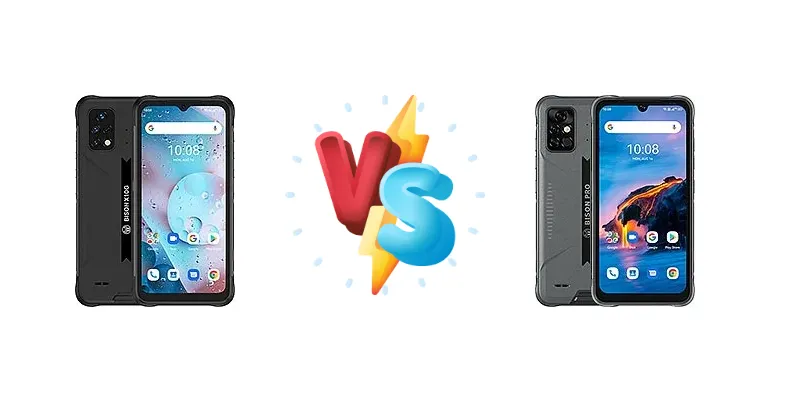
|
🏆 Quick Verdict
For most users, the Umidigi Bison Pro is the superior choice. Its Mediatek Helio G80 chipset, featuring an octa-core configuration, provides a noticeable performance uplift over the Bison X10G’s Unisoc Tiger T310. The faster 18W charging also significantly reduces downtime, making the Pro a more practical daily driver despite a potentially similar battery capacity.
| PHONES | ||
|---|---|---|
| Phone Names | Umidigi Bison X10G | Umidigi Bison Pro |
| Network | ||
|---|---|---|
| 2G bands | GSM 850 / 900 / 1800 / 1900 | GSM 850 / 900 / 1800 / 1900 |
| 3G bands | HSDPA 850 / 900 / 1700(AWS) / 1900 / 2100 | HSDPA 800 / 850 / 900 / 1700(AWS) / 1900 / 2100 |
| 4G bands | 1, 2, 3, 4, 5, 7, 8, 12, 13, 17, 18, 19, 20, 25, 26, 28, 34, 38, 39, 40, 41, 66 | 1, 2, 3, 4, 5, 7, 8, 12, 13, 17, 18, 19, 20, 25, 26, 28, 34, 38, 39, 40, 41, 66 |
| Speed | HSPA, LTE | HSPA, LTE |
| Technology | GSM / HSPA / LTE | GSM / CDMA / HSPA / CDMA2000 / LTE |
| Launch | ||
|---|---|---|
| Announced | 2021. Released 2021 | 2021. Released 2021 |
| Status | Discontinued | Discontinued |
| Body | ||
|---|---|---|
| Dimensions | 172.1 x 83.8 x 13.1 mm (6.78 x 3.30 x 0.52 in) | 164 x 79.6 x 12.7 mm (6.46 x 3.13 x 0.5 in) |
| SIM | Nano-SIM + Nano-SIM | Nano-SIM + Nano-SIM |
| Weight | - | 265 g (9.35 oz) |
| Display | ||
|---|---|---|
| Protection | - | Corning Gorilla Glass |
| Resolution | 720 x 1600 pixels, 20:9 ratio (~269 ppi density) | 1080 x 2340 pixels, 19.5:9 ratio (~409 ppi density) |
| Size | 6.53 inches, 102.9 cm2 (~71.4% screen-to-body ratio) | 6.3 inches, 97.4 cm2 (~74.6% screen-to-body ratio) |
| Type | IPS LCD | IPS LCD |
| Platform | ||
|---|---|---|
| CPU | Quad-core (1x2.0 GHz Cortex-A75 & 3x1.8 GHz Cortex-A55) | Octa-core (2x2.0 GHz Cortex-A75 & 6x1.8 GHz Cortex-A55) |
| Chipset | Unisoc Tiger T310 (12nm) | Mediatek Helio G80 (12 nm) |
| GPU | PowerVR GE8300 | Mali-G52 MC2 |
| OS | Android 11 | Android 11 |
| Memory | ||
|---|---|---|
| Card slot | microSDXC (uses shared SIM slot) | microSDXC (uses shared SIM slot) |
| Internal | 32GB 4GB RAM | 128GB 4GB RAM, 128GB 8GB RAM |
| Main Camera | ||
|---|---|---|
| Features | Dual-LED flash, HDR, panorama | Dual-LED flash, HDR, panorama |
| Triple | 16 MP, f/2.2, (wide), AF 8 MP, 119˚ (ultrawide) 5 MP (macro) | 48 MP, f/1.8, (wide), 1/2.0", AF 16 MP, 117˚ (ultrawide) 5 MP (macro) |
| Video | 1080p@30fps | 1080p@30fps |
| Selfie camera | ||
|---|---|---|
| Single | 8 MP, f/2.2, (wide) | 24 MP, f/2.0, (wide) |
| Video | 1080p@30fps | 1080p@30fps |
| Sound | ||
|---|---|---|
| 35mm jack | Yes | Yes |
| Loudspeaker | Yes | Yes |
| Comms | ||
|---|---|---|
| Bluetooth | 5.0, A2DP, LE | 4.2, A2DP |
| NFC | No | Yes |
| Positioning | GPS, GLONASS, GALILEO, BDS | GPS, GLONASS, GALILEO |
| Radio | Wireless FM radio | No |
| USB | USB Type-C, OTG | USB Type-C, OTG |
| WLAN | Wi-Fi 802.11 a/b/g/n, dual-band, Wi-Fi Direct | Wi-Fi 802.11 a/b/g/n/ac, dual-band, Wi-Fi Direct |
| Features | ||
|---|---|---|
| Sensors | Accelerometer, proximity, compass | Fingerprint (side-mounted), accelerometer, proximity, compass, barometer, thermometer (skin temperature) |
| Battery | ||
|---|---|---|
| Charging | 10W wired | 18W wired |
| Type | 6150 mAh | 5000 mAh |
| Misc | ||
|---|---|---|
| Colors | Hack Black | Storm Gray, Hack Black |
Umidigi Bison X10G
- Potentially lower price point
- Rugged design for durability
- Sufficient for basic smartphone tasks
- Slower Unisoc Tiger T310 processor
- Slow 10W charging
- Limited multitasking capabilities
Umidigi Bison Pro
- Faster Mediatek Helio G80 processor
- Faster 18W charging
- Improved multitasking and gaming performance
- Likely higher price than the X10G
- Rugged design may add bulk
- Camera performance dependent on sensor quality (unknown)
Display Comparison
Neither Umidigi provides detailed display specifications. Assuming typical IPS LCD panels for this price bracket, the display experience will likely be similar in terms of color accuracy and viewing angles. The absence of high refresh rates is expected. The key difference will likely be brightness, but without nits data, it's impossible to determine which offers better outdoor visibility. Bezels are also likely comparable, focusing on durability rather than minimizing screen borders.
Camera Comparison
Without detailed camera specs beyond the presence of a macro lens (likely 2MP on both), a direct comparison is difficult. Both phones likely feature a primary camera sensor, but resolution and sensor size are unknown. The image processing capabilities of the respective chipsets will play a role, with the Helio G80’s ISP likely offering better noise reduction and dynamic range. The macro lens on both is likely a marketing feature rather than a significant photographic asset.
Performance
The core difference lies in the chipsets. The Bison X10G’s Unisoc Tiger T310 is a quad-core processor built on a 12nm process. While efficient, its four cores are significantly less capable than the Bison Pro’s Mediatek Helio G80. The G80 boasts an octa-core configuration (2x2.0 GHz Cortex-A75 & 6x1.8 GHz Cortex-A55) also on a 12nm process, offering superior multi-tasking and gaming performance. The two Cortex-A75 cores in the G80 provide a substantial boost in single-core performance, crucial for app launch speeds and responsiveness. The Bison Pro will handle demanding applications and games with greater ease, while the X10G may exhibit noticeable lag under heavy load. RAM configurations are not specified, but the chipset difference will be the dominant factor.
Battery Life
Battery capacity is not specified for either device. However, the Bison Pro’s 18W wired charging is a significant advantage over the X10G’s 10W charging. This translates to a much faster 0-100% charge time, reducing downtime. Even with a similar battery capacity, the faster charging speed makes the Bison Pro more convenient for users who rely heavily on their phones throughout the day. The efficiency of the Helio G80 may also contribute to slightly better battery life under moderate use, offsetting any capacity differences.
Buying Guide
Buy the Umidigi Bison X10G if your primary need is extreme durability on a very tight budget and you primarily use your phone for basic tasks like calls, texts, and light social media. You’ll accept slower performance and longer charging times. Buy the Umidigi Bison Pro if you want a more responsive experience for multitasking, occasional gaming, and appreciate the convenience of faster charging, even if it means a slightly higher upfront cost. The Pro is the better all-rounder.