
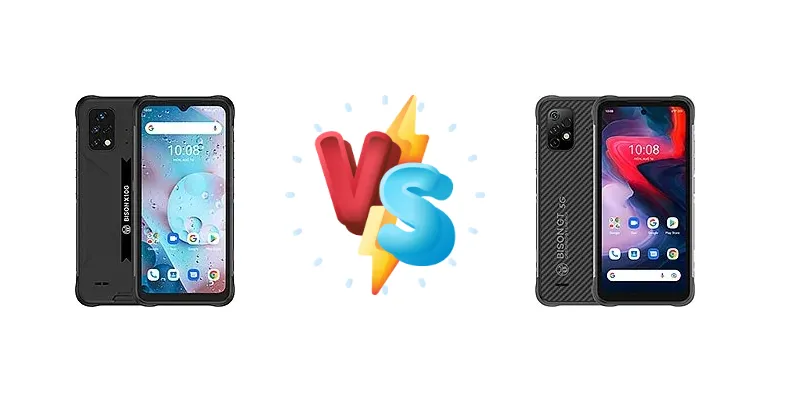
Umidigi Bison X10G vs GT2 5G: A Deep Dive into Budget Ruggedness
| Phones Images | |||||
|---|---|---|---|---|---|
|
🏆 Quick Verdict
For most users, the Umidigi Bison GT2 5G is the clear winner. Its Mediatek Dimensity 900 chipset offers substantially improved CPU and GPU performance compared to the X10G’s Unisoc Tiger T310, making it better suited for demanding tasks and future-proofing. The faster 18W charging is also a significant advantage.
| PHONES | ||
|---|---|---|
| Phone Names | Umidigi Bison X10G | Umidigi Bison GT2 5G |
| Network | ||
|---|---|---|
| 2G bands | GSM 850 / 900 / 1800 / 1900 | GSM 850 / 900 / 1800 / 1900 |
| 3G bands | HSDPA 850 / 900 / 1700(AWS) / 1900 / 2100 | HSDPA 800 / 850 / 900 / 1700(AWS) / 1900 / 2100 |
| 4G bands | 1, 2, 3, 4, 5, 7, 8, 12, 13, 17, 18, 19, 20, 25, 26, 28, 34, 38, 39, 40, 41, 66 | 1, 2, 3, 4, 5, 7, 8, 12, 13, 17, 18, 19, 20, 25, 26, 28, 34, 38, 39, 40, 41, 66 |
| 5G bands | - | 1, 2, 3, 5, 7, 8, 20, 25, 28, 38, 40, 41, 66, 77, 78, 79 SA/NSA |
| Speed | HSPA, LTE | HSPA, LTE, 5G |
| Technology | GSM / HSPA / LTE | GSM / CDMA / HSPA / LTE / 5G |
| Launch | ||
|---|---|---|
| Announced | 2021. Released 2021 | 2022 |
| Status | Discontinued | Available. Released 2022 |
| Body | ||
|---|---|---|
| Dimensions | 172.1 x 83.8 x 13.1 mm (6.78 x 3.30 x 0.52 in) | 172.2 x 83.9 x 12.9 mm (6.78 x 3.30 x 0.51 in) |
| SIM | Nano-SIM + Nano-SIM | Nano-SIM + Nano-SIM |
| Weight | - | 280 g (9.88 oz) |
| Display | ||
|---|---|---|
| Resolution | 720 x 1600 pixels, 20:9 ratio (~269 ppi density) | 1080 x 2400 pixels, 20:9 ratio (~405 ppi density) |
| Size | 6.53 inches, 102.9 cm2 (~71.4% screen-to-body ratio) | 6.5 inches, 102.0 cm2 (~70.6% screen-to-body ratio) |
| Type | IPS LCD | IPS LCD, 90Hz |
| Platform | ||
|---|---|---|
| CPU | Quad-core (1x2.0 GHz Cortex-A75 & 3x1.8 GHz Cortex-A55) | Octa-core (2x2.4 GHz Cortex-A78 & 6x2.0 GHz Cortex-A55) |
| Chipset | Unisoc Tiger T310 (12nm) | Mediatek Dimensity 900 (6 nm) |
| GPU | PowerVR GE8300 | Mali-G68 MC4 |
| OS | Android 11 | Android 12 |
| Memory | ||
|---|---|---|
| Card slot | microSDXC (uses shared SIM slot) | microSDXC (uses shared SIM slot) |
| Internal | 32GB 4GB RAM | 128GB 8GB RAM |
| Main Camera | ||
|---|---|---|
| Features | Dual-LED flash, HDR, panorama | Dual-LED flash, HDR, panorama |
| Triple | 16 MP, f/2.2, (wide), AF 8 MP, 119˚ (ultrawide) 5 MP (macro) | 64 MP, f/1.8, (wide), AF 8 MP, f/2.2, 117˚ (ultrawide) 5 MP (macro) |
| Video | 1080p@30fps | 4K@30fps, 1080p@30fps |
| Selfie camera | ||
|---|---|---|
| Single | 8 MP, f/2.2, (wide) | 24 MP, f/2.0, (wide) |
| Video | 1080p@30fps | 1080p@30fps |
| Sound | ||
|---|---|---|
| 35mm jack | Yes | Yes |
| Loudspeaker | Yes | Yes |
| Comms | ||
|---|---|---|
| Bluetooth | 5.0, A2DP, LE | 5.2, A2DP, LE |
| NFC | No | Yes |
| Positioning | GPS, GLONASS, GALILEO, BDS | GPS, GLONASS, GALILEO, BDS |
| Radio | Wireless FM radio | Wireless FM radio |
| USB | USB Type-C, OTG | USB Type-C |
| WLAN | Wi-Fi 802.11 a/b/g/n, dual-band, Wi-Fi Direct | Wi-Fi 802.11 a/b/g/n/ac/6, dual-band, Wi-Fi Direct |
| Features | ||
|---|---|---|
| Sensors | Accelerometer, proximity, compass | Fingerprint (side-mounted), accelerometer, proximity, compass, barometer, thermometer (skin temperature) |
| Battery | ||
|---|---|---|
| Charging | 10W wired | 18W wired |
| Type | 6150 mAh | 6150 mAh |
| Misc | ||
|---|---|---|
| Colors | Hack Black | Storm Grey |
Umidigi Bison X10G
- Most affordable option
- Rugged design for durability
- Acceptable for basic tasks
- Slow processor
- Slow charging
- Limited multitasking capabilities
Umidigi Bison GT2 5G
- Significantly faster processor
- 5G connectivity for faster data speeds
- Faster 18W charging
- Higher price point
- May still lack advanced camera features
- Rugged design may add bulk
Display Comparison
Neither Umidigi provides detailed display specifications. However, given the price points, we can assume both utilize IPS LCD panels. The key difference lies elsewhere. The focus is on ruggedness, not display fidelity. Expect similar viewing angles and color reproduction, but neither will compete with higher-end OLED displays.
Camera Comparison
Detailed camera specs are unavailable. Given the market segment, expect modest camera performance from both devices. The focus is likely on providing functional cameras for everyday snapshots rather than high-quality photography. The presence of a 2MP macro camera on both is likely a marketing feature with limited real-world utility. Image processing will likely be basic, prioritizing speed over detail.
Performance
The performance gap is the most significant differentiator. The Bison GT2 5G’s Mediatek Dimensity 900, fabricated on a 6nm process, is a substantial upgrade over the Bison X10G’s Unisoc Tiger T310 (12nm). The Dimensity 900’s octa-core configuration (2x2.4 GHz Cortex-A78 & 6x2.0 GHz Cortex-A55) provides significantly more processing power than the X10G’s quad-core setup (1x2.0 GHz Cortex-A75 & 3x1.8 GHz Cortex-A55). This translates to faster app loading times, smoother multitasking, and a more enjoyable gaming experience. The 6nm process also contributes to better thermal efficiency, reducing the likelihood of throttling under sustained load. Users who play mobile games or frequently use demanding applications will greatly benefit from the GT2 5G.
Battery Life
While battery capacity isn't specified, the Bison GT2 5G’s 18W wired charging is a clear advantage over the X10G’s 10W charging. This means significantly faster top-ups, reducing downtime. Even with a similar battery capacity, the GT2 5G will spend less time tethered to a charger. The more efficient Dimensity 900 chipset may also contribute to slightly better battery life during typical usage.
Buying Guide
Buy the Umidigi Bison X10G if you prioritize absolute affordability and only need a phone for basic tasks like calls, texts, and light social media. It’s a viable option for those on a very tight budget. Buy the Umidigi Bison GT2 5G if you want a smoother, more responsive experience, faster 5G connectivity, and the ability to handle more demanding apps and games. The performance uplift justifies the price difference for most users.