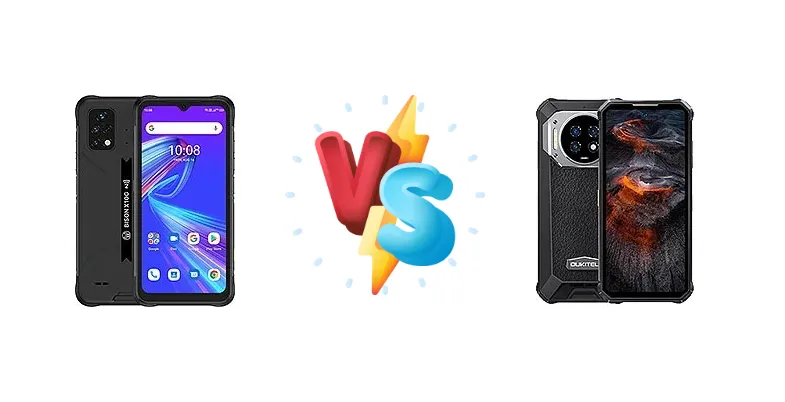
The rugged smartphone market is booming, offering durable devices for outdoor enthusiasts and demanding work environments. The Umidigi Bison X10G and Oukitel WP19 both aim to deliver this resilience at competitive price points, but they diverge significantly in their internal hardware. This comparison dissects those differences, focusing on performance, battery, and the practical implications for everyday use.
🏆 Quick Verdict
For the average user prioritizing performance and faster charging, the Oukitel WP19 is the clear winner. Its Helio G95 chipset offers a substantial performance uplift over the Bison X10G’s Unisoc T310, and the 33W charging significantly reduces downtime. However, the Bison X10G remains a viable option for those on a tighter budget and with less demanding needs.
| Network |
|---|
| 2G bands | GSM 850 / 900 / 1800 / 1900 | GSM 850 / 900 / 1800 / 1900 |
| 3G bands | HSDPA 850 / 900 / 1700(AWS) / 1900 / 2100 | HSDPA 850 / 900 / 1700(AWS) / 1900 / 2100 |
| 4G bands | 1, 2, 3, 4, 5, 7, 8, 12, 13, 17, 18, 19, 20, 25, 26, 28, 34, 38, 39, 40, 41, 66 | LTE |
| Speed | HSPA, LTE | HSPA, LTE |
| Technology | GSM / HSPA / LTE | GSM / HSPA / LTE |
| Launch |
|---|
| Announced | 2021. Released 2021 | 2022, June |
| Status | Discontinued | Available. Released 2022, July |
| Body |
|---|
| Dimensions | 172.1 x 83.8 x 13.1 mm (6.78 x 3.30 x 0.52 in) | - |
| SIM | Nano-SIM + Nano-SIM | Nano-SIM + Nano-SIM |
| Weight | - | - |
| Display |
|---|
| Resolution | 720 x 1600 pixels, 20:9 ratio (~269 ppi density) | 1080 x 2460 pixels (~396 ppi density) |
| Size | 6.53 inches, 102.9 cm2 (~71.4% screen-to-body ratio) | 6.78 inches, 109.2 cm2 |
| Type | IPS LCD | IPS LCD, 90Hz |
| Platform |
|---|
| CPU | Quad-core (1x2.0 GHz Cortex-A75 & 3x1.8 GHz Cortex-A55) | Octa-core (2x2.05 GHz Cortex-A76 & 6x2.0 GHz Cortex-A55) |
| Chipset | Unisoc Tiger T310 (12nm) | Mediatek MT6785V/CD Helio G95 (12 nm) |
| GPU | PowerVR GE8300 | Mali-G76 MC4 |
| OS | Android 11 | Android 12 |
| Memory |
|---|
| Card slot | microSDXC (uses shared SIM slot) | microSDXC (dedicated slot) |
| Internal | 64GB 4GB RAM | 256GB 8GB RAM |
| Main Camera |
|---|
| Features | Dual-LED flash, HDR, panorama | LED flash, panorama |
| Triple | 16 MP, f/2.2, (wide), AF
8 MP, 119˚ (ultrawide)
5 MP (macro) | 64 MP, f/1.8, (wide), PDAF
20 MP, f/2.0, (night vision), 4 infrared night vision lights
2 MP (macro) |
| Video | 1080p@30fps | 4K@30fps, 1080p@30fps |
| Selfie camera |
|---|
| Single | 8 MP, f/2.2, (wide) | 16 MP |
| Video | 1080p@30fps | Yes |
| Sound |
|---|
| 35mm jack | Yes | Unspecified |
| Loudspeaker | Yes | Yes |
| Comms |
|---|
| Bluetooth | 5.0, A2DP, LE | Yes |
| NFC | Yes | Yes |
| Positioning | GPS, GLONASS, GALILEO, BDS | GPS, GLONASS, GALILEO, BDS |
| Radio | Wireless FM radio | Unspecified |
| USB | USB Type-C, OTG | USB Type-C 2.0, OTG |
| WLAN | Wi-Fi 802.11 a/b/g/n, dual-band, Wi-Fi Direct | Yes |
| Features |
|---|
| Sensors | Fingerprint (side-mounted), accelerometer, proximity, compass | Unspecified |
| Battery |
|---|
| Charging | 10W wired | 33W wired |
| Type | 6150 mAh | Li-Po 21000 mAh |
| Misc |
|---|
| Colors | Hack Black | Blue, Camo, Camouflage |
| Price | - | About 380 EUR |
Umidigi Bison X10G NFC
- More affordable price point
- Rugged design for durability
- NFC support for contactless payments
- Significantly slower processor
- Extremely slow 10W charging
- Limited performance for demanding apps
Oukitel WP19
- Faster and more powerful Helio G95 processor
- 33W fast charging for reduced downtime
- Improved image processing capabilities
- Higher price compared to the Bison X10G
- Rugged design may be bulky
- Software updates may be less frequent
Display Comparison
Neither device boasts a standout display. Given the context data focuses on internal specs, we can infer both likely utilize IPS LCD panels common in this price bracket. The lack of information on resolution or refresh rate suggests both are targeting 720p or 1080p at 60Hz. The real difference will likely be in color calibration and peak brightness, areas where Oukitel often demonstrates slight improvements in their rugged lineup. Bezels are expected to be substantial on both, prioritizing durability over a modern, edge-to-edge aesthetic.
Camera Comparison
Without detailed camera specs, a direct comparison is difficult. However, the chipset difference suggests the WP19 will have a more capable image signal processor (ISP), leading to better image processing and potentially improved low-light performance. Both devices likely feature a primary camera alongside macro and depth sensors; the usefulness of the latter is questionable in both cases. The G95’s ability to handle higher resolution sensors and faster frame rates gives it an edge, even if the sensor sizes are similar. Expect the WP19 to offer more detailed and vibrant photos.
Performance
The Oukitel WP19’s Mediatek Helio G95 is the dominant force here. Built on a 12nm process, it features an octa-core configuration with 2x2.05 GHz Cortex-A76 cores and 6x2.0 GHz Cortex-A55 cores. This contrasts sharply with the Umidigi Bison X10G’s Unisoc Tiger T310, a quad-core chip with 1x2.0 GHz Cortex-A75 and 3x1.8 GHz Cortex-A55 cores. The G95’s higher core count and more powerful Cortex-A76 cores translate to significantly better multi-core and single-core performance, making the WP19 noticeably snappier in app loading, multitasking, and gaming. The Unisoc T310 is adequate for basic tasks, but will struggle with resource-intensive applications. While both are 12nm, the architectural advantages of the G95 are substantial.
Battery Life
Both phones are likely equipped with large batteries, typical of rugged devices. However, the Oukitel WP19’s 33W wired charging is a game-changer. The Umidigi Bison X10G is limited to a slow 10W charge, meaning significantly longer charging times. While the Bison X10G might have a slightly larger battery capacity (a common tactic in this segment), the WP19’s faster charging will minimize downtime and provide a more convenient user experience. A full charge on the Bison X10G could take upwards of 3 hours, while the WP19 should achieve a full charge in under 90 minutes.
Buying Guide
Buy the Umidigi Bison X10G NFC if you need a highly affordable, basic rugged phone for essential tasks like calls, texts, and light app usage, and aren't concerned with demanding gaming or fast charging. Buy the Oukitel WP19 if you prefer a more responsive experience, faster charging speeds, and the ability to handle more intensive applications and occasional gaming, even if it comes at a slightly higher price.
Frequently Asked Questions
❓ Will the Oukitel WP19 overheat during prolonged gaming sessions?
The Helio G95 is a capable processor, but it can generate heat under sustained load. Oukitel typically incorporates thermal management solutions in their rugged phones, such as graphite sheets, to mitigate overheating. While some throttling is possible during extended gaming, the WP19 is better equipped to handle it than the Bison X10G due to its more efficient chipset.
❓ Is the Unisoc Tiger T310 in the Umidigi Bison X10G sufficient for running popular social media apps?
Yes, the Unisoc Tiger T310 is capable of running popular social media apps like Facebook, Instagram, and TikTok. However, expect some lag and slower loading times compared to devices with more powerful processors. Multitasking between several apps may also be sluggish.
❓ Does the Oukitel WP19 support VoLTE and VoWiFi for improved call quality?
Typically, Oukitel WP19 supports VoLTE and VoWiFi, but compatibility depends on your carrier. It's crucial to check with your mobile provider to ensure these features are supported on their network before purchasing.
❓ How durable is the Bison X10G's screen? Is a screen protector necessary?
The Bison X10G is marketed as a rugged phone, implying a degree of scratch and drop resistance. However, the specific glass type isn't specified. We strongly recommend applying a tempered glass screen protector to prevent scratches and cracks, especially given the phone's intended use in demanding environments.