
Umidigi Bison X10G vs Nokia XR20: A Deep Dive into Rugged Smartphone Value
| Phones Images | |||||
|---|---|---|---|---|---|
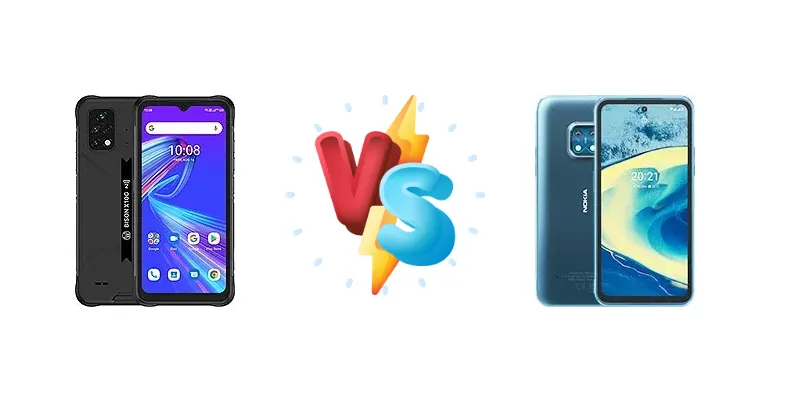
|
🏆 Quick Verdict
For the average user prioritizing 5G connectivity and a smoother overall experience, the Nokia XR20 is the better choice. Its Snapdragon 480 chipset and 18W charging offer a noticeable performance and convenience advantage, justifying the price difference over the Umidigi Bison X10G.
| PHONES | ||
|---|---|---|
| Phone Names | Umidigi Bison X10G NFC | Nokia XR20 |
| Network | ||
|---|---|---|
| 2G bands | GSM 850 / 900 / 1800 / 1900 | GSM 850 / 900 / 1800 / 1900 |
| 3G bands | HSDPA 850 / 900 / 1700(AWS) / 1900 / 2100 | HSDPA 850 / 900 / 1700(AWS) / 1900 / 2100 |
| 4G bands | 1, 2, 3, 4, 5, 7, 8, 12, 13, 17, 18, 19, 20, 25, 26, 28, 34, 38, 39, 40, 41, 66 | 1, 2, 3, 4, 5, 7, 8, 12, 13, 14, 20, 25, 26, 28, 30, 38, 40, 41, 48, 66, 71 |
| 5G bands | - | 2, 5, 25, 38, 41, 48, 66, 77, 78 SA/NSA |
| Speed | HSPA, LTE | HSPA, LTE, 5G |
| Technology | GSM / HSPA / LTE | GSM / CDMA / HSPA / EVDO / LTE / 5G |
| - | CDMA2000 1xEV-DO | |
| Launch | ||
|---|---|---|
| Announced | 2021. Released 2021 | 2021, July 27 |
| Status | Discontinued | Available. Released 2021, August 04 |
| Body | ||
|---|---|---|
| Dimensions | 172.1 x 83.8 x 13.1 mm (6.78 x 3.30 x 0.52 in) | 171.6 x 81.5 x 10.6 mm (6.76 x 3.21 x 0.42 in) |
| SIM | Nano-SIM + Nano-SIM | · Nano-SIM· Nano-SIM + Nano-SIM |
| Weight | - | 248 g (8.75 oz) |
| - | IP68 dust/water resistant (up to 1.5m for 60 min) Drop-to-concrete resistance from up to 1.8m MIL-STD-810H compliant | |
| Display | ||
|---|---|---|
| Protection | - | Corning Gorilla Glass Victus |
| Resolution | 720 x 1600 pixels, 20:9 ratio (~269 ppi density) | 1080 x 2400 pixels, 20:9 ratio (~395 ppi density) |
| Size | 6.53 inches, 102.9 cm2 (~71.4% screen-to-body ratio) | 6.67 inches, 107.4 cm2 (~76.8% screen-to-body ratio) |
| Type | IPS LCD | IPS LCD, 550 nits |
| Platform | ||
|---|---|---|
| CPU | Quad-core (1x2.0 GHz Cortex-A75 & 3x1.8 GHz Cortex-A55) | Octa-core (2x2.0 GHz Kryo 460 & 6x1.8 GHz Kryo 460) |
| Chipset | Unisoc Tiger T310 (12nm) | Qualcomm SM4350 Snapdragon 480 5G (8 nm) |
| GPU | PowerVR GE8300 | Adreno 619 |
| OS | Android 11 | Android 11, upgradable to Android 13 |
| Memory | ||
|---|---|---|
| Card slot | microSDXC (uses shared SIM slot) | microSDXC (uses shared SIM slot) |
| Internal | 64GB 4GB RAM | 64GB 4GB RAM, 128GB 6GB RAM |
| Main Camera | ||
|---|---|---|
| Dual | - | 48 MP, f/1.8, (wide), 1/2.25", 0.8µm, PDAF 13 MP, f/2.4, 123˚ (ultrawide), 1/3.0", 1.12µm |
| Features | Dual-LED flash, HDR, panorama | Zeiss optics, Dual-LED dual-tone flash, second LED flash, HDR, panorama |
| Single | - | 8 MP, f/2.0 (wide), 1/4.0", 1.12µm |
| Triple | 16 MP, f/2.2, (wide), AF 8 MP, 119˚ (ultrawide) 5 MP (macro) | - |
| Video | 1080p@30fps | 1080p@30fps |
| Selfie camera | ||
|---|---|---|
| Single | 8 MP, f/2.2, (wide) | 8 MP, f/2.0 (wide), 1/4.0", 1.12µm |
| Video | 1080p@30fps | 1080p@30fps |
| Sound | ||
|---|---|---|
| 3.5mm jack | - | Yes |
| 35mm jack | Yes | Yes |
| Loudspeaker | Yes | Yes, with stereo speakers |
| Comms | ||
|---|---|---|
| Bluetooth | 5.0, A2DP, LE | 5.1, A2DP, LE, aptX Adaptive |
| NFC | Yes | Yes |
| Positioning | GPS, GLONASS, GALILEO, BDS | GPS (L1+L5), GLONASS, BDS, GALILEO, QZSS, NavIC |
| Radio | Wireless FM radio | Unspecified |
| USB | USB Type-C, OTG | USB Type-C 3.0 |
| WLAN | Wi-Fi 802.11 a/b/g/n, dual-band, Wi-Fi Direct | Wi-Fi 802.11 a/b/g/n/ac/6, dual-band, Wi-Fi Direct |
| Features | ||
|---|---|---|
| Sensors | Fingerprint (side-mounted), accelerometer, proximity, compass | Fingerprint (side-mounted), accelerometer, gyro, proximity, compass, barometer |
| Battery | ||
|---|---|---|
| Charging | 10W wired | 18W wired 15W wireless |
| Type | 6150 mAh | Li-Po 4630 mAh |
| Misc | ||
|---|---|---|
| Colors | Hack Black | Ultra Blue, Granite Gray |
| Models | - | TA-1368, TA-1362 |
| Price | - | About 270 EUR |
| SAR EU | - | 1.13 W/kg (head) 1.43 W/kg (body) |
Umidigi Bison X10G NFC
- Significantly lower price point
- Rugged design for durability
- NFC support for contactless payments
- Slower Unisoc Tiger T310 chipset
- Slow 10W wired charging only
- Limited software update support
Nokia XR20
- Faster Snapdragon 480 5G chipset
- 18W wired and 15W wireless charging
- Nokia’s software update commitment
- Higher price compared to Umidigi Bison X10G
- Rugged design may not be as extreme as Bison X10G
- Potentially less battery capacity (unconfirmed)
Display Comparison
Neither device boasts a standout display. While specific display specs (resolution, panel type) are missing for the Bison X10G, it’s likely an LCD panel given its price point. The Nokia XR20’s display details are also absent, but Nokia typically uses IPS LCDs in this segment. The key difference lies in processing power impacting UI smoothness. The XR20’s Snapdragon 480 will provide a more responsive experience when navigating the interface and apps, even if the panel technology is similar. Bezels are likely comparable, focusing on durability rather than minimizing borders.
Camera Comparison
Camera performance is difficult to assess without detailed sensor information. However, the focus should be on the main sensor. While both likely feature multiple lenses, the quality of the primary sensor dictates image quality. The absence of sensor size details for both phones makes a direct comparison difficult. The XR20 benefits from Qualcomm’s image signal processor (ISP) within the Snapdragon 480, which generally delivers better image processing and noise reduction compared to Unisoc’s ISP. The Bison X10G likely relies heavily on software processing to compensate for a potentially lower-quality sensor.
Performance
The performance gap is significant. The Nokia XR20’s Qualcomm Snapdragon 480 5G (8nm) is a clear upgrade over the Umidigi Bison X10G’s Unisoc Tiger T310 (12nm). The 8nm process node of the Snapdragon 480 translates to better power efficiency and less heat generation under load. Furthermore, the XR20’s octa-core CPU (2x2.0 GHz Kryo 460 & 6x1.8 GHz Kryo 460) offers more processing power than the Bison X10G’s quad-core configuration (1x2.0 GHz Cortex-A75 & 3x1.8 GHz Cortex-A55). This means faster app loading times, smoother multitasking, and a more responsive user experience on the XR20. While neither is a gaming powerhouse, the XR20 will handle graphically intensive games with fewer stutters.
Battery Life
Both phones aim for all-day battery life, but the charging experience differs significantly. The Nokia XR20’s 18W wired charging and 15W wireless charging provide greater flexibility and convenience. The Umidigi Bison X10G is limited to 10W wired charging, resulting in considerably longer charging times. While battery capacity isn’t specified, the XR20’s more efficient chipset and faster charging capabilities offset any potential capacity difference, providing a more practical user experience. The XR20’s wireless charging is a significant advantage for users who prefer cable-free charging.
Buying Guide
Buy the Umidigi Bison X10G NFC if you need a highly affordable, durable phone for basic tasks and aren't reliant on 5G or demanding applications. It’s ideal for construction workers, outdoor enthusiasts on a tight budget, or as a reliable backup device. Buy the Nokia XR20 if you prefer a more future-proof device with 5G, faster charging, and Nokia’s commitment to software updates, making it suitable for users who want a dependable phone for several years and value a smoother user experience.