
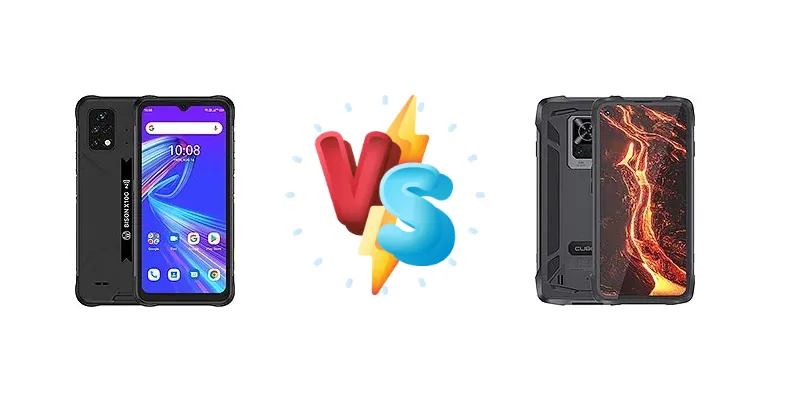
Umidigi Bison X10G vs Cubot KingKong 7: A Deep Dive into Rugged Smartphone Performance
| Phones Images | |||||
|---|---|---|---|---|---|
|
🏆 Quick Verdict
For the average user seeking a balance of performance and affordability, the Cubot KingKong 7 emerges as the slightly better choice. Its Helio P60 chipset, featuring an octa-core CPU, provides a noticeable performance advantage over the Bison X10G’s quad-core Tiger T310, making it more suitable for multitasking and demanding applications.
| PHONES | ||
|---|---|---|
| Phone Names | Umidigi Bison X10G NFC | Cubot KingKong 7 |
| Network | ||
|---|---|---|
| 2G bands | GSM 850 / 900 / 1800 / 1900 | GSM 850 / 900 / 1800 / 1900 |
| 3G bands | HSDPA 850 / 900 / 1700(AWS) / 1900 / 2100 | HSDPA 850 / 900 / 1700(AWS) / 1900 / 2100 |
| 4G bands | 1, 2, 3, 4, 5, 7, 8, 12, 13, 17, 18, 19, 20, 25, 26, 28, 34, 38, 39, 40, 41, 66 | 1, 2, 3, 4, 5, 7, 8, 12, 13, 17, 18, 19, 20, 25, 26, 28, 38, 40, 41, 66 |
| Speed | HSPA, LTE | HSPA, LTE |
| Technology | GSM / HSPA / LTE | GSM / CDMA / HSPA / LTE |
| Launch | ||
|---|---|---|
| Announced | 2021. Released 2021 | 2022 |
| Status | Discontinued | Available. Released 2022 |
| Body | ||
|---|---|---|
| Dimensions | 172.1 x 83.8 x 13.1 mm (6.78 x 3.30 x 0.52 in) | 166.8 x 83.5 x 14 mm (6.57 x 3.29 x 0.55 in) |
| SIM | Nano-SIM + Nano-SIM | Nano-SIM + Nano-SIM |
| Weight | - | 267 g (9.42 oz) |
| Display | ||
|---|---|---|
| Resolution | 720 x 1600 pixels, 20:9 ratio (~269 ppi density) | 1080 x 2300 pixels (~400 ppi density) |
| Size | 6.53 inches, 102.9 cm2 (~71.4% screen-to-body ratio) | 6.36 inches, 100.4 cm2 (~72.1% screen-to-body ratio) |
| Type | IPS LCD | IPS LCD |
| Platform | ||
|---|---|---|
| CPU | Quad-core (1x2.0 GHz Cortex-A75 & 3x1.8 GHz Cortex-A55) | Octa-core (4x2.0 GHz Cortex-A73 & 4x2.0 GHz Cortex-A53) |
| Chipset | Unisoc Tiger T310 (12nm) | Mediatek MT6771V/CA Helio P60 (12 nm) |
| GPU | PowerVR GE8300 | Mali-G72 MP3 |
| OS | Android 11 | Android 11 |
| Memory | ||
|---|---|---|
| Card slot | microSDXC (uses shared SIM slot) | microSDXC (uses shared SIM slot) |
| Internal | 64GB 4GB RAM | 128GB 8GB RAM |
| Main Camera | ||
|---|---|---|
| Features | Dual-LED flash, HDR, panorama | LED flash |
| Triple | 16 MP, f/2.2, (wide), AF 8 MP, 119˚ (ultrawide) 5 MP (macro) | 64 MP, (wide), AF 16 MP, (ultrawide) 5 MP (macro) |
| Video | 1080p@30fps | Yes |
| Selfie camera | ||
|---|---|---|
| Single | 8 MP, f/2.2, (wide) | 32 MP |
| Video | 1080p@30fps | Yes |
| Sound | ||
|---|---|---|
| 35mm jack | Yes | Unspecified |
| Loudspeaker | Yes | Yes |
| Comms | ||
|---|---|---|
| Bluetooth | 5.0, A2DP, LE | 4.2, A2DP |
| NFC | Yes | Yes |
| Positioning | GPS, GLONASS, GALILEO, BDS | GPS, GLONASS, BDS |
| Radio | Wireless FM radio | Unspecified |
| USB | USB Type-C, OTG | USB Type-C, OTG |
| WLAN | Wi-Fi 802.11 a/b/g/n, dual-band, Wi-Fi Direct | Wi-Fi 802.11 a/b/g/n |
| Features | ||
|---|---|---|
| Sensors | Fingerprint (side-mounted), accelerometer, proximity, compass | Fingerprint (rear-mounted), accelerometer, gyro, proximity, compass |
| Battery | ||
|---|---|---|
| Charging | 10W wired | - |
| Type | 6150 mAh | 5000 mAh |
| Misc | ||
|---|---|---|
| Colors | Hack Black | Black |
Umidigi Bison X10G NFC
- Potentially lower price point
- NFC support for contactless payments
- Rugged design for durability
- Quad-core processor limits performance
- Slow 10W charging
- Limited multitasking capabilities
Cubot KingKong 7
- Octa-core processor for smoother performance
- More responsive user experience
- Potentially faster charging
- May be slightly more expensive
- Rugged design may add bulk
- NFC support not confirmed
Display Comparison
Neither device’s display specifications are provided, so a direct comparison is limited. However, given their price points, both likely utilize IPS LCD panels. The focus here shifts to durability; both are rugged phones, implying reinforced glass and robust construction. The absence of details like resolution or refresh rate suggests neither prioritizes a premium visual experience, focusing instead on resilience.
Camera Comparison
Without detailed camera specifications, a comprehensive comparison is impossible. However, it’s reasonable to assume both phones feature basic camera setups geared towards functional photography rather than high-end image quality. The prevalence of 2MP macro lenses in this segment suggests both may include one, but its utility is questionable. The larger sensor size (if any) will be the determining factor, but without that data, we can only speculate. Image processing will likely be similar, prioritizing contrast and saturation over natural color reproduction.
Performance
The core difference lies in the chipsets. The Cubot KingKong 7’s MediaTek Helio P60 (12nm) boasts an octa-core CPU configuration – four Cortex-A73 cores clocked at 2.0 GHz and four Cortex-A53 cores at 2.0 GHz. This contrasts sharply with the Umidigi Bison X10G’s Unisoc Tiger T310 (12nm) which utilizes a quad-core setup: one Cortex-A75 at 2.0 GHz and three Cortex-A55 cores at 1.8 GHz. The Helio P60’s higher core count and more powerful A73 cores translate to significantly better multi-tasking and application launch speeds. While both are built on a 12nm process, the architectural advantages of the Helio P60 are clear. Users who frequently switch between apps or engage in light gaming will find the KingKong 7 a more fluid experience.
Battery Life
Battery capacity isn’t specified for either device. However, the Bison X10G’s 10W charging is a significant drawback. The KingKong 7 likely offers a similar or slightly faster charging rate, but without confirmation, it’s difficult to say. A slower charging speed means longer downtime, impacting usability for users who rely heavily on their phones throughout the day. The actual battery life will depend on usage patterns, but the charging speed is a clear disadvantage for the Bison X10G.
Buying Guide
Buy the Umidigi Bison X10G NFC if you prioritize NFC functionality and are primarily focused on basic smartphone tasks like calling, texting, and light social media use. Its lower price point makes it ideal for those on a tight budget. Buy the Cubot KingKong 7 if you need a more responsive experience for multitasking, occasional gaming, or running more demanding apps. The octa-core processor offers a tangible performance boost, justifying the potential price difference.