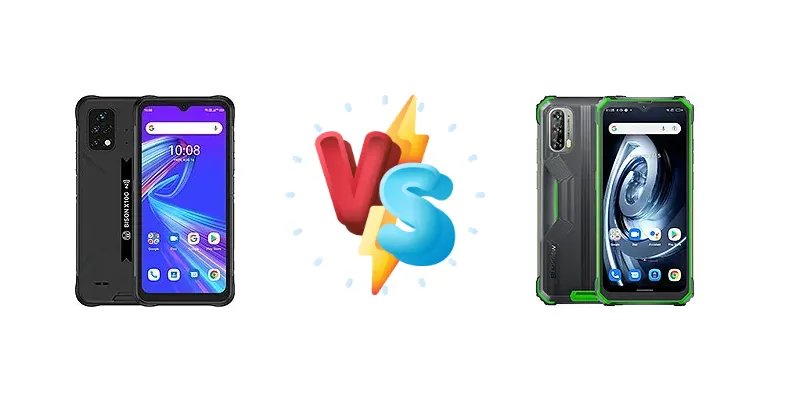
The rugged smartphone market offers a compelling alternative for users prioritizing durability and reliability. Both the Umidigi Bison X10G NFC and the Blackview BV7100 cater to this need, but diverge significantly in their internal hardware. This comparison dissects these differences, focusing on performance, battery life, and charging capabilities to determine which device delivers the best value for your needs.
🏆 Quick Verdict
For the average user needing a dependable, affordable rugged phone, the Blackview BV7100 emerges as the stronger choice. Its Helio G85 chipset provides a noticeable performance uplift over the Bison X10G’s Tiger T310, and the 33W fast charging is a significant convenience, offsetting the slightly smaller battery capacity.
| Network |
|---|
| 2G bands | GSM 850 / 900 / 1800 / 1900 | GSM 850 / 900 / 1800 / 1900 |
| 3G bands | HSDPA 850 / 900 / 1700(AWS) / 1900 / 2100 | HSDPA 900 / 2100 |
| 4G bands | 1, 2, 3, 4, 5, 7, 8, 12, 13, 17, 18, 19, 20, 25, 26, 28, 34, 38, 39, 40, 41, 66 | 1, 3, 7, 8, 20, 40 |
| Speed | HSPA, LTE | HSPA, LTE |
| Technology | GSM / HSPA / LTE | GSM / HSPA / LTE |
| Launch |
|---|
| Announced | 2021. Released 2021 | 2022, September 07 |
| Status | Discontinued | Available. Released 2022, September 14 |
| Body |
|---|
| Dimensions | 172.1 x 83.8 x 13.1 mm (6.78 x 3.30 x 0.52 in) | 174 x 81.4 x 18.9 mm (6.85 x 3.20 x 0.74 in) |
| SIM | Nano-SIM + Nano-SIM | Nano-SIM + Nano-SIM |
| Weight | - | 460 g (1.01 lb) |
| | - | IP68/IP69K dust/water resistant (up to 1.5m for 30 min)
MIL-STD-810H compliant |
| Display |
|---|
| Resolution | 720 x 1600 pixels, 20:9 ratio (~269 ppi density) | 1080 x 2408 pixels, 20:9 ratio (~401 ppi density) |
| Size | 6.53 inches, 102.9 cm2 (~71.4% screen-to-body ratio) | 6.58 inches, 104.3 cm2 (~73.6% screen-to-body ratio) |
| Type | IPS LCD | IPS LCD, 90Hz, 480 nits |
| Platform |
|---|
| CPU | Quad-core (1x2.0 GHz Cortex-A75 & 3x1.8 GHz Cortex-A55) | Octa-core (2x2.0 GHz Cortex-A75 & 6x1.8 GHz Cortex-A55) |
| Chipset | Unisoc Tiger T310 (12nm) | Mediatek MT6769Z Helio G85 (12 nm) |
| GPU | PowerVR GE8300 | Mali-G52 MC2 |
| OS | Android 11 | Android 12, Doke-OS 3.0 |
| Memory |
|---|
| Card slot | microSDXC (uses shared SIM slot) | microSDXC (uses shared SIM slot) |
| Internal | 64GB 4GB RAM | 128GB 6GB RAM |
| | - | eMMC 5.1 |
| Main Camera |
|---|
| Features | Dual-LED flash, HDR, panorama | LED flash, HDR, panorama |
| Single | - | 8 MP |
| Triple | 16 MP, f/2.2, (wide), AF
8 MP, 119˚ (ultrawide)
5 MP (macro) | 12 MP, f/2.0, (wide), 1/2.55", 1.4µm, dual pixel AF
8 MP, 117˚ (ultrawide)
Auxiliary lens |
| Video | 1080p@30fps | 1080p@30fps |
| Selfie camera |
|---|
| Single | 8 MP, f/2.2, (wide) | 8 MP |
| Video | 1080p@30fps | 1080p@30fps |
| Sound |
|---|
| 3.5mm jack | - | No |
| 35mm jack | Yes | No |
| Loudspeaker | Yes | Yes |
| Comms |
|---|
| Bluetooth | 5.0, A2DP, LE | 5.0, A2DP, LE |
| NFC | Yes | Yes |
| Positioning | GPS, GLONASS, GALILEO, BDS | GPS, GLONASS, GALILEO, BDS |
| Radio | Wireless FM radio | FM radio |
| USB | USB Type-C, OTG | USB Type-C, OTG |
| WLAN | Wi-Fi 802.11 a/b/g/n, dual-band, Wi-Fi Direct | Wi-Fi 802.11 a/b/g/n/ac, dual-band |
| Features |
|---|
| Sensors | Fingerprint (side-mounted), accelerometer, proximity, compass | Fingerprint (side-mounted), accelerometer, gyro, compass |
| Battery |
|---|
| Charging | 10W wired | 33W wired, 51% in 66 min
Reverse wired |
| Type | 6150 mAh | 13000 mAh |
| Misc |
|---|
| Colors | Hack Black | Black, Orange, Green |
| Price | - | About 220 EUR |
Umidigi Bison X10G NFC
- Potentially lower price point.
- NFC support for contactless payments.
- Rugged design for durability.
- Significantly slower processor.
- Extremely slow 10W charging.
- Limited performance for gaming or multitasking.
Blackview BV7100
- Faster and more responsive Helio G85 processor.
- 33W fast charging with 51% in 66 minutes.
- Reverse wired charging for added convenience.
- May be slightly more expensive.
- Rugged design can add bulk.
- Camera performance relies on software optimization.
Display Comparison
Neither device’s display specifications are provided, so a direct comparison is limited. However, given the price points, both likely utilize IPS LCD panels. The Blackview BV7100, being slightly more premium, *may* feature a higher peak brightness for improved outdoor visibility. Bezels are expected to be substantial on both, typical of rugged designs prioritizing protection over sleek aesthetics. Color accuracy is likely to be standard for this segment, prioritizing durability over color science.
Camera Comparison
Without detailed camera specifications, a precise comparison is difficult. However, the chipset difference indirectly impacts camera performance. The Helio G85’s image signal processor (ISP) is more advanced, enabling faster image processing and potentially better low-light performance. Both phones likely feature a primary camera and several auxiliary lenses (often 2MP macro or depth sensors of limited utility). The BV7100’s superior processing power will likely result in more detailed and vibrant photos, even with similar sensor sizes. The Bison X10G’s camera will be adequate for casual snapshots, but the BV7100 offers a more refined imaging experience.
Performance
The core difference lies in the chipsets. The Blackview BV7100’s MediaTek Helio G85 is an octa-core processor featuring two Cortex-A75 cores clocked at 2.0 GHz, paired with six Cortex-A55 cores at 1.8 GHz. This contrasts with the Umidigi Bison X10G’s Unisoc Tiger T310, a quad-core chip with a single Cortex-A75 at 2.0 GHz and three Cortex-A55 cores at 1.8 GHz. The Helio G85’s additional cores and optimized architecture translate to a demonstrably faster and smoother experience, particularly in multitasking and gaming. While both are built on a 12nm process, the Helio G85’s GPU is significantly more capable, offering better graphics performance. The Bison X10G will handle basic tasks, but the BV7100 provides headroom for more demanding applications.
Battery Life
Battery capacity isn’t specified for either device, but the Blackview BV7100’s 33W wired charging is a game-changer. The Bison X10G is limited to 10W charging, meaning significantly longer charge times. Blackview claims 51% charge in 66 minutes, suggesting a full charge will take around 2 hours. The Bison X10G will likely require 3+ hours for a full charge. Furthermore, the BV7100 supports reverse wired charging, allowing it to act as a power bank for other devices – a feature absent on the Bison X10G. Even if the Bison X10G has a slightly larger battery capacity, the BV7100’s faster charging and reverse charging capabilities provide a more practical user experience.
Buying Guide
Buy the Umidigi Bison X10G NFC if you prioritize absolute affordability and NFC functionality is essential, and your usage is limited to basic tasks like calls, messaging, and light social media. Buy the Blackview BV7100 if you need a more responsive experience for gaming or multitasking, value faster charging speeds, and appreciate the added convenience of reverse wired charging.
Frequently Asked Questions
❓ Will the Blackview BV7100 overheat during extended gaming sessions?
The Helio G85 is a relatively efficient chipset. While it will generate heat during prolonged gaming, the BV7100’s rugged design likely incorporates heat dissipation features to mitigate throttling. It’s unlikely to overheat to the point of being unusable, but sustained peak performance may be limited.
❓ Is the NFC on the Umidigi Bison X10G compatible with all payment systems?
NFC compatibility varies by region and payment provider. The Bison X10G’s NFC should work with most major contactless payment systems like Google Pay and Samsung Pay, but it’s always best to check with your specific bank or provider for confirmation.
❓ How durable is the Blackview BV7100's reverse charging feature?
Blackview's reverse charging is designed for emergency top-ups of smaller devices like earbuds or smartwatches. Repeatedly using it to fully charge another phone will significantly drain the BV7100's battery and may reduce its long-term battery health. It's best used sparingly.