
Umidigi Bison X10 vs Ulefone Armor X10 Pro: A Detailed Comparison for Budget Buyers
| Phones Images | |||||
|---|---|---|---|---|---|
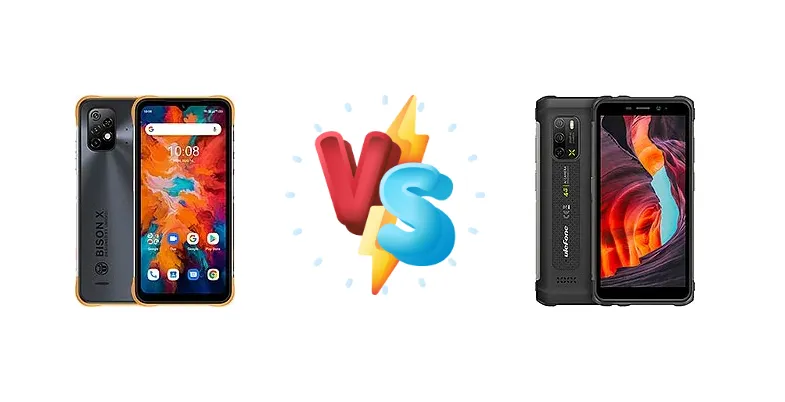
|
🏆 Quick Verdict
For the average user prioritizing responsiveness and smoother multitasking, the Umidigi Bison X10 is the better choice. Its Mediatek Helio P60 chipset, featuring Cortex-A73 cores, provides a noticeable performance advantage over the Ulefone Armor X10 Pro’s Helio P22, despite both phones sharing the same 10W charging.
| PHONES | ||
|---|---|---|
| Phone Names | Umidigi Bison X10 | Ulefone Armor X10 Pro |
| Network | ||
|---|---|---|
| 2G bands | GSM 850 / 900 / 1800 / 1900 | GSM 850 / 900 / 1800 / 1900 |
| 3G bands | HSDPA 800 / 850 / 900 / 1700(AWS) / 1900 / 2100 | HSDPA 850 / 900 / 1700(AWS) / 1900 / 2100 |
| 4G bands | 1, 2, 3, 4, 5, 7, 8, 12, 13, 17, 18, 19, 20, 26, 28, 34, 38, 39, 40, 41, 66 | 1, 2, 3, 4, 5, 7, 8, 12, 13, 17, 18, 19, 20, 25, 26, 28 |
| Speed | HSPA, LTE | HSPA 21/5.76 Mbps, LTE Cat6 300/150 Mbps |
| Technology | GSM / CDMA / HSPA / EVDO / LTE | GSM / HSPA / LTE |
| Launch | ||
|---|---|---|
| Announced | 2021. Released 2021 | 2022, March 10 |
| Status | Discontinued | Available. Released 2022, March 10 |
| Body | ||
|---|---|---|
| Dimensions | 169.7 x 82.1 x 12.9 mm (6.68 x 3.23 x 0.51 in) | 158.2 x 76.7 x 14.6 mm (6.23 x 3.02 x 0.57 in) |
| SIM | Nano-SIM + Nano-SIM | Nano-SIM + Nano-SIM |
| Weight | 282 g (9.95 oz) | 256 g (9.03 oz) |
| - | IP68/IP69K dust/water resistant (up to 1.5m for 30 min) Drop-to-concrete resistance from up to 1.2m MIL-STD-810G compliant | |
| Display | ||
|---|---|---|
| Resolution | 720 x 1600 pixels, 20:9 ratio (~269 ppi density) | 720 x 1440 pixels, 18:9 ratio (~295 ppi density) |
| Size | 6.53 inches, 102.9 cm2 (~73.9% screen-to-body ratio) | 5.45 inches, 76.7 cm2 (~63.2% screen-to-body ratio) |
| Type | IPS LCD | IPS LCD |
| Platform | ||
|---|---|---|
| CPU | Octa-core (4x2.0 GHz Cortex-A73 & 4x2.0 GHz Cortex-A53) | Octa-core 2.0 GHz Cortex-A53 |
| Chipset | Mediatek Helio P60 (12 nm) | Mediatek MT6762 Helio P22 (12 nm) |
| GPU | Mali-G72 MP3 | PowerVR GE8320 |
| OS | Android 11 | Android 11 |
| Memory | ||
|---|---|---|
| Card slot | microSDXC (uses shared SIM slot) | microSDXC (dedicated slot) |
| Internal | 64GB 4GB RAM, 128GB 4GB RAM | 64GB 4GB RAM |
| - | eMMC 5.1 | |
| Main Camera | ||
|---|---|---|
| Dual | - | 20 MP, f/1.8, 26mm (wide), 1/2.78", 1.0µm, PDAF Auxiliary lens |
| Features | Dual-LED flash, HDR, panorama | Dual-LED flash |
| Single | - | 5 MP, f/2.2 |
| Triple | 20 MP, f/1.8, (wide), AF 8 MP, 120˚ (ultrawide) 5 MP (macro) | - |
| Video | 1080p@30fps | 1080p@30fps |
| Selfie camera | ||
|---|---|---|
| Features | - | HDR |
| Single | 8 MP, f/2.2, (wide) | 5 MP, f/2.2 |
| Video | 1080p@30fps | 1080p@30fps |
| Sound | ||
|---|---|---|
| 3.5mm jack | - | Yes |
| 35mm jack | Yes | Yes |
| Loudspeaker | Yes | Yes |
| Comms | ||
|---|---|---|
| Bluetooth | 4.2, A2DP | 5.0, A2DP, LE |
| NFC | Yes | Yes |
| Positioning | GPS, GLONASS, GALILEO, BDS | GPS, GLONASS, GALILEO, BDS |
| Radio | Wireless FM radio | FM radio, RDS, recording |
| USB | USB Type-C, OTG | USB Type-C 2.0, OTG |
| WLAN | Wi-Fi 802.11 a/b/g/n/ac, dual-band, Wi-Fi Direct | Wi-Fi 802.11 a/b/g/n/ac, dual-band, Wi-Fi Direct |
| Features | ||
|---|---|---|
| Sensors | Fingerprint (side-mounted), accelerometer, proximity, compass, barometer | Accelerometer, proximity, compass |
| Battery | ||
|---|---|---|
| Charging | 10W wired | 10W wired |
| Type | 6150 mAh | Li-Po 5180 mAh |
| Misc | ||
|---|---|---|
| Colors | Storm Gray, Supersonic Yellow, Hack Black | Black/Gray |
| Price | - | About 170 EUR |
Umidigi Bison X10
- More powerful Helio P60 processor for smoother performance
- Potentially better power efficiency with the Helio P60
- Likely superior image processing capabilities
- May be slightly more expensive than the Armor X10 Pro
- 10W charging is relatively slow
Ulefone Armor X10 Pro
- Likely more affordable price point
- Rugged design for durability
- Acceptable performance for basic tasks
- Significantly weaker Helio P22 processor
- Less responsive user experience
- Potentially lower image quality
Display Comparison
Neither device’s display specifications are provided, so a direct comparison is limited. However, given their price points, both likely utilize IPS LCD panels. The focus here shifts to the internal hardware impacting display responsiveness. The Bison X10’s more powerful GPU, driven by the Helio P60, will likely translate to slightly smoother scrolling and animations, even if the resolution and refresh rates are identical.
Camera Comparison
Without detailed camera specifications, a direct comparison is difficult. However, it’s reasonable to assume both phones feature budget-oriented camera systems. The image signal processor (ISP) within the Helio P60 of the Bison X10 is likely more capable than the ISP in the Helio P22 of the Armor X10 Pro, potentially leading to better image processing, particularly in low-light conditions. Any differences in sensor size or lens aperture would further accentuate this advantage.
Performance
The core difference lies in the chipsets. The Umidigi Bison X10’s Mediatek Helio P60 utilizes a combination of Cortex-A73 and Cortex-A53 cores, offering a significant architectural advantage over the Ulefone Armor X10 Pro’s Helio P22, which relies solely on Cortex-A53 cores. The A73 cores in the Bison X10 provide substantially higher single-core performance, crucial for app launch speeds and general responsiveness. While both are 12nm chips, the P60’s more efficient core design will likely result in better sustained performance under load. This means the Bison X10 will handle multitasking and moderately demanding apps with greater ease.
Battery Life
Both devices share the same 10W wired charging, meaning charging times will be comparable. While battery capacity isn’t specified, the Helio P60 in the Bison X10 is generally more power-efficient than the Helio P22 in the Armor X10 Pro. This means the Bison X10 could potentially achieve similar or even better battery life despite potentially having a smaller battery capacity, due to its more efficient processor.
Buying Guide
Buy the Umidigi Bison X10 if you need a phone capable of handling more demanding apps, occasional gaming, and smoother overall operation. It’s ideal for users who value performance over absolute battery longevity. Buy the Ulefone Armor X10 Pro if your primary concern is maximizing battery life for basic tasks and you prioritize a lower price point, accepting a trade-off in processing speed.