
Umidigi Bison X10 vs Oukitel WP18 Pro: A Deep Dive into Budget Ruggedness
| Phones Images | |||||
|---|---|---|---|---|---|
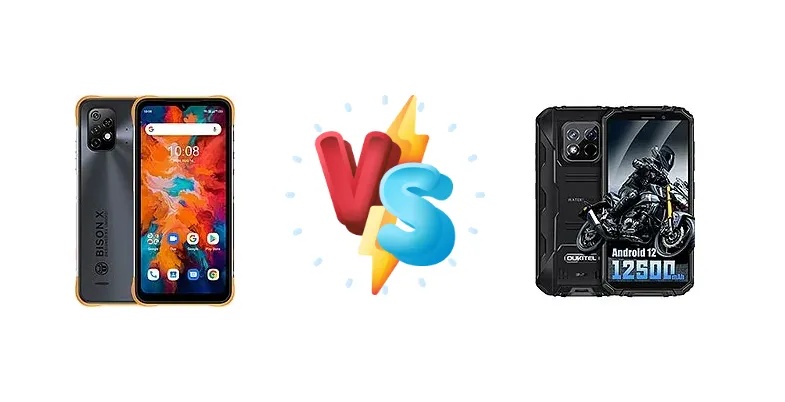
|
🏆 Quick Verdict
For the average user needing a dependable, if not blazing-fast, rugged phone, the Umidigi Bison X10 edges out the Oukitel WP18 Pro. Its Helio P60 chipset, featuring Cortex-A73 cores, provides a noticeable performance advantage for multitasking and moderately demanding applications, despite the slower 10W charging.
| PHONES | ||
|---|---|---|
| Phone Names | Umidigi Bison X10 | Oukitel WP18 Pro |
| Network | ||
|---|---|---|
| 2G bands | GSM 850 / 900 / 1800 / 1900 | GSM 850 / 900 / 1800 / 1900 |
| 3G bands | HSDPA 800 / 850 / 900 / 1700(AWS) / 1900 / 2100 | HSDPA 850 / 900 / 1700(AWS) / 1900 / 2100 |
| 4G bands | 1, 2, 3, 4, 5, 7, 8, 12, 13, 17, 18, 19, 20, 26, 28, 34, 38, 39, 40, 41, 66 | 1, 2, 3, 4, 5, 7, 8, 12, 17, 18, 19, 20, 25, 26, 28, 66 |
| Speed | HSPA, LTE | HSPA, LTE |
| Technology | GSM / CDMA / HSPA / EVDO / LTE | GSM / HSPA / LTE |
| Launch | ||
|---|---|---|
| Announced | 2021. Released 2021 | 2022, October |
| Status | Discontinued | Available. Released 2022, October |
| Body | ||
|---|---|---|
| Dimensions | 169.7 x 82.1 x 12.9 mm (6.68 x 3.23 x 0.51 in) | - |
| SIM | Nano-SIM + Nano-SIM | Nano-SIM + Nano-SIM |
| Weight | 282 g (9.95 oz) | - |
| Display | ||
|---|---|---|
| Resolution | 720 x 1600 pixels, 20:9 ratio (~269 ppi density) | 720 x 1440 pixels, 18:9 ratio (~271 ppi density) |
| Size | 6.53 inches, 102.9 cm2 (~73.9% screen-to-body ratio) | 5.93 inches, 90.7 cm2 |
| Type | IPS LCD | IPS LCD |
| Platform | ||
|---|---|---|
| CPU | Octa-core (4x2.0 GHz Cortex-A73 & 4x2.0 GHz Cortex-A53) | Octa-core 2.0 GHz Cortex-A53 |
| Chipset | Mediatek Helio P60 (12 nm) | Mediatek MT6762 Helio P22 (12 nm) |
| GPU | Mali-G72 MP3 | PowerVR GE8320 |
| OS | Android 11 | Android 12 |
| Memory | ||
|---|---|---|
| Card slot | microSDXC (uses shared SIM slot) | microSDXC (uses shared SIM slot) |
| Internal | 64GB 4GB RAM, 128GB 4GB RAM | 64GB 4GB RAM |
| Main Camera | ||
|---|---|---|
| Dual | - | 13 MP, (wide), AF Secondary unspecified camera |
| Features | Dual-LED flash, HDR, panorama | LED flash |
| Triple | 20 MP, f/1.8, (wide), AF 8 MP, 120˚ (ultrawide) 5 MP (macro) | - |
| Video | 1080p@30fps | 1080p@30fps |
| Selfie camera | ||
|---|---|---|
| Single | 8 MP, f/2.2, (wide) | 5 MP |
| Video | 1080p@30fps | Yes |
| Sound | ||
|---|---|---|
| 35mm jack | Yes | Unspecified |
| Loudspeaker | Yes | Yes |
| Comms | ||
|---|---|---|
| Bluetooth | 4.2, A2DP | Yes |
| NFC | Yes | No |
| Positioning | GPS, GLONASS, GALILEO, BDS | GPS, GLONASS, GALILEO, BDS |
| Radio | Wireless FM radio | Unspecified |
| USB | USB Type-C, OTG | Yes |
| WLAN | Wi-Fi 802.11 a/b/g/n/ac, dual-band, Wi-Fi Direct | Yes |
| Features | ||
|---|---|---|
| Sensors | Fingerprint (side-mounted), accelerometer, proximity, compass, barometer | Fingerprint (rear-mounted), accelerometer, compass |
| Battery | ||
|---|---|---|
| Charging | 10W wired | 18W wired |
| Type | 6150 mAh | Li-Po 12500 mAh |
| Misc | ||
|---|---|---|
| Colors | Storm Gray, Supersonic Yellow, Hack Black | Orange |
| Price | - | About 190 EUR |
Umidigi Bison X10
- More powerful Helio P60 chipset for smoother performance.
- Cortex-A73 cores provide a noticeable boost in responsiveness.
- Potentially better multitasking capabilities.
- Slower 10W charging.
- Likely lacks advanced display features.
- Camera performance is likely average for the price.
Oukitel WP18 Pro
- Faster 18W wired charging.
- Suitable for basic smartphone tasks.
- Rugged design offers good protection.
- Less powerful Helio P22 chipset.
- Cortex-A53 only cores limit performance.
- May struggle with demanding apps and games.
Display Comparison
Neither device boasts a standout display. Given the context data focuses on internal specs, we can infer both likely utilize IPS LCD panels common in this price bracket. The absence of details like resolution or refresh rate suggests a focus on cost-effectiveness. Bezels are likely substantial on both, prioritizing drop protection over maximizing screen real estate. Color accuracy will likely be standard for the segment, leaning towards practical usability rather than color-critical work.
Camera Comparison
Without detailed camera specifications, a direct comparison is difficult. However, the market segment suggests both phones will feature a primary camera supplemented by auxiliary lenses of limited utility (likely 2MP macro/depth sensors). The image processing will likely prioritize scene recognition and basic enhancements over advanced features. The absence of OIS on either device suggests reliance on software stabilization, which will be less effective in low-light conditions. The larger the primary sensor (which is unknown), the better the low-light performance will be, but we can't determine that from the provided data.
Performance
The core difference lies in the chipsets. The Umidigi Bison X10’s MediaTek Helio P60 utilizes a more sophisticated core configuration: four Cortex-A73 cores clocked at 2.0 GHz alongside four Cortex-A53 cores. This contrasts with the Oukitel WP18 Pro’s Helio P22, which features eight Cortex-A53 cores at the same clock speed. The A73 cores in the Bison X10 offer significantly higher single-core performance, translating to snappier app launches and smoother multitasking. While both are 12nm chips, the architectural advantage of the P60 is substantial. This means the Bison X10 will handle more demanding apps and games with less lag, benefitting users who occasionally engage in mobile gaming or resource-intensive tasks.
Battery Life
The battery capacity is not specified for either device, but both are likely in the 4000-5000 mAh range, typical for rugged phones. The Oukitel WP18 Pro’s 18W wired charging is a clear advantage over the Umidigi Bison X10’s 10W charging. This translates to significantly faster top-up times, reducing downtime. While a larger battery capacity on the Bison X10 could partially offset this, the faster charging of the WP18 Pro is more immediately beneficial for users who frequently need to quickly replenish their battery.
Buying Guide
Buy the Umidigi Bison X10 if you need a phone capable of handling everyday tasks and light gaming with reasonable responsiveness. It’s ideal for users who prioritize a smoother user experience over the absolute fastest charging speeds. Buy the Oukitel WP18 Pro if you prioritize faster charging and are primarily focused on basic smartphone functions like calls, texts, and light social media use, and are willing to trade some performance for that convenience.