
Umidigi Bison X10 vs Blackview BV8800: A Deep Dive into Rugged Smartphone Performance
| Phones Images | |||||
|---|---|---|---|---|---|
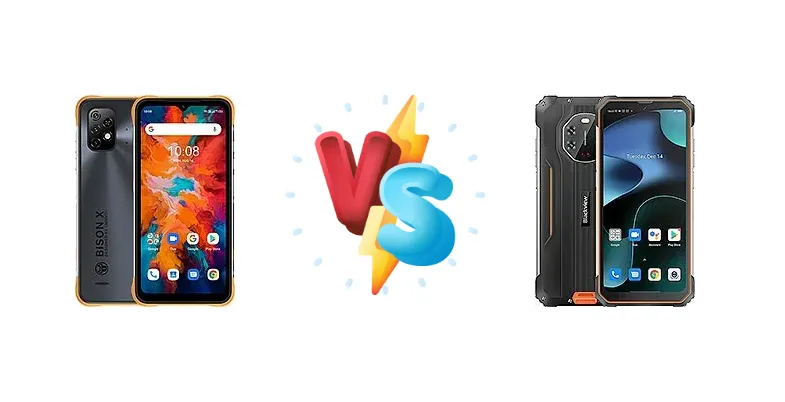
|
🏆 Quick Verdict
For the average user prioritizing performance and convenience, the Blackview BV8800 is the better choice. Its Helio G96 chipset offers a noticeable performance uplift over the Bison X10’s Helio P60, and the 33W charging dramatically reduces downtime. While both offer excellent battery endurance, the BV8800’s faster charging is a key advantage.
| PHONES | ||
|---|---|---|
| Phone Names | Umidigi Bison X10 | Blackview BV8800 |
| Network | ||
|---|---|---|
| 2G bands | GSM 850 / 900 / 1800 / 1900 | GSM 850 / 900 / 1800 / 1900 |
| 3G bands | HSDPA 800 / 850 / 900 / 1700(AWS) / 1900 / 2100 | HSDPA 800 / 850 / 900 / 1700(AWS) / 1900 / 2100 |
| 4G bands | 1, 2, 3, 4, 5, 7, 8, 12, 13, 17, 18, 19, 20, 26, 28, 34, 38, 39, 40, 41, 66 | 1, 2, 3, 4, 5, 7, 8, 12, 13, 17, 18, 19, 20, 25, 26, 28, 30, 34, 38, 39, 40, 41, 66 |
| Speed | HSPA, LTE | HSPA, LTE |
| Technology | GSM / CDMA / HSPA / EVDO / LTE | GSM / CDMA / HSPA / CDMA2000 / LTE |
| - | CDMA2000 1x | |
| Launch | ||
|---|---|---|
| Announced | 2021. Released 2021 | 2021, December 24 |
| Status | Discontinued | Available. Released 2022, January 10 |
| Body | ||
|---|---|---|
| Dimensions | 169.7 x 82.1 x 12.9 mm (6.68 x 3.23 x 0.51 in) | 176.2 x 83.5 x 17.7 mm (6.94 x 3.29 x 0.70 in) |
| SIM | Nano-SIM + Nano-SIM | Nano-SIM + Nano-SIM |
| Weight | 282 g (9.95 oz) | 367 g (12.95 oz) |
| - | IP68/IP69K dust/water resistant (up to 1.5m for 30 min) Drop-to-concrete resistance from up to 1.5m MIL-STD-810H compliant | |
| Display | ||
|---|---|---|
| Resolution | 720 x 1600 pixels, 20:9 ratio (~269 ppi density) | 1080 x 2408 pixels, 20:9 ratio (~401 ppi density) |
| Size | 6.53 inches, 102.9 cm2 (~73.9% screen-to-body ratio) | 6.58 inches, 104.3 cm2 (~70.9% screen-to-body ratio) |
| Type | IPS LCD | IPS LCD, 90Hz, 480 nits |
| Platform | ||
|---|---|---|
| CPU | Octa-core (4x2.0 GHz Cortex-A73 & 4x2.0 GHz Cortex-A53) | Octa-core (2x2.05 GHz Cortex-A76 & 6x2.0 GHz Cortex-A55) |
| Chipset | Mediatek Helio P60 (12 nm) | Mediatek MT6781 Helio G96 (12 nm) |
| GPU | Mali-G72 MP3 | Mali-G57 MC2 |
| OS | Android 11 | Android 11, Doke-OS 3.0 |
| Memory | ||
|---|---|---|
| Card slot | microSDXC (uses shared SIM slot) | No |
| Internal | 64GB 4GB RAM, 128GB 4GB RAM | 128GB 8GB RAM |
| - | UFS 2.1 | |
| Main Camera | ||
|---|---|---|
| Features | Dual-LED flash, HDR, panorama | Dual-LED flash, HDR, panorama |
| Quad | - | 50 MP, f/1.8, (wide), PDAF 8 MP, f/2.2, 117˚ (ultrawide) 20 MP, f/1.8, (IR camera), 2 IR emitters Auxiliary lens |
| Single | - | 16 MP, f/2.0, (wide) |
| Triple | 20 MP, f/1.8, (wide), AF 8 MP, 120˚ (ultrawide) 5 MP (macro) | - |
| Video | 1080p@30fps | 1440p@30fps |
| Selfie camera | ||
|---|---|---|
| Single | 8 MP, f/2.2, (wide) | 16 MP, f/2.0, (wide) |
| Video | 1080p@30fps | 1080p@30fps |
| Sound | ||
|---|---|---|
| 3.5mm jack | - | No |
| 35mm jack | Yes | No |
| Loudspeaker | Yes | Yes |
| Comms | ||
|---|---|---|
| Bluetooth | 4.2, A2DP | 5.2, A2DP, LE |
| NFC | Yes | Yes |
| Positioning | GPS, GLONASS, GALILEO, BDS | GPS, GLONASS, GALILEO, BDS |
| Radio | Wireless FM radio | FM radio |
| USB | USB Type-C, OTG | USB Type-C 2.0, OTG |
| WLAN | Wi-Fi 802.11 a/b/g/n/ac, dual-band, Wi-Fi Direct | Wi-Fi 802.11 a/b/g/n/ac |
| Features | ||
|---|---|---|
| Sensors | Fingerprint (side-mounted), accelerometer, proximity, compass, barometer | Fingerprint (side-mounted), accelerometer, gyro, proximity, compass, barometer |
| Battery | ||
|---|---|---|
| Charging | 10W wired | 33W wired, 31% in 30 min, 100% in 90 min Reverse wired |
| Type | 6150 mAh | 8380 mAh |
| Misc | ||
|---|---|---|
| Colors | Storm Gray, Supersonic Yellow, Hack Black | Black, Orange, Green |
| Price | - | About 350 EUR |
| Tests | ||
|---|---|---|
| Battery life | - | Endurance rating 199h |
| Camera | - | Photo / Video |
| Display | - | Contrast ratio: 1348:1 (nominal) |
| Loudspeaker | - | -29.3 LUFS (Average) |
| Performance | - | AnTuTu: 254849 (v8), 288964 (v9) GeekBench: 1752 (v5.1) GFXBench: 10fps (ES 3.1 onscreen) |
Umidigi Bison X10
- Highly affordable price point
- Rugged build quality for durability
- Decent battery endurance
- Outdated Helio P60 chipset
- Slow 10W charging
- Limited performance for demanding tasks
Blackview BV8800
- More powerful Helio G96 chipset
- Fast 33W wired charging with reverse charging
- Brighter display for outdoor visibility
- Higher price compared to the Bison X10
- Rugged design may be bulky for some users
- Camera details are limited
Display Comparison
Both devices share a contrast ratio of 1348:1, suggesting similar image quality in terms of black levels. However, the Blackview BV8800 boasts a measured peak brightness of 501 nits, which, while not exceptional, provides a more visible display in direct sunlight compared to the Bison X10, whose brightness is unspecified. The lack of information on the Bison X10’s panel technology makes it difficult to assess its color accuracy or viewing angles relative to the BV8800.
Camera Comparison
Both phones list 'Photo / Video' capabilities, but lack specific details. Without sensor size, aperture, or image processing information, a direct comparison is impossible. However, the market segment suggests the BV8800 likely benefits from a more advanced camera system, given its higher price point and focus on overall performance. It's reasonable to assume the BV8800 will deliver better image quality, particularly in low-light conditions, though this remains speculative without further data. The inclusion of a 2MP macro lens on either device is unlikely to significantly impact overall camera performance.
Performance
The Blackview BV8800’s Mediatek Helio G96 chipset represents a significant upgrade over the Umidigi Bison X10’s Helio P60. The G96 utilizes two Cortex-A76 cores clocked at 2.05 GHz alongside six Cortex-A55 cores, offering superior single-core and multi-core performance compared to the P60’s four Cortex-A73 and four Cortex-A53 cores, both clocked at 2.0 GHz. This translates to snappier app launches, smoother multitasking, and a more enjoyable gaming experience on the BV8800. The G96’s improved GPU also provides a noticeable boost in graphics performance.
Battery Life
Both devices achieve an endurance rating of 199 hours, indicating comparable battery life under similar usage conditions. However, the Blackview BV8800’s 33W wired charging is a game-changer. It can reach 31% charge in just 30 minutes and fully charge in 90 minutes, significantly reducing downtime compared to the Bison X10’s slow 10W charging. The BV8800 also offers reverse wired charging, a feature absent on the Bison X10, adding to its versatility.
Buying Guide
Buy the Umidigi Bison X10 if you need a highly affordable, durable phone for basic tasks and aren't concerned with demanding applications or quick charging. It’s ideal for users who prioritize cost-effectiveness above all else. Buy the Blackview BV8800 if you prefer a more responsive experience, faster charging speeds, and a chipset capable of handling more intensive tasks like gaming or video editing, even if it comes at a slightly higher price.