
Umidigi Bison X10 Pro vs Ulefone Armor 11T 5G: A Deep Dive into Rugged Smartphone Performance
| Phones Images | |||||
|---|---|---|---|---|---|
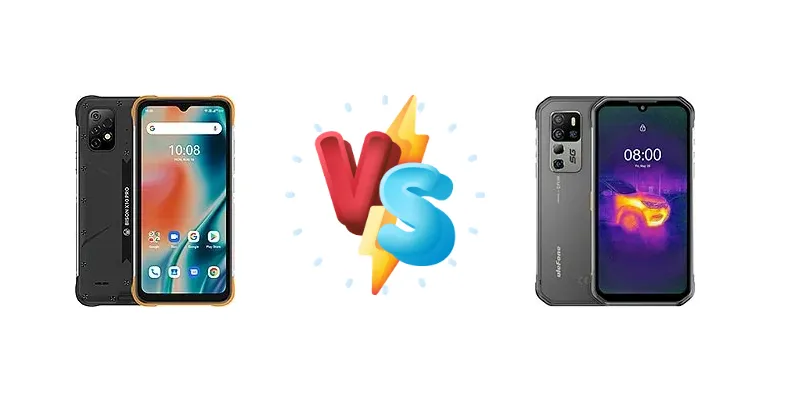
|
🏆 Quick Verdict
For the average user prioritizing responsiveness and future-proofing, the Ulefone Armor 11T 5G is the clear winner. Its Mediatek Dimensity 800 chipset delivers a substantial performance uplift over the Bison X10 Pro’s Helio P60, justifying the price difference for those needing more than basic functionality.
| PHONES | ||
|---|---|---|
| Phone Names | Umidigi Bison X10 Pro | Ulefone Armor 11T 5G |
| Network | ||
|---|---|---|
| 2G bands | GSM 850 / 900 / 1800 / 1900 | GSM 850 / 900 / 1800 / 1900 |
| 3G bands | HSDPA 800 / 850 / 900 / 1700(AWS) / 1900 / 2100 | HSDPA 850 / 900 / 1700(AWS) / 1900 / 2100 |
| 4G bands | 1, 2, 3, 4, 5, 7, 8, 12, 13, 17, 18, 19, 20, 26, 28, 34, 38, 39, 40, 41, 66 | 1, 2, 3, 4, 5, 7, 8, 12, 13, 17, 18, 19, 20, 25, 26, 28, 34, 38, 39, 40, 41, 66 |
| 5G bands | - | 1, 3, 5, 8, 20, 28, 38, 41, 77, 78, 79 SA/NSA |
| Speed | HSPA, LTE | HSPA, LTE, 5G |
| Technology | GSM / CDMA / HSPA / EVDO / LTE | GSM / CDMA / HSPA / EVDO / LTE / 5G |
| - | CDMA2000 1xEV-DO | |
| Launch | ||
|---|---|---|
| Announced | 2021. Released 2021 | 2021, May 29 |
| Status | Discontinued | Available. Released 2021, June 07 |
| Body | ||
|---|---|---|
| Build | - | Front glass, aluminum back with rubber, aluminum frame |
| Dimensions | 169.7 x 82.1 x 12.9 mm (6.68 x 3.23 x 0.51 in) | 163.8 x 81.6 x 14.2 mm (6.45 x 3.21 x 0.56 in) |
| SIM | Nano-SIM + Nano-SIM | Nano-SIM + Nano-SIM |
| Weight | 285 g (10.05 oz) | 293 g (10.34 oz) |
| - | IP69K dust/water resistant (up to 1.5m for 30 min) Drop-to-concrete resistance from up to 1.2m MIL-STD-810G compliant | |
| Display | ||
|---|---|---|
| Protection | - | Oleophobic coating |
| Resolution | 720 x 1600 pixels, 20:9 ratio (~269 ppi density) | 720 x 1560 pixels, 19.5:9 ratio (~282 ppi density) |
| Size | 6.53 inches, 102.9 cm2 (~73.9% screen-to-body ratio) | 6.1 inches, 91.3 cm2 (~68.3% screen-to-body ratio) |
| Type | IPS LCD | IPS LCD |
| Platform | ||
|---|---|---|
| CPU | Octa-core (4x2.0 GHz Cortex-A73 & 4x2.0 GHz Cortex-A53) | Octa-core (4x2.0 GHz Cortex-A76 & 4x2.0 GHz Cortex-A55) |
| Chipset | Mediatek Helio P60 (12 nm) | Mediatek Dimensity 800 (7 nm) |
| GPU | Mali-G72 MP3 | Mali-G57 MP4 |
| OS | Android 11 | Android 11 |
| Memory | ||
|---|---|---|
| Card slot | microSDXC (uses shared SIM slot) | No |
| Internal | 128GB 4GB RAM, 128GB 6GB RAM | 256GB 8GB RAM |
| - | UFS 2.1 | |
| Main Camera | ||
|---|---|---|
| Features | Dual-LED flash, HDR, panorama | Dual-LED dual-tone flash, HDR, panorama |
| Penta | - | 48 MP, f/1.8, 26mm (wide), 1/2.0", 0.8µm, PDAF FLIR thermal camera (Lepton module) 5 MP 2 MP (macro) Auxiliary lens |
| Single | - | 16 MP, f/2.0 |
| Triple | 20 MP, f/1.8, (wide), AF 8 MP, 120˚ (ultrawide) 5 MP (macro) | - |
| Video | 1080p@30fps | 4K@30fps, 1080p@30fps |
| Selfie camera | ||
|---|---|---|
| Features | - | HDR, panorama |
| Single | 8 MP, f/2.2, (wide) | 16 MP, f/2.0 |
| Video | 1080p@30fps | 1080p@30fps |
| Sound | ||
|---|---|---|
| 3.5mm jack | - | Yes |
| 35mm jack | Yes | Yes |
| Loudspeaker | Yes | Yes |
| Comms | ||
|---|---|---|
| Bluetooth | 4.2, A2DP | 5.0, A2DP, LE |
| NFC | Yes | Yes |
| Positioning | GPS, GLONASS, GALILEO, BDS | GPS, GLONASS, GALILEO, BDS |
| Radio | Wireless FM radio | FM radio, RDS, recording |
| USB | USB Type-C, OTG | USB Type-C 2.0, OTG |
| WLAN | Wi-Fi 802.11 a/b/g/n/ac, dual-band, Wi-Fi Direct | Wi-Fi 802.11 a/b/g/n/ac, Wi-Fi Direct |
| Features | ||
|---|---|---|
| Sensors | Fingerprint (side-mounted), accelerometer, proximity, compass, barometer, thermometer (skin temperature) | Fingerprint (side-mounted), accelerometer, gyro, proximity, compass, baroceptor |
| Battery | ||
|---|---|---|
| Charging | 10W wired | 18W wired 10W wireless |
| Type | 6150 mAh | Li-Po 5200 mAh |
| Misc | ||
|---|---|---|
| Colors | Storm Gray, Supersonic Yellow, Hack Black | Black |
| Price | - | About 590 EUR |
Umidigi Bison X10 Pro
- Highly affordable price point
- Rugged build quality for durability
- Simple and straightforward user experience
- Outdated Helio P60 chipset
- Slow 10W charging
- Limited performance for demanding tasks
Ulefone Armor 11T 5G
- Powerful Mediatek Dimensity 800 chipset
- 5G connectivity for faster data speeds
- Faster 18W wired and 10W wireless charging
- Higher price compared to the Bison X10 Pro
- Rugged design may be bulky for some users
- Software updates may be less frequent than mainstream brands
Display Comparison
Neither device's display specifications are provided, so a direct comparison is limited. However, given the Armor 11T 5G's positioning as a more premium device, it likely features a higher-quality panel with better color accuracy and potentially a higher refresh rate. The Bison X10 Pro, focusing on cost-effectiveness, likely utilizes a standard LCD panel. Bezels are expected to be larger on the Bison X10 Pro to minimize manufacturing costs.
Camera Comparison
Without detailed camera specifications, a precise comparison is difficult. However, the Armor 11T 5G, being the more expensive device, likely features a larger sensor and more sophisticated image processing algorithms. While both phones likely include multiple cameras, the Bison X10 Pro may rely heavily on software interpolation to achieve higher megapixel counts. The Armor 11T 5G’s image quality will likely be superior in low-light conditions and offer more dynamic range.
Performance
The core difference lies in the chipsets. The Ulefone Armor 11T 5G’s Mediatek Dimensity 800 (7nm) represents a significant leap over the Umidigi Bison X10 Pro’s Helio P60 (12nm). The Dimensity 800 utilizes Cortex-A76 cores, offering substantially improved single-core performance compared to the Bison X10 Pro’s Cortex-A73 cores. This translates to faster app loading times, smoother multitasking, and a more responsive user experience. The 7nm process node also contributes to better thermal efficiency, reducing the likelihood of throttling during sustained workloads. The Armor 11T 5G will handle demanding games and applications with ease, while the Bison X10 Pro will struggle with graphically intensive tasks.
Battery Life
The Armor 11T 5G offers a clear advantage in charging speed with 18W wired and 10W wireless charging, compared to the Bison X10 Pro’s 10W wired charging only. While battery capacity isn't specified, the faster charging of the Armor 11T 5G minimizes downtime. The Dimensity 800’s improved power efficiency also contributes to potentially longer real-world battery life, despite potentially having a similar capacity to the Bison X10 Pro.
Buying Guide
Buy the Umidigi Bison X10 Pro if you need a highly affordable, durable phone for essential tasks like calls, texts, and light app usage, and aren't concerned with demanding games or future software updates. Buy the Ulefone Armor 11T 5G if you prioritize 5G connectivity, smoother multitasking, and the ability to run more resource-intensive applications, even in challenging environments. The Armor 11T 5G is for users who need a phone that can keep up with their active lifestyle and evolving needs.