
Umidigi Bison X10 Pro vs Oukitel WP18 Pro: A Deep Dive into Budget Ruggedness
| Phones Images | |||||
|---|---|---|---|---|---|
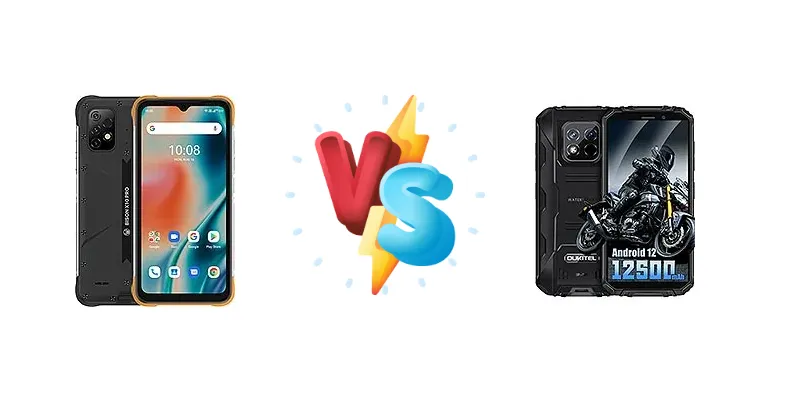
|
🏆 Quick Verdict
For the average user needing a dependable, if not blazing-fast, rugged phone, the Umidigi Bison X10 Pro edges out the Oukitel WP18 Pro. Its Helio P60 chipset, featuring Cortex-A73 cores, provides a noticeable performance advantage for multitasking and moderately demanding apps, outweighing the WP18 Pro’s faster charging.
| PHONES | ||
|---|---|---|
| Phone Names | Umidigi Bison X10 Pro | Oukitel WP18 Pro |
| Network | ||
|---|---|---|
| 2G bands | GSM 850 / 900 / 1800 / 1900 | GSM 850 / 900 / 1800 / 1900 |
| 3G bands | HSDPA 800 / 850 / 900 / 1700(AWS) / 1900 / 2100 | HSDPA 850 / 900 / 1700(AWS) / 1900 / 2100 |
| 4G bands | 1, 2, 3, 4, 5, 7, 8, 12, 13, 17, 18, 19, 20, 26, 28, 34, 38, 39, 40, 41, 66 | 1, 2, 3, 4, 5, 7, 8, 12, 17, 18, 19, 20, 25, 26, 28, 66 |
| Speed | HSPA, LTE | HSPA, LTE |
| Technology | GSM / CDMA / HSPA / EVDO / LTE | GSM / HSPA / LTE |
| Launch | ||
|---|---|---|
| Announced | 2021. Released 2021 | 2022, October |
| Status | Discontinued | Available. Released 2022, October |
| Body | ||
|---|---|---|
| Dimensions | 169.7 x 82.1 x 12.9 mm (6.68 x 3.23 x 0.51 in) | - |
| SIM | Nano-SIM + Nano-SIM | Nano-SIM + Nano-SIM |
| Weight | 285 g (10.05 oz) | - |
| Display | ||
|---|---|---|
| Resolution | 720 x 1600 pixels, 20:9 ratio (~269 ppi density) | 720 x 1440 pixels, 18:9 ratio (~271 ppi density) |
| Size | 6.53 inches, 102.9 cm2 (~73.9% screen-to-body ratio) | 5.93 inches, 90.7 cm2 |
| Type | IPS LCD | IPS LCD |
| Platform | ||
|---|---|---|
| CPU | Octa-core (4x2.0 GHz Cortex-A73 & 4x2.0 GHz Cortex-A53) | Octa-core 2.0 GHz Cortex-A53 |
| Chipset | Mediatek Helio P60 (12 nm) | Mediatek MT6762 Helio P22 (12 nm) |
| GPU | Mali-G72 MP3 | PowerVR GE8320 |
| OS | Android 11 | Android 12 |
| Memory | ||
|---|---|---|
| Card slot | microSDXC (uses shared SIM slot) | microSDXC (uses shared SIM slot) |
| Internal | 128GB 4GB RAM, 128GB 6GB RAM | 64GB 4GB RAM |
| Main Camera | ||
|---|---|---|
| Dual | - | 13 MP, (wide), AF Secondary unspecified camera |
| Features | Dual-LED flash, HDR, panorama | LED flash |
| Triple | 20 MP, f/1.8, (wide), AF 8 MP, 120˚ (ultrawide) 5 MP (macro) | - |
| Video | 1080p@30fps | 1080p@30fps |
| Selfie camera | ||
|---|---|---|
| Single | 8 MP, f/2.2, (wide) | 5 MP |
| Video | 1080p@30fps | Yes |
| Sound | ||
|---|---|---|
| 35mm jack | Yes | Unspecified |
| Loudspeaker | Yes | Yes |
| Comms | ||
|---|---|---|
| Bluetooth | 4.2, A2DP | Yes |
| NFC | Yes | No |
| Positioning | GPS, GLONASS, GALILEO, BDS | GPS, GLONASS, GALILEO, BDS |
| Radio | Wireless FM radio | Unspecified |
| USB | USB Type-C, OTG | Yes |
| WLAN | Wi-Fi 802.11 a/b/g/n/ac, dual-band, Wi-Fi Direct | Yes |
| Features | ||
|---|---|---|
| Sensors | Fingerprint (side-mounted), accelerometer, proximity, compass, barometer, thermometer (skin temperature) | Fingerprint (rear-mounted), accelerometer, compass |
| Battery | ||
|---|---|---|
| Charging | 10W wired | 18W wired |
| Type | 6150 mAh | Li-Po 12500 mAh |
| Misc | ||
|---|---|---|
| Colors | Storm Gray, Supersonic Yellow, Hack Black | Orange |
| Price | - | About 190 EUR |
Umidigi Bison X10 Pro
- More powerful Helio P60 chipset for better performance.
- Cortex-A73 cores enable smoother multitasking.
- Potentially longer battery life if it has a larger capacity.
- Slower 10W charging.
- Likely lacks advanced display features.
Oukitel WP18 Pro
- Faster 18W wired charging.
- Potentially quicker top-ups for users on the go.
- Rugged design for durability.
- Less powerful Helio P22 chipset.
- Cortex-A53 only architecture limits performance.
- May struggle with demanding applications.
Display Comparison
Neither device’s display specifications are provided, so a direct comparison is limited. However, given their price points, both likely utilize IPS LCD panels. The focus here shifts to durability; both phones are marketed as rugged, implying reinforced glass or plastic coverings. The absence of details like resolution or refresh rate suggests neither prioritizes a premium visual experience, focusing instead on resilience.
Camera Comparison
Without detailed camera specifications, assessing image quality is difficult. However, the market segment suggests both phones will rely on budget sensors. The absence of information regarding sensor size or optical image stabilization (OIS) indicates neither phone will excel in low-light photography. The focus will likely be on providing functional, rather than exceptional, image capture capabilities. Any 2MP macro or depth sensors present on either device should be considered marketing features with limited real-world utility.
Performance
The core difference lies in the chipsets. The Umidigi Bison X10 Pro’s MediaTek Helio P60 utilizes a more sophisticated architecture with four Cortex-A73 cores clocked at 2.0 GHz alongside four Cortex-A53 cores. This contrasts sharply with the Oukitel WP18 Pro’s Helio P22, which features eight Cortex-A53 cores at the same clock speed. The A73 cores in the P60 offer significantly higher single-core performance, translating to snappier app launches and smoother multitasking. While both are 12nm chips, the architectural advantage of the P60 is substantial. Users who intend to play even moderately demanding games will find the Bison X10 Pro a more capable device.
Battery Life
Battery capacity isn’t specified for either device, but the charging wattage reveals a key difference. The Oukitel WP18 Pro’s 18W wired charging is significantly faster than the Umidigi Bison X10 Pro’s 10W charging. This means the WP18 Pro will reach a full charge considerably quicker. However, faster charging doesn’t necessarily equate to longer battery life. If the Bison X10 Pro has a larger battery capacity, it could offset the slower charging speed and provide comparable or even superior overall runtime. The WP18 Pro will appeal to users who frequently need to top up their battery quickly, while the Bison X10 Pro may suit those who prioritize extended usage between charges.
Buying Guide
Buy the Umidigi Bison X10 Pro if you need a phone capable of handling more than basic tasks, such as light gaming or running multiple apps simultaneously, and value a more responsive user experience. Buy the Oukitel WP18 Pro if your primary concern is maximizing battery uptime and you prioritize faster charging speeds over raw processing power, and your usage is limited to essential communication and light app use.