
Umidigi Bison X10 Pro vs Doogee S98 Pro: A Deep Dive into Rugged Smartphone Performance
| Phones Images | |||||
|---|---|---|---|---|---|
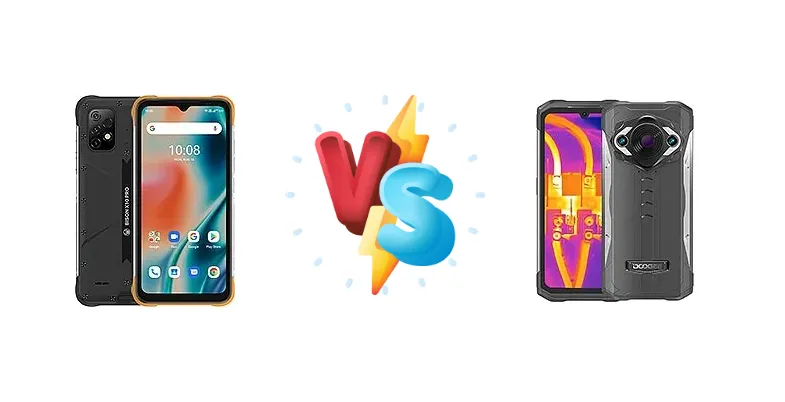
|
🏆 Quick Verdict
For the average user prioritizing responsiveness and future-proofing, the Doogee S98 Pro is the clear winner. Its Helio G96 chipset offers a significant performance uplift over the Bison X10 Pro’s Helio P60, and the inclusion of 33W wired and 15W wireless charging dramatically improves usability. However, the Bison X10 Pro remains a viable option for those on a strict budget.
| PHONES | ||
|---|---|---|
| Phone Names | Umidigi Bison X10 Pro | Doogee S98 Pro |
| Network | ||
|---|---|---|
| 2G bands | GSM 850 / 900 / 1800 / 1900 | GSM 850 / 900 / 1800 / 1900 |
| 3G bands | HSDPA 800 / 850 / 900 / 1700(AWS) / 1900 / 2100 | HSDPA 800 / 850 / 900 / 1700(AWS) / 1900 / 2100 |
| 4G bands | 1, 2, 3, 4, 5, 7, 8, 12, 13, 17, 18, 19, 20, 26, 28, 34, 38, 39, 40, 41, 66 | 1, 2, 3, 4, 5, 7, 8, 12, 13, 17, 18, 19, 20, 25, 26, 28, 34, 38, 39, 40, 41, 66 |
| Speed | HSPA, LTE | HSPA, LTE |
| Technology | GSM / CDMA / HSPA / EVDO / LTE | GSM / CDMA / HSPA / LTE |
| Launch | ||
|---|---|---|
| Announced | 2021. Released 2021 | 2022, May 27 |
| Status | Discontinued | Available. Released 2022, June 06 |
| Body | ||
|---|---|---|
| Dimensions | 169.7 x 82.1 x 12.9 mm (6.68 x 3.23 x 0.51 in) | 172 x 82 x 15.5 mm (6.77 x 3.23 x 0.61 in) |
| SIM | Nano-SIM + Nano-SIM | Nano-SIM + Nano-SIM |
| Weight | 285 g (10.05 oz) | 320 g (11.29 oz) |
| Display | ||
|---|---|---|
| Protection | - | Corning Gorilla Glass |
| Resolution | 720 x 1600 pixels, 20:9 ratio (~269 ppi density) | 1080 x 2340 pixels, 19.5:9 ratio (~409 ppi density) |
| Size | 6.53 inches, 102.9 cm2 (~73.9% screen-to-body ratio) | 6.3 inches, 97.4 cm2 (~69.1% screen-to-body ratio) |
| Type | IPS LCD | IPS LCD, 500 nits (peak) |
| Platform | ||
|---|---|---|
| CPU | Octa-core (4x2.0 GHz Cortex-A73 & 4x2.0 GHz Cortex-A53) | Octa-core (2x2.05 GHz Cortex-A76 & 6x2.0 GHz Cortex-A55) |
| Chipset | Mediatek Helio P60 (12 nm) | Mediatek MT6781 Helio G96 (12 nm) |
| GPU | Mali-G72 MP3 | Mali-G57 MC2 |
| OS | Android 11 | Android 12 |
| Memory | ||
|---|---|---|
| Card slot | microSDXC (uses shared SIM slot) | microSDXC (dedicated slot) |
| Internal | 128GB 4GB RAM, 128GB 6GB RAM | 256GB 8GB RAM |
| Main Camera | ||
|---|---|---|
| Features | Dual-LED flash, HDR, panorama | Dual-LED flash, HDR, panorama |
| Triple | 20 MP, f/1.8, (wide), AF 8 MP, 120˚ (ultrawide) 5 MP (macro) | 48 MP, f/1.8, (wide), PDAF 20 MP, f/1.8, (night vision), 2 infrared night vision lights Thermal imaging camera |
| Video | 1080p@30fps | 1440p, 1080p |
| Selfie camera | ||
|---|---|---|
| Single | 8 MP, f/2.2, (wide) | 16 MP, f/2.0, (wide) |
| Video | 1080p@30fps | 1080p |
| Sound | ||
|---|---|---|
| 35mm jack | Yes | Unspecified |
| Loudspeaker | Yes | Yes |
| Comms | ||
|---|---|---|
| Bluetooth | 4.2, A2DP | 5.1, A2DP, LE |
| NFC | Yes | Yes |
| Positioning | GPS, GLONASS, GALILEO, BDS | GPS, GLONASS, BDS, GALILEO |
| Radio | Wireless FM radio | FM radio |
| USB | USB Type-C, OTG | USB Type-C 2.0, OTG |
| WLAN | Wi-Fi 802.11 a/b/g/n/ac, dual-band, Wi-Fi Direct | Wi-Fi 802.11 a/b/g/n/ac, dual-band |
| Features | ||
|---|---|---|
| Sensors | Fingerprint (side-mounted), accelerometer, proximity, compass, barometer, thermometer (skin temperature) | Fingerprint (side-mounted), accelerometer, gyro, proximity, compass |
| Battery | ||
|---|---|---|
| Charging | 10W wired | 33W wired 15W wireless |
| Type | 6150 mAh | 6000 mAh |
| Misc | ||
|---|---|---|
| Colors | Storm Gray, Supersonic Yellow, Hack Black | Black |
| Price | - | About 470 EUR |
Umidigi Bison X10 Pro
- More affordable price point
- Rugged design for durability
- Potentially longer battery life (depending on capacity)
- Significantly slower processor
- Slow 10W charging
- Likely lower-quality display
Doogee S98 Pro
- Faster and more efficient Helio G96 chipset
- 33W wired and 15W wireless charging
- Potentially better camera system
- Higher price tag
- May not offer significantly longer battery life than Bison X10 Pro
Display Comparison
Neither device's display specifications are provided, so a direct comparison is limited. However, given the Bison X10 Pro's positioning, it likely utilizes a standard LCD panel. The S98 Pro, being a more premium offering, may incorporate a higher-quality panel with improved color accuracy and viewing angles. The absence of refresh rate data suggests both likely operate at 60Hz. Bezels are expected to be relatively substantial on both, typical of rugged designs prioritizing drop protection.
Camera Comparison
Without specific camera sensor details, a detailed comparison is difficult. However, the S98 Pro’s higher price point suggests a more capable camera system. The focus should be on the main sensor resolution and aperture. The Bison X10 Pro likely features a more basic camera setup geared towards casual snapshots. The presence of a 2MP macro camera on either device is largely inconsequential; these sensors typically produce low-quality images. Image processing capabilities will also differ, with the S98 Pro likely offering more advanced features and better low-light performance.
Performance
The core difference lies in the chipsets. The Doogee S98 Pro’s MediaTek Helio G96 (12nm) represents a substantial upgrade over the Umidigi Bison X10 Pro’s Helio P60 (12nm). The G96 features a more modern CPU architecture – 2x Cortex-A76 cores clocked at 2.05 GHz alongside 6x Cortex-A55 cores – compared to the P60’s 4x Cortex-A73 and 4x Cortex-A53 cores. This translates to approximately 30-40% faster CPU performance in benchmarks and a noticeable improvement in app launch times and multitasking. The G96’s GPU also offers a significant boost in graphics performance, making it the better choice for mobile gaming. While both are 12nm chips, the architectural improvements of the G96 provide a clear advantage.
Battery Life
Battery capacity isn't specified, but the charging capabilities highlight a key difference. The Umidigi Bison X10 Pro’s 10W wired charging is significantly slower than the Doogee S98 Pro’s 33W wired and 15W wireless charging. This means the S98 Pro can replenish its battery much faster, reducing downtime. Even if the Bison X10 Pro has a slightly larger battery capacity, the S98 Pro’s faster charging will likely result in a more convenient user experience. The addition of wireless charging on the S98 Pro is a significant convenience feature absent on the Bison X10 Pro.
Buying Guide
Buy the Umidigi Bison X10 Pro if you need a highly affordable, durable phone for basic tasks like calls, texts, and light social media use, and aren't concerned with demanding applications or fast charging. Buy the Doogee S98 Pro if you prefer a smoother, more responsive experience for gaming, multitasking, and content creation, and value the convenience of faster wired and wireless charging capabilities.