
Umidigi Bison GT2 vs Ulefone Armor 12 5G: A Deep Dive into Rugged Smartphone Performance
| Phones Images | |||||
|---|---|---|---|---|---|
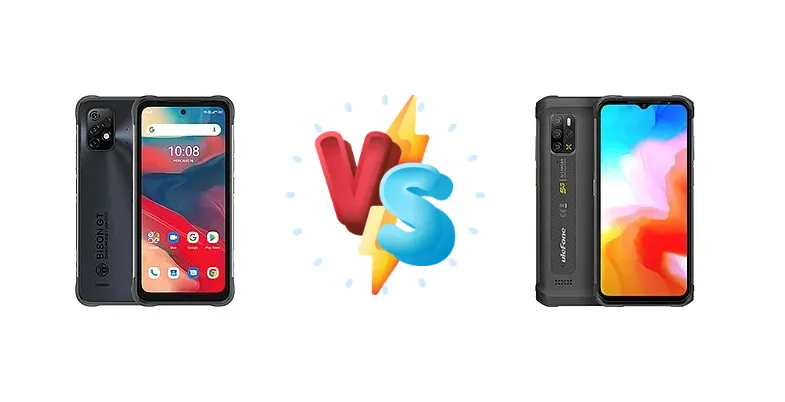
|
🏆 Quick Verdict
For the average user prioritizing consistent performance and 5G connectivity, the Ulefone Armor 12 5G emerges as the better choice. Its Dimensity 700 chipset, built on a more efficient 7nm process, provides a noticeable performance edge over the Bison GT2’s Helio G95, despite similar CPU core configurations. The addition of wireless charging further sweetens the deal.
| PHONES | ||
|---|---|---|
| Phone Names | Umidigi Bison GT2 | Ulefone Armor 12 5G |
| Network | ||
|---|---|---|
| 2G bands | GSM 850 / 900 / 1800 / 1900 | GSM 850 / 900 / 1800 / 1900 |
| 3G bands | HSDPA 800 / 850 / 900 / 1700(AWS) / 1900 / 2100 | HSDPA 850 / 900 / 1700(AWS) / 1900 / 2100 |
| 4G bands | 1, 2, 3, 4, 5, 7, 8, 12, 13, 17, 18, 19, 20, 25, 26, 28, 34, 38, 39, 40, 41, 66 | 1, 2, 3, 4, 5, 7, 8, 12, 13, 17, 18, 19, 20, 25, 26, 28, 34, 38, 39, 40, 41, 66 |
| 5G bands | - | 1, 3, 28, 38, 41, 77, 78 SA/NSA |
| Speed | HSPA, LTE | HSPA, LTE, 5G |
| Technology | GSM / CDMA / HSPA / LTE | GSM / CDMA / HSPA / EVDO / LTE / 5G |
| - | CDMA2000 1xEV-DO | |
| Launch | ||
|---|---|---|
| Announced | 2022 | 2021, August 14 |
| Status | Available. Released 2022 | Available. Released 2021, August 23 |
| Body | ||
|---|---|---|
| Build | - | Front glass, aluminum back with rubber, aluminum frame |
| Dimensions | 172.2 x 83.9 x 12.9 mm (6.78 x 3.30 x 0.51 in) | 175.9 x 82.5 x 14.3 mm (6.93 x 3.25 x 0.56 in) |
| SIM | Nano-SIM + Nano-SIM | Nano-SIM + Nano-SIM |
| Weight | 280 g (9.88 oz) | 296 g (10.44 oz) |
| - | IP68 dust/water resistant (up to 1.5m for 30 min) Drop-to-concrete resistance from up to 1.2m MIL-STD-810G compliant | |
| Display | ||
|---|---|---|
| Resolution | 1080 x 2400 pixels, 20:9 ratio (~405 ppi density) | 720 x 1560 pixels, 19.5:9 ratio (~264 ppi density) |
| Size | 6.5 inches, 102.0 cm2 (~70.6% screen-to-body ratio) | 6.52 inches, 104.4 cm2 (~71.9% screen-to-body ratio) |
| Type | IPS LCD, 90Hz | IPS LCD |
| Platform | ||
|---|---|---|
| CPU | Octa-core (2x2.05 GHz Cortex-A76 & 6x2.0 GHz Cortex-A55) | Octa-core (2x2.2 GHz Cortex-A76 & 6x2.0 GHz Cortex-A55) |
| Chipset | Mediatek Helio G95 (12 nm) | Mediatek Dimensity 700 (7 nm) |
| GPU | Mali-G76 MC4 | Mali-G57 MC2 |
| OS | Android 12 | Android 11 |
| Memory | ||
|---|---|---|
| Card slot | microSDXC (uses shared SIM slot) | microSDXC |
| Internal | 128GB 8GB RAM | 128GB 8GB RAM |
| Main Camera | ||
|---|---|---|
| Features | Dual-LED flash, HDR, panorama | Dual-LED flash, HDR, panorama |
| Quad | - | 48 MP, f/1.8, 26mm (wide), 1/2.0", 0.8µm, PDAF 8 MP, f/2.2, (ultrawide) 2 MP (macro) Auxiliary lens |
| Single | - | 16 MP, f/2.2 |
| Triple | 64 MP, f/1.8, (wide), AF 8 MP, f/2.2, 117˚ (ultrawide) 5 MP (macro) | - |
| Video | 1080p@30fps | 1440p@30fps |
| Selfie camera | ||
|---|---|---|
| Features | - | HDR, panorama |
| Single | 24 MP, f/2.0, (wide) | 16 MP, f/2.2 |
| Video | 1080p@30fps | 1080p@30fps |
| Sound | ||
|---|---|---|
| 3.5mm jack | - | No |
| 35mm jack | Yes | No |
| Loudspeaker | Yes | Yes, with dual speakers |
| Comms | ||
|---|---|---|
| Bluetooth | 5.0, A2DP, LE | 5.1, A2DP, LE |
| NFC | Yes | Yes |
| Positioning | GPS, GLONASS, GALILEO, BDS | GPS, GLONASS, GALILEO, BDS |
| Radio | Wireless FM radio | Wireless FM radio, RDS |
| USB | USB Type-C | USB Type-C 2.0, OTG |
| WLAN | Wi-Fi 802.11 a/b/g/n/ac, dual-band, Wi-Fi Direct | Wi-Fi 802.11 a/b/g/n/ac, Wi-Fi Direct |
| Features | ||
|---|---|---|
| Sensors | Fingerprint (side-mounted), accelerometer, proximity, compass, barometer, thermometer (skin temperature) | Fingerprint (side-mounted), accelerometer, gyro, proximity, compass, coulombmeter |
| Battery | ||
|---|---|---|
| Charging | 18W wired | 18W wired 15W wireless |
| Type | 6150 mAh | Li-Po 5180 mAh |
| Misc | ||
|---|---|---|
| Colors | Storm Grey | Black/Orange, Gray/Black |
| Price | - | About 370 EUR |
Umidigi Bison GT2
- More affordable price point
- Rugged design for durability
- Simple and straightforward user experience
- Less powerful processor (Helio G95)
- No 5G connectivity
- No wireless charging
Ulefone Armor 12 5G
- Faster and more efficient processor (Dimensity 700)
- 5G connectivity for faster data speeds
- Wireless charging for added convenience
- Slightly higher price
- Rugged design adds bulk
- Potentially more complex software features
Display Comparison
Neither device boasts a standout display. Both likely utilize IPS LCD panels, common in this price bracket. However, detailed specs like resolution and peak brightness are missing. The focus here is on durability, not visual fidelity. Bezels are expected to be substantial on both, prioritizing screen protection. Color accuracy is likely to be standard for the segment, leaning towards practical rather than color-critical applications.
Camera Comparison
Without detailed sensor information, a direct camera comparison is difficult. However, the market segment suggests both phones will feature a multi-camera setup with a primary sensor, an ultrawide, and potentially a macro lens. The presence of a larger primary sensor (if present) would be a key differentiator, but this information is unavailable. Image processing will likely be tuned for vibrant colors and enhanced contrast, typical of budget-friendly smartphones. The 2MP macro lenses often found on these devices offer limited practical benefit due to their low resolution and lack of optical image stabilization (OIS).
Performance
The core difference lies in the chipsets. The Ulefone Armor 12 5G’s MediaTek Dimensity 700, fabricated on a 7nm process, offers a significant advantage in power efficiency compared to the Umidigi Bison GT2’s 12nm Helio G95. While both CPUs feature the same core configuration – 2x2.05/2.2 GHz Cortex-A76 and 6x2.0 GHz Cortex-A55 – the smaller node size of the Dimensity 700 translates to less heat generation under sustained load, potentially reducing thermal throttling during gaming or demanding applications. This means the Armor 12 5G will likely maintain higher sustained performance. The Armor 12 5G also benefits from integrated 5G modem capabilities, absent in the Bison GT2.
Battery Life
Both devices offer 18W wired charging, suggesting similar charging speeds – approximately 2-3 hours for a full charge. The Ulefone Armor 12 5G adds 15W wireless charging, a convenience feature absent on the Bison GT2. While battery capacity isn’t specified, rugged phones typically prioritize larger batteries to compensate for the increased weight and size. The Dimensity 700’s superior power efficiency in the Armor 12 5G could translate to slightly longer battery life, even with a similar capacity, due to reduced power draw during typical usage.
Buying Guide
Buy the Umidigi Bison GT2 if you need a highly affordable rugged phone and prioritize a slightly simpler user experience. It’s ideal for users who primarily use their phone for basic tasks and don’t require the latest 5G speeds. Buy the Ulefone Armor 12 5G if you prefer a more future-proof device with 5G connectivity, faster processing, and the convenience of wireless charging, even if it comes at a slightly higher price point.