
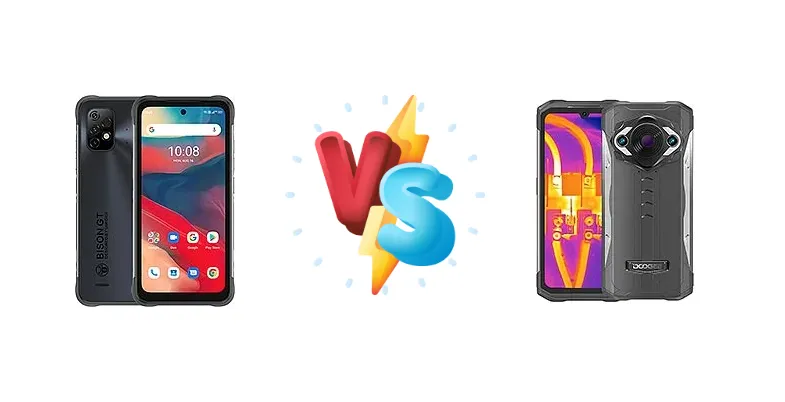
Umidigi Bison GT2 vs Doogee S98 Pro: A Deep Dive into Rugged Smartphone Performance
| Phones Images | |||||
|---|---|---|---|---|---|
|
🏆 Quick Verdict
For the average user prioritizing faster charging and a slight edge in processing capability, the Doogee S98 Pro is the better choice. Its 33W wired and 15W wireless charging significantly reduce downtime compared to the Bison GT2’s 18W wired charging, despite both utilizing the same core CPU architecture.
| PHONES | ||
|---|---|---|
| Phone Names | Umidigi Bison GT2 | Doogee S98 Pro |
| Network | ||
|---|---|---|
| 2G bands | GSM 850 / 900 / 1800 / 1900 | GSM 850 / 900 / 1800 / 1900 |
| 3G bands | HSDPA 800 / 850 / 900 / 1700(AWS) / 1900 / 2100 | HSDPA 800 / 850 / 900 / 1700(AWS) / 1900 / 2100 |
| 4G bands | 1, 2, 3, 4, 5, 7, 8, 12, 13, 17, 18, 19, 20, 25, 26, 28, 34, 38, 39, 40, 41, 66 | 1, 2, 3, 4, 5, 7, 8, 12, 13, 17, 18, 19, 20, 25, 26, 28, 34, 38, 39, 40, 41, 66 |
| Speed | HSPA, LTE | HSPA, LTE |
| Technology | GSM / CDMA / HSPA / LTE | GSM / CDMA / HSPA / LTE |
| Launch | ||
|---|---|---|
| Announced | 2022 | 2022, May 27 |
| Status | Available. Released 2022 | Available. Released 2022, June 06 |
| Body | ||
|---|---|---|
| Dimensions | 172.2 x 83.9 x 12.9 mm (6.78 x 3.30 x 0.51 in) | 172 x 82 x 15.5 mm (6.77 x 3.23 x 0.61 in) |
| SIM | Nano-SIM + Nano-SIM | Nano-SIM + Nano-SIM |
| Weight | 280 g (9.88 oz) | 320 g (11.29 oz) |
| Display | ||
|---|---|---|
| Protection | - | Corning Gorilla Glass |
| Resolution | 1080 x 2400 pixels, 20:9 ratio (~405 ppi density) | 1080 x 2340 pixels, 19.5:9 ratio (~409 ppi density) |
| Size | 6.5 inches, 102.0 cm2 (~70.6% screen-to-body ratio) | 6.3 inches, 97.4 cm2 (~69.1% screen-to-body ratio) |
| Type | IPS LCD, 90Hz | IPS LCD, 500 nits (peak) |
| Platform | ||
|---|---|---|
| CPU | Octa-core (2x2.05 GHz Cortex-A76 & 6x2.0 GHz Cortex-A55) | Octa-core (2x2.05 GHz Cortex-A76 & 6x2.0 GHz Cortex-A55) |
| Chipset | Mediatek Helio G95 (12 nm) | Mediatek MT6781 Helio G96 (12 nm) |
| GPU | Mali-G76 MC4 | Mali-G57 MC2 |
| OS | Android 12 | Android 12 |
| Memory | ||
|---|---|---|
| Card slot | microSDXC (uses shared SIM slot) | microSDXC (dedicated slot) |
| Internal | 128GB 8GB RAM | 256GB 8GB RAM |
| Main Camera | ||
|---|---|---|
| Features | Dual-LED flash, HDR, panorama | Dual-LED flash, HDR, panorama |
| Triple | 64 MP, f/1.8, (wide), AF 8 MP, f/2.2, 117˚ (ultrawide) 5 MP (macro) | 48 MP, f/1.8, (wide), PDAF 20 MP, f/1.8, (night vision), 2 infrared night vision lights Thermal imaging camera |
| Video | 1080p@30fps | 1440p, 1080p |
| Selfie camera | ||
|---|---|---|
| Single | 24 MP, f/2.0, (wide) | 16 MP, f/2.0, (wide) |
| Video | 1080p@30fps | 1080p |
| Sound | ||
|---|---|---|
| 35mm jack | Yes | Unspecified |
| Loudspeaker | Yes | Yes |
| Comms | ||
|---|---|---|
| Bluetooth | 5.0, A2DP, LE | 5.1, A2DP, LE |
| NFC | Yes | Yes |
| Positioning | GPS, GLONASS, GALILEO, BDS | GPS, GLONASS, BDS, GALILEO |
| Radio | Wireless FM radio | FM radio |
| USB | USB Type-C | USB Type-C 2.0, OTG |
| WLAN | Wi-Fi 802.11 a/b/g/n/ac, dual-band, Wi-Fi Direct | Wi-Fi 802.11 a/b/g/n/ac, dual-band |
| Features | ||
|---|---|---|
| Sensors | Fingerprint (side-mounted), accelerometer, proximity, compass, barometer, thermometer (skin temperature) | Fingerprint (side-mounted), accelerometer, gyro, proximity, compass |
| Battery | ||
|---|---|---|
| Charging | 18W wired | 33W wired 15W wireless |
| Type | 6150 mAh | 6000 mAh |
| Misc | ||
|---|---|---|
| Colors | Storm Grey | Black |
| Price | - | About 470 EUR |
Umidigi Bison GT2
- Potentially lower price point
- Rugged design for durability
- Solid performance for everyday tasks
- Slower 18W wired charging
- No wireless charging support
- Likely less refined software experience
Doogee S98 Pro
- Faster 33W wired charging
- Convenient 15W wireless charging
- Slightly improved processor (Helio G96)
- Higher price compared to Bison GT2
- Rugged design may be bulky
- Software experience may still be basic
Display Comparison
Neither device's display specifications are provided, so a direct comparison is limited. However, given the market segment, both likely utilize IPS LCD panels prioritizing durability over cutting-edge technology like OLED. Expect similar color accuracy and viewing angles. The absence of information on refresh rates suggests both are likely capped at 60Hz, focusing on power efficiency. Bezels are expected to be moderate, prioritizing structural integrity over maximizing screen real estate.
Camera Comparison
Camera specifications are absent, making a detailed comparison impossible. However, given the rugged phone category, both devices likely prioritize durability and practicality over high-end camera features. Expect a main sensor around 48MP-64MP, potentially with OIS on the Doogee S98 Pro given its higher price point. The inclusion of a 2MP macro lens is probable on both, but its utility is limited due to the low resolution and fixed focus. Image processing will likely focus on producing vibrant, shareable photos rather than natural color accuracy.
Performance
Both the Umidigi Bison GT2 and Doogee S98 Pro are powered by MediaTek Helio G95 and G96 chipsets respectively, both built on a 12nm process. Critically, both CPUs share the same core configuration: a dual-core Cortex-A76 setup clocked at 2.05 GHz, paired with a hexa-core Cortex-A55 cluster at 2.0 GHz. The Helio G96 in the Doogee S98 Pro offers a slight advantage due to its marginally higher clock speeds and improved GPU performance, translating to smoother multitasking and potentially better frame rates in graphically intensive games. However, the difference is unlikely to be dramatic in real-world usage. RAM configurations are not specified, but LPDDR4X is a likely candidate for both, impacting memory bandwidth and overall system responsiveness.
Battery Life
Battery capacity is not specified for either device. However, the Doogee S98 Pro’s charging capabilities provide a significant advantage. Its 33W wired charging will substantially reduce charging times compared to the Umidigi Bison GT2’s 18W wired charging. The addition of 15W wireless charging on the S98 Pro offers further convenience, allowing for cable-free top-ups. While a larger battery capacity on the Bison GT2 could partially offset the slower charging, the S98 Pro’s faster charging speeds are more impactful for users who frequently need to replenish their battery.
Buying Guide
Buy the Umidigi Bison GT2 if you need a highly durable phone on a tighter budget and aren't overly concerned with the fastest possible charging speeds. It provides a solid foundation for everyday tasks and light gaming. Buy the Doogee S98 Pro if you prefer a more versatile charging experience – including wireless – and want a slight performance boost for demanding applications, justifying the higher price point.