
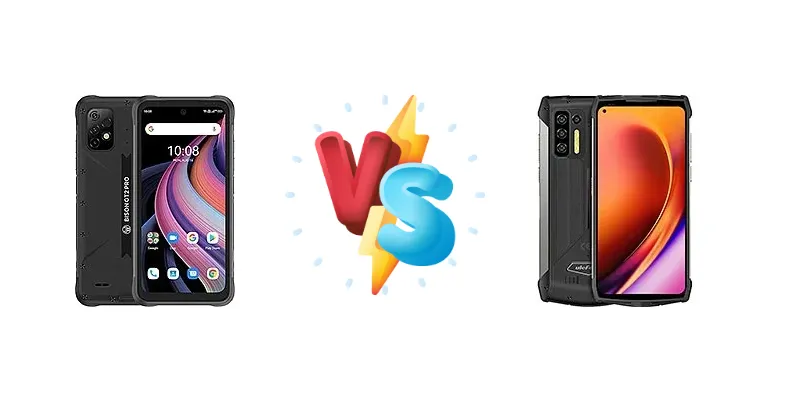
Umidigi Bison GT2 Pro vs. Ulefone Power Armor 13: A Rugged Showdown
| Phones Images | |||||
|---|---|---|---|---|---|
|
🏆 Quick Verdict
For the average user prioritizing all-around usability, the Ulefone Power Armor 13 emerges as the better choice. Its 33W wired, 15W wireless, and 5W reverse wireless charging capabilities, coupled with a measured 401 nits brightness and 296-hour endurance rating, provide a significant advantage in real-world convenience and longevity, despite sharing the same Helio G95 chipset.
| PHONES | ||
|---|---|---|
| Phone Names | Umidigi Bison GT2 Pro | Ulefone Power Armor 13 |
| Network | ||
|---|---|---|
| 2G bands | GSM 850 / 900 / 1800 / 1900 | GSM 850 / 900 / 1800 / 1900 |
| 3G bands | HSDPA 800 / 850 / 900 / 1700(AWS) / 1900 / 2100 | HSDPA 850 / 900 / 1700(AWS) / 1900 / 2100 |
| 4G bands | 1, 2, 3, 4, 5, 7, 8, 12, 13, 17, 18, 19, 20, 25, 26, 28, 34, 38, 39, 40, 41, 66 | 1, 2, 3, 4, 5, 7, 8, 12, 13, 17, 18, 19, 20, 25, 26, 28, 38, 40, 66 |
| Speed | HSPA, LTE | HSPA 42.2/11.5 Mbps, LTE Cat12 600/150 Mbps |
| Technology | GSM / CDMA / HSPA / LTE | GSM / HSPA / LTE |
| Launch | ||
|---|---|---|
| Announced | 2022 | 2021, July 22 |
| Status | Available. Released 2022 | Available. Released 2021, July 26 |
| Body | ||
|---|---|---|
| Dimensions | 172.2 x 83.9 x 12.9 mm (6.78 x 3.30 x 0.51 in) | 183.7 x 85.4 x 20.8 mm (7.23 x 3.36 x 0.82 in) |
| SIM | Nano-SIM + Nano-SIM | Nano-SIM + Nano-SIM |
| Weight | 280 g (9.88 oz) | 492 g (1.08 lb) |
| - | IP68 dust/water resistant (up to 1.5m for 30 min) Drop-to-concrete resistance from up to 1.2m MIL-STD-810G compliant | |
| Display | ||
|---|---|---|
| Protection | - | Corning Gorilla Glass 3 |
| Resolution | 1080 x 2400 pixels, 20:9 ratio (~405 ppi density) | 1080 x 2400 pixels, 20:9 ratio (~386 ppi density) |
| Size | 6.5 inches, 102.0 cm2 (~70.6% screen-to-body ratio) | 6.81 inches, 112.0 cm2 (~71.4% screen-to-body ratio) |
| Type | IPS LCD, 90Hz | IPS LCD |
| Platform | ||
|---|---|---|
| CPU | Octa-core (2x2.05 GHz Cortex-A76 & 6x2.0 GHz Cortex-A55) | Octa-core (2x2.05 GHz Cortex-A76 & 6x2.0 GHz Cortex-A55) |
| Chipset | Mediatek Helio G95 (12 nm) | Mediatek MT6785V/CD Helio G95 (12 nm) |
| GPU | Mali-G76 MC4 | Mali-G76 MC4 |
| OS | Android 12 | Android 11 |
| Memory | ||
|---|---|---|
| Card slot | microSDXC (uses shared SIM slot) | microSDXC (uses shared SIM slot) |
| Internal | 256GB 8GB RAM | 256GB 8GB RAM |
| Main Camera | ||
|---|---|---|
| Features | Dual-LED flash, HDR, panorama | Quad-LED flash, HDR, panorama |
| Penta | - | 48 MP, f/1.8, 26mm (wide), 1/2.0", 0.8µm, PDAF 8 MP, f/2.2, (ultrawide) 2 MP (macro) Auxiliary lens |
| Triple | 64 MP, f/1.8, (wide), AF 8 MP, f/2.2, 117˚ (ultrawide) 5 MP (macro) | - |
| Video | 1080p@30fps | 4K@30fps, 1080p@30fps |
| Selfie camera | ||
|---|---|---|
| Features | - | HDR, panorama |
| Single | 24 MP, f/2.0, (wide) | 16 MP, f/2.2 |
| Video | 1080p@30fps | 1080p@30fps |
| Sound | ||
|---|---|---|
| 3.5mm jack | - | Yes |
| 35mm jack | Yes | Yes |
| Loudspeaker | Yes | Yes |
| Comms | ||
|---|---|---|
| Bluetooth | 5.0, A2DP, LE | 5.0, A2DP, LE |
| NFC | Yes | Yes |
| Positioning | GPS, GLONASS, GALILEO, BDS | GPS, GLONASS, GALILEO, BDS |
| Radio | Wireless FM radio | FM radio, RDS, recording |
| USB | USB Type-C | - |
| WLAN | Wi-Fi 802.11 a/b/g/n/ac, dual-band, Wi-Fi Direct | Wi-Fi 802.11 a/b/g/n/ac, dual-band |
| Features | ||
|---|---|---|
| Sensors | Fingerprint (side-mounted), accelerometer, proximity, compass, barometer, thermometer (skin temperature) | Fingerprint (side-mounted), accelerometer, gyro, proximity, compass, baroceptor, coulombmeter |
| - | Infrared distance measure (error range: 1~20m, ±10mm; 20~40m, ±25mm) | |
| Battery | ||
|---|---|---|
| Charging | 18W wired | 33W wired 15W wireless 5W reverse wireless |
| Type | 6150 mAh | Li-Po 13200 mAh |
| Misc | ||
|---|---|---|
| Colors | Hack Black | Black |
| Price | - | About 300 EUR |
| Tests | ||
|---|---|---|
| Battery life | - | Endurance rating 296h |
| Camera | - | Photo / Video |
| Display | - | Contrast ratio: 1306:1 (nominal) |
| Loudspeaker | - | -28.3 LUFS (Average) |
| Performance | - | AnTuTu: 294194 (v8), 351678 (v9) GeekBench: 1610 (v5.1) GFXBench: 18fps (ES 3.1 onscreen) |
Umidigi Bison GT2 Pro
- Potentially lighter build due to simpler charging circuitry.
- Streamlined user experience focused on core functionality.
- Competitive price point (likely).
- Limited charging options (only 18W wired).
- Likely lower peak brightness compared to the Ulefone.
- No wireless or reverse wireless charging.
Ulefone Power Armor 13
- Versatile charging: 33W wired, 15W wireless, 5W reverse wireless.
- Higher peak brightness (401 nits) for outdoor visibility.
- Excellent battery endurance (296 hours).
- Potentially heavier build due to more complex charging components.
- May command a slightly higher price.
- Similar CPU performance to the Bison GT2 Pro.
Display Comparison
Both devices share a contrast ratio of 1306:1, suggesting similar color reproduction capabilities. However, the Ulefone Power Armor 13 boasts a measured peak brightness of 401 nits, a crucial advantage for outdoor use where the Bison GT2 Pro’s brightness is not specified. While both likely utilize IPS LCD panels given the price point, the higher brightness of the Power Armor 13 translates to better visibility under direct sunlight, benefiting users working or recreating outdoors.
Camera Comparison
Both phones list 'Photo / Video' capabilities, but lack specific details regarding sensor size, aperture, or image stabilization. This suggests a similar level of camera performance geared towards casual photography. Without further information, it's difficult to differentiate their camera systems. The absence of details implies neither phone is targeting photography enthusiasts, and the inclusion of a 2MP macro lens (likely present on both) is more for marketing than practical use.
Performance
Both the Umidigi Bison GT2 Pro and the Ulefone Power Armor 13 are powered by the Mediatek Helio G95 (12 nm) chipset, featuring an octa-core CPU configuration with 2x2.05 GHz Cortex-A76 and 6x2.0 GHz Cortex-A55 cores. This means CPU performance will be virtually identical for everyday tasks and most gaming scenarios. The lack of information regarding RAM type and speed for both devices makes it difficult to assess potential multitasking differences, but the chipset itself is the primary performance bottleneck.
Battery Life
The Ulefone Power Armor 13 significantly differentiates itself with its charging capabilities. While the Umidigi Bison GT2 Pro offers only 18W wired charging, the Power Armor 13 supports 33W wired, 15W wireless, and 5W reverse wireless charging. This versatility is a major advantage for users who frequently travel or work in areas with limited access to traditional power outlets. The Power Armor 13 also boasts an endurance rating of 296 hours, indicating a substantial battery life advantage, despite the lack of specific mAh capacity information for either device.
Buying Guide
Buy the Umidigi Bison GT2 Pro if you need a rugged phone with a focus on streamlined performance and don't heavily rely on wireless charging. It's ideal for users who prioritize a lighter, more agile experience. Buy the Ulefone Power Armor 13 if you prefer maximum battery life, flexible charging options (including wireless and reverse wireless), and a brighter display for outdoor visibility. This phone is best suited for professionals or adventurers who need reliable power in remote locations.