
Umidigi Bison GT2 Pro vs Ulefone Armor 10 5G: A Deep Dive into Rugged Performance
| Phones Images | |||||
|---|---|---|---|---|---|
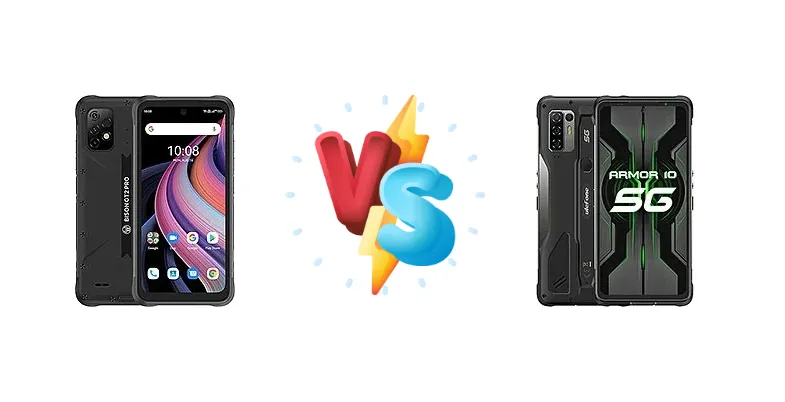
|
🏆 Quick Verdict
For users prioritizing raw gaming performance and a lower price point, the Umidigi Bison GT2 Pro is the better choice. However, the Ulefone Armor 10 5G’s Dimensity 800 offers superior power efficiency, 5G connectivity, and the convenience of wireless charging, making it ideal for users who value longevity and modern features.
| PHONES | ||
|---|---|---|
| Phone Names | Umidigi Bison GT2 Pro | Ulefone Armor 10 5G |
| Network | ||
|---|---|---|
| 2G bands | GSM 850 / 900 / 1800 / 1900 | GSM 850 / 900 / 1800 / 1900 |
| 3G bands | HSDPA 800 / 850 / 900 / 1700(AWS) / 1900 / 2100 | HSDPA 850 / 900 / 1700(AWS) / 1900 / 2100 |
| 4G bands | 1, 2, 3, 4, 5, 7, 8, 12, 13, 17, 18, 19, 20, 25, 26, 28, 34, 38, 39, 40, 41, 66 | 1, 2, 3, 4, 5, 7, 8, 12, 13, 17, 18, 19, 20, 25, 26, 28, 34, 38, 39, 40, 41, 66 |
| 5G bands | - | 1, 3, 41, 77, 78, 79 SA/NSA |
| Speed | HSPA, LTE | HSPA, LTE, 5G |
| Technology | GSM / CDMA / HSPA / LTE | GSM / CDMA / HSPA / EVDO / LTE / 5G |
| - | CDMA2000 1xEV-DO | |
| Launch | ||
|---|---|---|
| Announced | 2022 | 2020, November 17. Released 2020, December 07 |
| Status | Available. Released 2022 | Discontinued |
| Body | ||
|---|---|---|
| Build | - | Front glass, aluminum back with rubber, aluminum frame |
| Dimensions | 172.2 x 83.9 x 12.9 mm (6.78 x 3.30 x 0.51 in) | 176.5 x 82.8 x 14.6 mm (6.95 x 3.26 x 0.57 in) |
| SIM | Nano-SIM + Nano-SIM | Nano-SIM + Nano-SIM |
| Weight | 280 g (9.88 oz) | 328 g (11.57 oz) |
| - | IP68 dust/water resistant (up to 1.5m for 30 min) Drop-to-concrete resistance from up to 1.2m MIL-STD-810G compliant | |
| Display | ||
|---|---|---|
| Protection | - | Scratch-resistant glass, oleophobic coating |
| Resolution | 1080 x 2400 pixels, 20:9 ratio (~405 ppi density) | 1080 x 2400 pixels, 20:9 ratio (~395 ppi density) |
| Size | 6.5 inches, 102.0 cm2 (~70.6% screen-to-body ratio) | 6.67 inches, 107.4 cm2 (~73.5% screen-to-body ratio) |
| Type | IPS LCD, 90Hz | IPS LCD |
| Platform | ||
|---|---|---|
| CPU | Octa-core (2x2.05 GHz Cortex-A76 & 6x2.0 GHz Cortex-A55) | Octa-core (4x2.0 GHz Cortex-A76 & 4x2.0 GHz Cortex-A55) |
| Chipset | Mediatek Helio G95 (12 nm) | Mediatek Dimensity 800 (7 nm) |
| GPU | Mali-G76 MC4 | Mali-G57 MP4 |
| OS | Android 12 | Android 10, planned upgrade to Android 11 |
| Memory | ||
|---|---|---|
| Card slot | microSDXC (uses shared SIM slot) | microSDXC (uses shared SIM slot) |
| Internal | 256GB 8GB RAM | 128GB 8GB RAM |
| Main Camera | ||
|---|---|---|
| Features | Dual-LED flash, HDR, panorama | LED flash, Panorama, HDR |
| Quad | - | 64 MP, f/1.9, 26mm (wide), 1/1.72", 0.8µm, PDAF 8 MP, f/2.2, 119˚ (ultrawide) 5 MP (macro) Auxiliary lens |
| Triple | 64 MP, f/1.8, (wide), AF 8 MP, f/2.2, 117˚ (ultrawide) 5 MP (macro) | - |
| Video | 1080p@30fps | 4K@30fps, 1080p@30fps |
| Selfie camera | ||
|---|---|---|
| Single | 24 MP, f/2.0, (wide) | 16 MP, f/2.2 |
| Video | 1080p@30fps | 1080p@30fps |
| Sound | ||
|---|---|---|
| 3.5mm jack | - | Yes |
| 35mm jack | Yes | Yes |
| Loudspeaker | Yes | Yes |
| Comms | ||
|---|---|---|
| Bluetooth | 5.0, A2DP, LE | 5.2, A2DP, LE |
| NFC | Yes | Yes |
| Positioning | GPS, GLONASS, GALILEO, BDS | GPS, GLONASS, GALILEO, BDS |
| Radio | Wireless FM radio | FM radio, RDS, recording |
| USB | USB Type-C | USB Type-C 2.0, OTG |
| WLAN | Wi-Fi 802.11 a/b/g/n/ac, dual-band, Wi-Fi Direct | Wi-Fi 802.11 a/b/g/n/ac, Wi-Fi Direct |
| Features | ||
|---|---|---|
| Sensors | Fingerprint (side-mounted), accelerometer, proximity, compass, barometer, thermometer (skin temperature) | Fingerprint (side-mounted), accelerometer, gyro, proximity, compass, baroceptor, coulombmeter |
| Battery | ||
|---|---|---|
| Charging | 18W wired | 15W wired 15W wireless |
| Type | 6150 mAh | Li-Po 5800 mAh |
| Misc | ||
|---|---|---|
| Colors | Hack Black | Black |
| Price | - | About 420 EUR |
Umidigi Bison GT2 Pro
- Strong gaming performance with Helio G95
- Potentially lower price point
- Rugged design for durability
- Less power-efficient chipset
- No 5G connectivity
- Limited to wired charging
Ulefone Armor 10 5G
- 5G connectivity for faster data speeds
- Wireless charging for added convenience
- More power-efficient Dimensity 800 chipset
- Slightly lower peak gaming performance
- Potentially higher price point
- Wired charging is slower than some competitors
Display Comparison
Neither device boasts a standout display. Both likely utilize IPS LCD panels, common in this price bracket. The key difference lies under the hood. While specific display specs are unavailable, the Armor 10 5G’s Dimensity 800 chipset includes a more advanced ISP capable of better image signal processing, potentially improving display color accuracy. However, without detailed measurements, this remains speculative. Both will likely feature ruggedized glass for protection.
Camera Comparison
Without detailed camera specs beyond the chipsets, a direct comparison is difficult. However, the Dimensity 800’s more advanced ISP in the Ulefone Armor 10 5G provides a significant advantage in image processing. This means better dynamic range, noise reduction, and overall image quality, particularly in challenging lighting conditions. The Bison GT2 Pro will likely rely more heavily on software processing, which can sometimes lead to over-sharpening or artificial-looking images. The absence of information regarding sensor sizes makes a definitive statement impossible, but the Armor 10 5G has the potential for superior image quality.
Performance
The core battleground is the chipset. The Ulefone Armor 10 5G’s Mediatek Dimensity 800 (7nm) significantly outperforms the Umidigi Bison GT2 Pro’s Helio G95 (12nm) in terms of efficiency. The 7nm process allows for more transistors in a smaller space, resulting in better performance per watt. While the Bison GT2 Pro’s CPU core configuration (2x2.05 GHz Cortex-A76 & 6x2.0 GHz Cortex-A55) is similar to the Armor 10 5G (4x2.0 GHz Cortex-A76 & 4x2.0 GHz Cortex-A55), the Dimensity 800’s superior architecture and process node translate to a smoother overall experience, especially during sustained workloads. The Armor 10 5G also benefits from 5G connectivity, a feature absent in the Bison GT2 Pro.
Battery Life
Both phones offer adequate battery capacity for a full day of use, but the Ulefone Armor 10 5G has a clear advantage. While the Bison GT2 Pro is limited to 18W wired charging, the Armor 10 5G supports both 15W wired and 15W wireless charging. This provides greater flexibility and convenience. More importantly, the Dimensity 800’s superior power efficiency means the Armor 10 5G will likely achieve longer battery life under similar usage scenarios. The 7nm process node contributes to significantly reduced power consumption, offsetting any potential capacity difference.
Buying Guide
Buy the Umidigi Bison GT2 Pro if you need a phone primarily for mobile gaming and don't mind sacrificing 5G and wireless charging. Its Helio G95 chipset delivers strong performance for the price. Buy the Ulefone Armor 10 5G if you prefer a more balanced experience with 5G connectivity, wireless charging, and a more efficient processor for all-day use, even if it means slightly lower peak gaming performance.