
Umidigi Bison GT2 Pro vs Doogee S97 Pro: A Deep Dive into Rugged Performance
| Phones Images | |||||
|---|---|---|---|---|---|
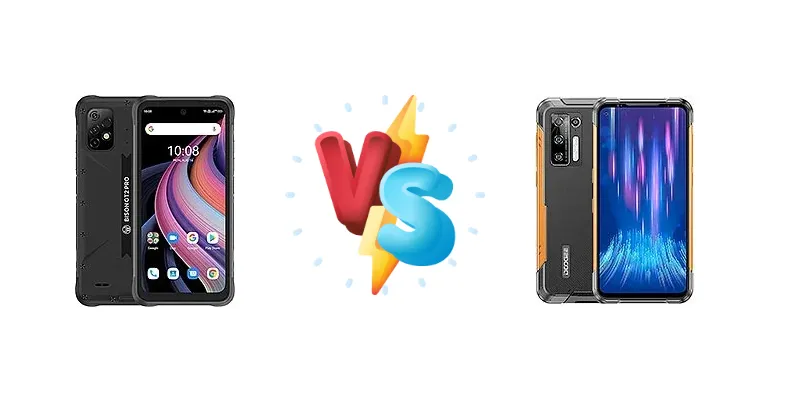
|
🏆 Quick Verdict
For the average user prioritizing faster charging and the convenience of wireless charging, the Doogee S97 Pro is the better choice. While both phones share the same Helio G95 chipset, the S97 Pro’s 33W charging significantly reduces downtime compared to the Bison GT2 Pro’s 18W offering. However, budget-conscious buyers may find the Bison GT2 Pro a compelling alternative.
| PHONES | ||
|---|---|---|
| Phone Names | Umidigi Bison GT2 Pro | Doogee S97 Pro |
| Network | ||
|---|---|---|
| 2G bands | GSM 850 / 900 / 1800 / 1900 | GSM 850 / 900 / 1800 / 1900 |
| 3G bands | HSDPA 800 / 850 / 900 / 1700(AWS) / 1900 / 2100 | HSDPA 800 / 850 / 900 / 1700(AWS) / 1900 / 2100 |
| 4G bands | 1, 2, 3, 4, 5, 7, 8, 12, 13, 17, 18, 19, 20, 25, 26, 28, 34, 38, 39, 40, 41, 66 | 1, 2, 3, 4, 5, 7, 8, 12, 13, 17, 18, 19, 20, 25, 26, 28, 38, 40, 66 |
| Speed | HSPA, LTE | HSPA, LTE |
| Technology | GSM / CDMA / HSPA / LTE | GSM / HSPA / LTE |
| Launch | ||
|---|---|---|
| Announced | 2022 | 2021, April |
| Status | Available. Released 2022 | Available. Released 2021, April |
| Body | ||
|---|---|---|
| Dimensions | 172.2 x 83.9 x 12.9 mm (6.78 x 3.30 x 0.51 in) | 170.2 x 83.6 x 16.2 mm (6.70 x 3.29 x 0.64 in) |
| SIM | Nano-SIM + Nano-SIM | Nano-SIM + Nano-SIM |
| Weight | 280 g (9.88 oz) | - |
| Display | ||
|---|---|---|
| Protection | - | Corning Gorilla Glass |
| Resolution | 1080 x 2400 pixels, 20:9 ratio (~405 ppi density) | 720 x 1560 pixels, 19.5:9 ratio (~269 ppi density) |
| Size | 6.5 inches, 102.0 cm2 (~70.6% screen-to-body ratio) | 6.39 inches, 100.2 cm2 (~70.4% screen-to-body ratio) |
| Type | IPS LCD, 90Hz | IPS LCD |
| Platform | ||
|---|---|---|
| CPU | Octa-core (2x2.05 GHz Cortex-A76 & 6x2.0 GHz Cortex-A55) | Octa-core (2x2.0 GHz Cortex-A76 & 6x2.0 GHz Cortex-A55) |
| Chipset | Mediatek Helio G95 (12 nm) | Mediatek MT6785V/CD Helio G95 (12 nm) |
| GPU | Mali-G76 MC4 | Mali-G76 MC4 |
| OS | Android 12 | Android 11 |
| Memory | ||
|---|---|---|
| Card slot | microSDXC (uses shared SIM slot) | microSDXC (uses shared SIM slot) |
| Internal | 256GB 8GB RAM | 128GB 8GB RAM |
| Main Camera | ||
|---|---|---|
| Features | Dual-LED flash, HDR, panorama | Quad-LED flash, HDR, panorama |
| Triple | 64 MP, f/1.8, (wide), AF 8 MP, f/2.2, 117˚ (ultrawide) 5 MP (macro) | 48 MP, f/1.8, (wide), PDAF 8 MP, f/2.2, 130˚, (ultrawide) 2 MP (macro) Auxiliary lens |
| Video | 1080p@30fps | 1080p |
| Selfie camera | ||
|---|---|---|
| Single | 24 MP, f/2.0, (wide) | 16 MP, f/2.0, (wide) |
| Video | 1080p@30fps | 1080p |
| Sound | ||
|---|---|---|
| 35mm jack | Yes | Unspecified |
| Loudspeaker | Yes | Yes |
| Comms | ||
|---|---|---|
| Bluetooth | 5.0, A2DP, LE | 5.0, A2DP, LE |
| NFC | Yes | Yes |
| Positioning | GPS, GLONASS, GALILEO, BDS | GPS, GLONASS, BDS, GALILEO |
| Radio | Wireless FM radio | FM radio |
| USB | USB Type-C | USB Type-C 2.0, OTG |
| WLAN | Wi-Fi 802.11 a/b/g/n/ac, dual-band, Wi-Fi Direct | Wi-Fi 802.11 a/b/g/n/ac, dual-band |
| Features | ||
|---|---|---|
| Sensors | Fingerprint (side-mounted), accelerometer, proximity, compass, barometer, thermometer (skin temperature) | Fingerprint (side-mounted), accelerometer, gyro, proximity, compass, laser rangefinder |
| Battery | ||
|---|---|---|
| Charging | 18W wired | 33W wired 10W wireless |
| Type | 6150 mAh | 8500 mAh |
| Misc | ||
|---|---|---|
| Colors | Hack Black | Black, Orange, Red |
| Price | - | About 300 EUR |
Umidigi Bison GT2 Pro
- Potentially lower price point
- Rugged build quality
- Helio G95 provides adequate performance
- Slow 18W charging
- No wireless charging
- Limited information on display quality
Doogee S97 Pro
- Faster 33W wired charging
- Convenient 10W wireless charging
- Helio G95 provides adequate performance
- Potentially higher price
- Rugged build quality may not be significantly better
- Limited information on display quality
Display Comparison
Both devices are expected to feature LCD panels, typical for this price segment and rugged builds. Specifics like resolution and refresh rate are not provided, but the focus here is on durability rather than display fidelity. Bezels are likely to be substantial on both to contribute to drop protection. Color accuracy is unlikely to be a key differentiator, with both prioritizing visibility in bright outdoor conditions over color calibration.
Camera Comparison
Camera details beyond the main sensor are sparse. Both phones likely feature multiple rear cameras, but the emphasis should be on the primary sensor's capabilities. The absence of information regarding sensor size and aperture makes a direct comparison difficult. Image processing will likely be tuned for vibrant colors and enhanced contrast, common in this segment. The inclusion of a 2MP macro camera on either device is largely a marketing tactic, offering limited practical benefit due to the small sensor size and lack of optical image stabilization (OIS).
Performance
Both the Umidigi Bison GT2 Pro and the Doogee S97 Pro utilize the Mediatek Helio G95 (12 nm) chipset, featuring an octa-core CPU configuration with 2x2.05 GHz Cortex-A76 and 6x2.0 GHz Cortex-A55 cores. While the CPU clock speeds are slightly different (2.05GHz vs 2.0GHz), the real-world performance difference will be minimal. The Helio G95 is a capable mid-range processor suitable for everyday tasks and moderate gaming. Thermal management will be crucial in sustained workloads; the rugged design may limit passive cooling, potentially leading to throttling under prolonged stress. RAM configurations are not specified, but LPDDR4X is likely, impacting multitasking performance.
Battery Life
The battery capacity is not specified for either device, but rugged phones typically prioritize large batteries for extended use in the field. The key differentiator here is charging speed. The Doogee S97 Pro boasts 33W wired charging and 10W wireless charging, offering significantly faster charging times than the Umidigi Bison GT2 Pro’s 18W wired charging. A full 0-100% charge on the S97 Pro is expected to take around 90-120 minutes, while the Bison GT2 Pro will likely require over two hours. The addition of wireless charging on the S97 Pro provides added convenience, especially for users who prefer cable-free charging.
Buying Guide
Buy the Umidigi Bison GT2 Pro if you need a highly durable phone and are willing to sacrifice charging speed for a potentially lower price point. It’s ideal for users who prioritize longevity and infrequent charging. Buy the Doogee S97 Pro if you prefer faster charging, the added convenience of wireless charging, and a more modern charging ecosystem. This phone suits users who actively use their devices throughout the day and need quick power top-ups.