
Umidigi Bison 2 vs Bison Pro: A Deep Dive into Rugged Performance
| Phones Images | |||||
|---|---|---|---|---|---|
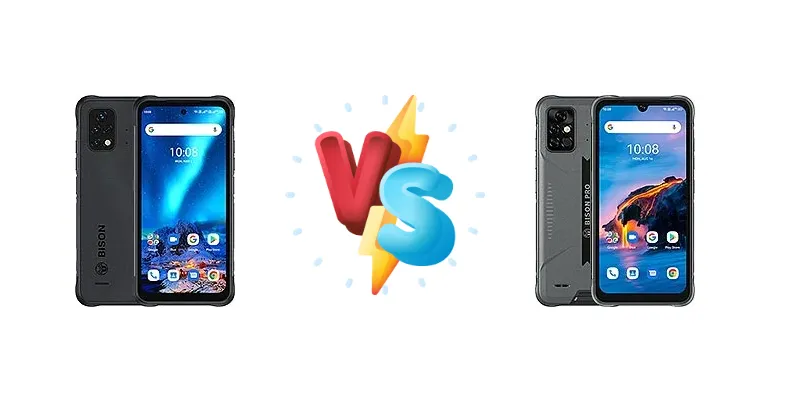
|
🏆 Quick Verdict
For the average user prioritizing consistent performance and slightly better gaming capabilities, the Umidigi Bison Pro is the superior choice. While both offer robust build quality and 18W charging, the Helio G80’s higher clock speeds and architectural refinements provide a noticeable edge in responsiveness and multitasking.
| PHONES | ||
|---|---|---|
| Phone Names | Umidigi Bison 2 | Umidigi Bison Pro |
| Network | ||
|---|---|---|
| 2G bands | GSM 850 / 900 / 1800 / 1900 | GSM 850 / 900 / 1800 / 1900 |
| 3G bands | HSDPA 800 / 850 / 900 / 1700(AWS) / 1900 / 2100 | HSDPA 800 / 850 / 900 / 1700(AWS) / 1900 / 2100 |
| 4G bands | 1, 2, 3, 4, 5, 7, 8, 12, 13, 17, 18, 19, 20, 25, 26, 28, 34, 38, 39, 40, 41, 66 | 1, 2, 3, 4, 5, 7, 8, 12, 13, 17, 18, 19, 20, 25, 26, 28, 34, 38, 39, 40, 41, 66 |
| Speed | HSPA, LTE | HSPA, LTE |
| Technology | GSM / CDMA / HSPA / LTE | GSM / CDMA / HSPA / CDMA2000 / LTE |
| Launch | ||
|---|---|---|
| Announced | 2022 | 2021. Released 2021 |
| Status | Available. Released 2022 | Discontinued |
| Body | ||
|---|---|---|
| Dimensions | 172.1 x 83.8 x 12.9 mm (6.78 x 3.30 x 0.51 in) | 164 x 79.6 x 12.7 mm (6.46 x 3.13 x 0.5 in) |
| SIM | Nano-SIM + Nano-SIM | Nano-SIM + Nano-SIM |
| Weight | 280 g (9.88 oz) | 265 g (9.35 oz) |
| Display | ||
|---|---|---|
| Protection | - | Corning Gorilla Glass |
| Resolution | 1080 x 2400 pixels, 20:9 ratio (~405 ppi density) | 1080 x 2340 pixels, 19.5:9 ratio (~409 ppi density) |
| Size | 6.5 inches, 102.0 cm2 (~70.7% screen-to-body ratio) | 6.3 inches, 97.4 cm2 (~74.6% screen-to-body ratio) |
| Type | IPS LCD | IPS LCD |
| Platform | ||
|---|---|---|
| CPU | Octa-core (2x2.2 GHz Cortex-A75 & 6x2.0 GHz Cortex-A55) | Octa-core (2x2.0 GHz Cortex-A75 & 6x1.8 GHz Cortex-A55) |
| Chipset | Mediatek Helio P90 (12 nm) | Mediatek Helio G80 (12 nm) |
| GPU | PowerVR GM9446 | Mali-G52 MC2 |
| OS | Android 12 | Android 11 |
| Memory | ||
|---|---|---|
| Card slot | microSDXC (uses shared SIM slot) | microSDXC (uses shared SIM slot) |
| Internal | 128GB 6GB RAM | 128GB 4GB RAM, 128GB 8GB RAM |
| Main Camera | ||
|---|---|---|
| Features | Dual-LED flash, HDR | Dual-LED flash, HDR, panorama |
| Triple | 48 MP, f/2.2, (wide), AF 16 MP, f/2.2, (ultrawide) 5 MP (macro) | 48 MP, f/1.8, (wide), 1/2.0", AF 16 MP, 117˚ (ultrawide) 5 MP (macro) |
| Video | 1080p@30fps | 1080p@30fps |
| Selfie camera | ||
|---|---|---|
| Single | 24 MP, f/2.0, (wide) | 24 MP, f/2.0, (wide) |
| Video | 1080p@30fps | 1080p@30fps |
| Sound | ||
|---|---|---|
| 35mm jack | Yes | Yes |
| Loudspeaker | Yes | Yes |
| Comms | ||
|---|---|---|
| Bluetooth | 5.0, A2DP, LE | 4.2, A2DP |
| NFC | Yes | Yes |
| Positioning | GPS, GLONASS, GALILEO, BDS | GPS, GLONASS, GALILEO |
| Radio | Wireless FM radio | No |
| USB | USB Type-C, OTG | USB Type-C, OTG |
| WLAN | Wi-Fi 802.11 a/b/g/n/ac, dual-band, Wi-Fi Direct | Wi-Fi 802.11 a/b/g/n/ac, dual-band, Wi-Fi Direct |
| Features | ||
|---|---|---|
| Sensors | Fingerprint (side-mounted), accelerometer, proximity, compass, barometer, thermometer (skin temperature) | Fingerprint (side-mounted), accelerometer, proximity, compass, barometer, thermometer (skin temperature) |
| Battery | ||
|---|---|---|
| Charging | 18W wired | 18W wired |
| Type | 6150 mAh | 5000 mAh |
| Misc | ||
|---|---|---|
| Colors | Black | Storm Gray, Hack Black |
Umidigi Bison 2
- Potentially higher peak CPU clock speeds for burst performance.
- May be available at a lower price point.
- Rugged design for durability.
- Older chipset architecture.
- Potentially lower sustained performance under load.
- Less optimized GPU for gaming.
Umidigi Bison Pro
- More efficient chipset architecture for better sustained performance.
- Improved GPU for smoother gaming experience.
- Enhanced image processing capabilities.
- Lower peak CPU clock speeds.
- May be slightly more expensive.
- Rugged design adds bulk.
Display Comparison
Both the Bison 2 and Bison Pro likely feature similar LCD panels, given their market positioning. However, detailed display specs (resolution, brightness, color gamut) are unavailable. The focus here is on durability, and both are built to withstand harsh conditions. Without specific data, it’s safe to assume both prioritize visibility in direct sunlight over color accuracy.
Camera Comparison
Without detailed camera specifications beyond the presence of multiple sensors, a direct comparison is difficult. However, the image signal processor (ISP) within the Helio G80 generally offers improved image processing capabilities compared to the P90. This could result in slightly better dynamic range and noise reduction in photos and videos captured on the Bison Pro. The inclusion of a 2MP macro lens on both devices is largely a marketing feature, offering limited practical benefit due to its low resolution.
Performance
The core difference lies in the chipsets. The Bison 2 utilizes the Mediatek Helio P90, featuring a dual-core Cortex-A75 setup clocked at 2.2 GHz, paired with six Cortex-A55 cores at 2.0 GHz. The Bison Pro steps down to the Helio G80, with a dual-core Cortex-A75 clocked at 2.0 GHz and six Cortex-A55 cores at 1.8 GHz. While the P90 has a higher peak clock speed on its prime cores, the G80 benefits from architectural improvements and a more optimized GPU. This translates to a smoother experience in graphically intensive applications and games. The lower clock speed on the G80’s A75 cores is offset by its more efficient design, potentially leading to better sustained performance under load.
Battery Life
Both devices feature 18W wired charging, suggesting similar charging speeds. Battery capacity is not specified, but given their rugged design and target audience, both likely house batteries in the 4000-5000 mAh range. The Helio G80’s improved efficiency could translate to slightly longer battery life on the Bison Pro, especially during gaming or other demanding tasks. However, real-world battery life will heavily depend on usage patterns.
Buying Guide
Buy the Umidigi Bison 2 if you primarily need a durable phone for basic communication, social media, and light tasks, and value potential cost savings. Buy the Umidigi Bison Pro if you frequently engage in mobile gaming, run demanding applications, or require smoother multitasking, and are willing to spend a bit more for the performance boost.